
Mind map
L8. Electron transport chain II
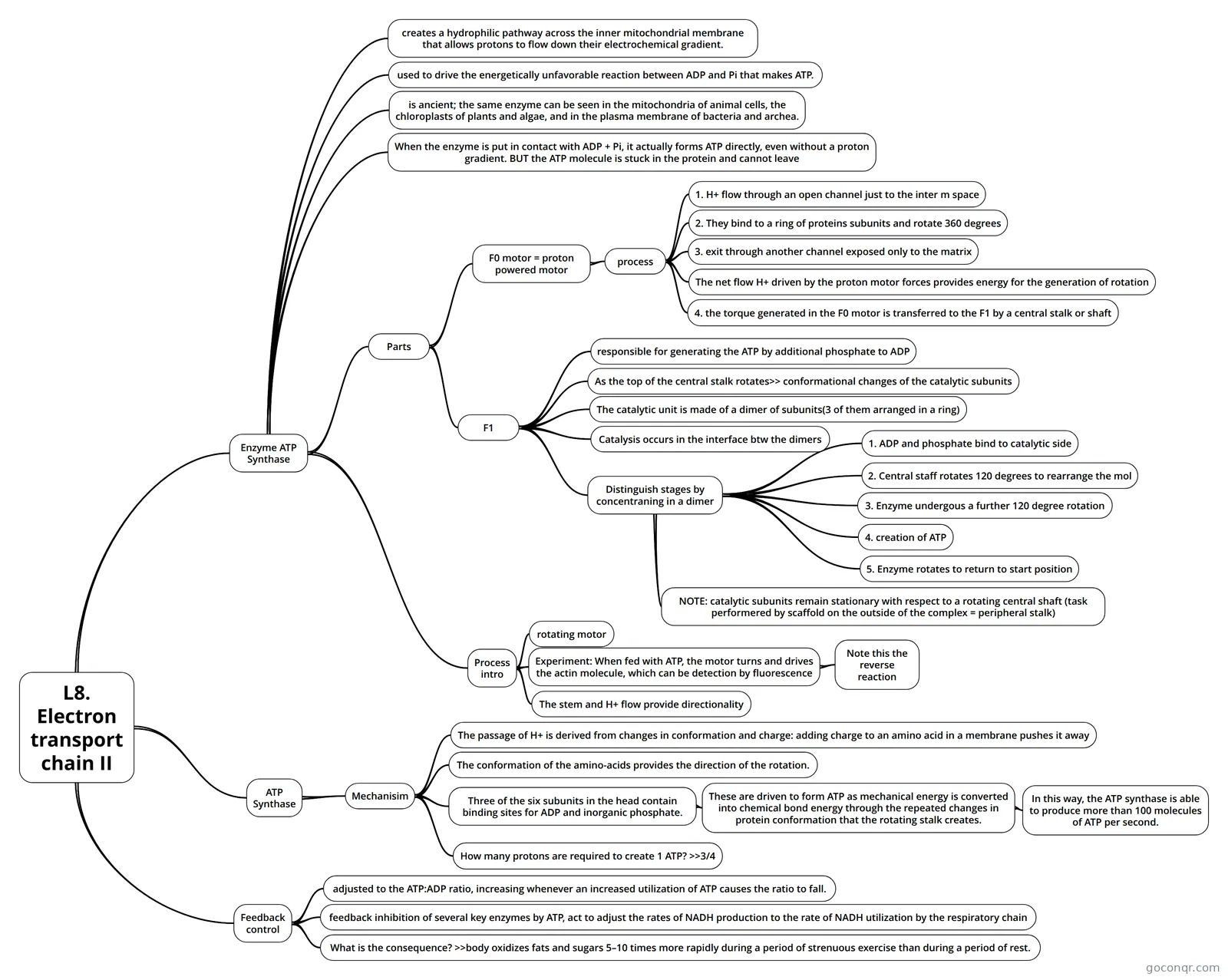
Mind map: Electron transport chain II
Map content
L8. Electron transport chain II
ATP Synthase
- Mechanisim
- The passage of H+ is derived from changes in conformation and charge: adding charge to an amino acid in a membrane pushes it away
- The conformation of the amino-acids provides the direction of the rotation.
- Three of the six subunits in the head contain binding sites for ADP and inorganic phosphate.
- These are driven to form ATP as mechanical energy is converted into chemical bond energy through the repeated changes in protein conformation that the rotating stalk creates.
- In this way, the ATP synthase is able to produce more than 100 molecules of ATP per second.
- These are driven to form ATP as mechanical energy is converted into chemical bond energy through the repeated changes in protein conformation that the rotating stalk creates.
- How many protons are required to create 1 ATP? >>3/4
- Mechanisim
Enzyme ATP Synthase
- creates a hydrophilic pathway across the inner mitochondrial membrane that allows protons to flow down their electrochemical gradient.
- used to drive the energetically unfavorable reaction between ADP and Pi that makes ATP.
- is ancient; the same enzyme can be seen in the mitochondria of animal cells, the chloroplasts of plants and algae, and in the plasma membrane of bacteria and archea.
- When the enzyme is put in contact with ADP + Pi, it actually forms ATP directly, even without a proton gradient. BUT the ATP molecule is stuck in the protein and cannot leave
- Process intro
- rotating motor
- Experiment: When fed with ATP, the motor turns and drives the actin molecule, which can be detection by fluorescence
- Note this the reverse reaction
- The stem and H+ flow provide directionality
- Parts
- F0 motor = proton powered motor
- process
- 1. H+ flow through an open channel just to the inter m space
- 2. They bind to a ring of proteins subunits and rotate 360 degrees
- 3. exit through another channel exposed only to the matrix
- The net flow H+ driven by the proton motor forces provides energy for the generation of rotation
- 4. the torque generated in the F0 motor is transferred to the F1 by a central stalk or shaft
- process
- F1
- responsible for generating the ATP by additional phosphate to ADP
- As the top of the central stalk rotates>> conformational changes of the catalytic subunits
- The catalytic unit is made of a dimer of subunits(3 of them arranged in a ring)
- Catalysis occurs in the interface btw the dimers
- Distinguish stages by concentraning in a dimer
- 1. ADP and phosphate bind to catalytic side
- 2. Central staff rotates 120 degrees to rearrange the mol
- 3. Enzyme undergous a further 120 degree rotation
- 4. creation of ATP
- 5. Enzyme rotates to return to start position
- NOTE: catalytic subunits remain stationary with respect to a rotating central shaft (task performered by scaffold on the outside of the complex = peripheral stalk)
- F0 motor = proton powered motor
Feedback control
- adjusted to the ATP:ADP ratio, increasing whenever an increased utilization of ATP causes the ratio to fall.
- feedback inhibition of several key enzymes by ATP, act to adjust the rates of NADH production to the rate of NADH utilization by the respiratory chain
- What is the consequence? >>body oxidizes fats and sugars 5–10 times more rapidly during a period of strenuous exercise than during a period of rest.
Information
- Description
- Biomolecular Proc in BIoeng 1 Mind Map on L8. Electron transport chain II, created by Sofía Herrero on 05/02/2019.
- Created by
- Sofía Herrero
- Views
- 1
- Rating
More on Electron Transport and Oxidative Phosphorylation