
Mind map
MANAGING THE CLASSROOM
Map content
MANAGING THE CLASSROOM
Classroom management
- When we want to manage the class in an effective way, we must be able to handle the different situations in the classroom. Among them the organization of the classroom space, the way that the students work, and how we organise our classroom time. Is also necessary to consider how we use our voice and how we talk to the students.
The teacher in the classroom
- The classroom environment is managed according to the physical presence of the teacher. Our behavior shows a clear effect on the management of the class. The way we stand and move, the way we react to what happens in the classroom, and if we are aware of what is going on. And that is how we know when teaching is succesful or if the lessons are unsatisfactory.
- Proximity
- Teachers need to be conscious on how close they are to the students, because there are some students that feel uncomfortable if the teacher stands in front of them but there are other students that might feel distance as apathy. So the teacher should analyze the students' reaction to know how to behave.
- Awareness
- The teacher has to be aware of what students are doing, this includes if they are watching and listening carefully. For the students to learn a language is necessary that the teacher keeps in contact with them. But as teachers is also necessary self-awareness of our behavior and undertand how our students see us in order to succed in the development of the class.
- Appropriacy
- As teachers we must consider how we can behave in a way which is appropriate to the students, how we are teaching and the relationship that we want to establish with them, so we have to decide how close we should be with them. It means that the way we sit and stand in classrooms is crucial because if we want to manage a class efectively we must create a friendly atmosphere.
- Movement
- Where we spend our time class depends on our personal style. Some of the teachers keep in front of the class just moving side to side or in the middle which can be bored for students. Others spend their time class striding up and down the aisles between the chairs, but teachers who are constantly in motion but that makes students exhausted because they keep moving their heads side to side.
Using the voice
- One of our most importart instrument is our voice. The way we talk to the students and the tone is }very crucial of the impact that we cause in the class. There are three important issues to take into account.
- Variety
- According to the type of lesson or activity teachers must vary their volume and tone of voice. When giving instructions or introducing to a new activity is different to a conversation. Also when they want to get the students' attention vary from teacher to teacher, some use very loud voices but others talk softly, so they will want to stop to listen to the teacher.
- Conservation
- The teachers have to demonstrate that they are relaxed, therefore, it is important to breathe correctly, and in that way they can conserve their vocal energy, because conserving the voice is one of the things teachers will take into account when planning a day's or a week's work.
- Audibility
- Teachers, must be audible by the students at the back of the classroom as those that are in front, taking into account that shouting is not necessary to be audible, because good voice projection is more important than volume, but in the other hand is also unpleasant speaking softly, because both are unhelpful for the students.
Talking to students
- The language is a skill that teachers and parents have in common, and the way that the talk to the children and interact with them is very different because of the kind of relationship that they have. They are constantly of the effect of their words so they are able to adjust their language use. Language, teachers need to be aware of three things. Firstly, they should consider the kind of language that students are able to understand. Secondly they need to think about what they want to say to the students and the best way to do it. And thirdly, they must consider the manner in which they will speak.
Giving instructions
- When we give instructions to the students, the way we talk to them is crucial, because if they do not understand what they have to do because if we are not clear, even the best activity will be a waste if time. There are two important rules when giving instructions: they must be keep as simple as possible, and they must be logical. And teachers must keep checking that the students have understood.
Using the L1
- All English learners come to their classroom with at least one other language, their mother tongue (L1), so we must ask ourselves if it is appropiate for them to use it, because the main objective is to learn and L2. And a natural process of learning a foreign language is that beginners translate into their L1. But in the other hand there should be an English environment in the classroom, and English must be heard as much as possible by the students that is why the teacher should avoid a long time talking in their L1.
Student talk and teacher talk
- Classes are sometimes criticised because there is too much TTT (Teacher Talking Time) and not enough STT (Student Talking Time). Because students have less chance to practice, but good TTT may have beneficial qualities using comprehensible input. So we have also consider TTQ (Teacher Talking Quality) and the students with the right kind of talking will understand and acquire the language. The best lessons, therefore, are the ones where STT is maximised.
Creating lesson stages
- Teachers do not always explain exactly what they are going to do. But in some cases they have to be clear to start a lesson. So the first thing that the teacher needs is to get the students' attention saying something loudly, like "can I have your attention please?", but sometimes students just speak louder to not be interrupted, so the teacher raises his or her hand in order to make them know that he or she is going to talk. When the teacher has brought an activity is necessary to give a clossure: a summary or a prediction of the next lesson, because is necessary to end the lesson succesfully and that creates enthusiasm in the students so they will come to the next lesson with a good atitude.
Different seating arrangements
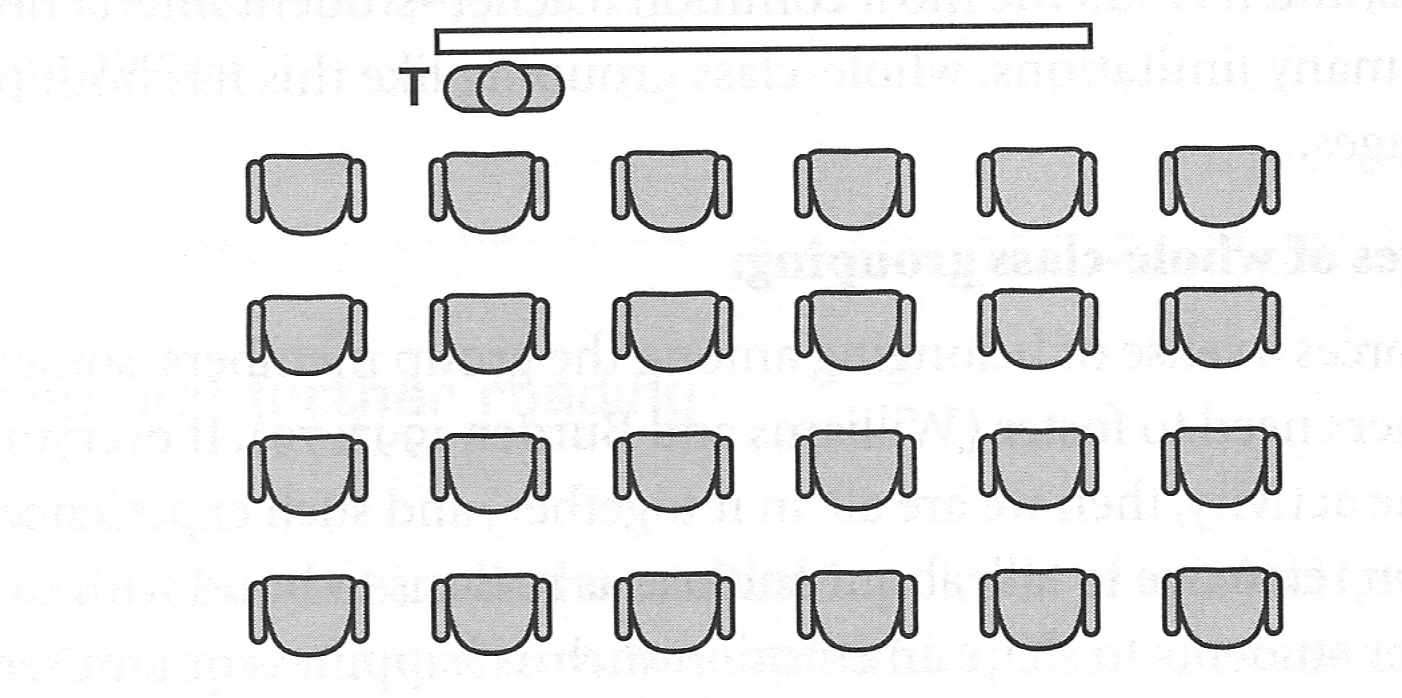
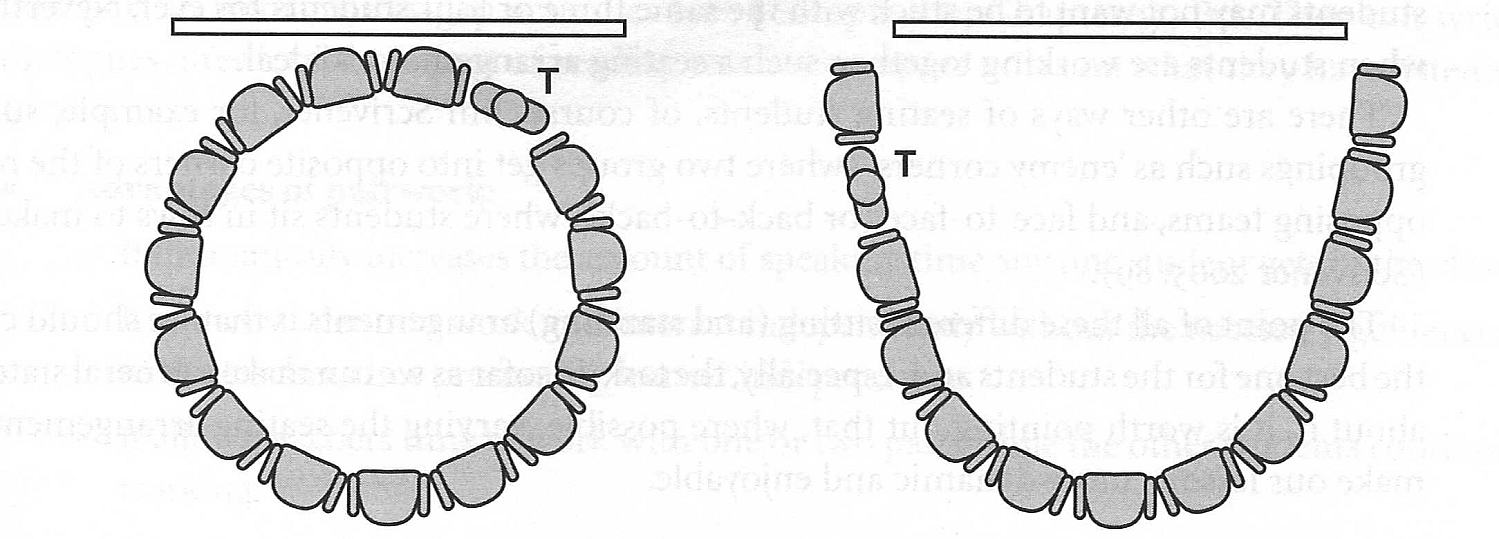
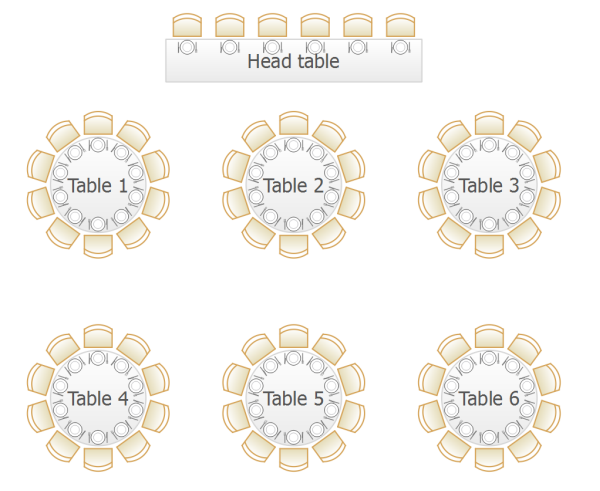
- The different arrangements of chairs and tables are controversial when teaching because it has to do with the way that the students learn and arise questions like "Is one kind of seating arrangement better than another?", "What are the advantages of each?". We will look at the advantages and disadvantages of various seating arrangements.
- Orderly rows
- The advantage of this arrangement is that the teacher has a clear view of all the students and they can also see the teacher, and this enables to the teacher to work with the whole class and it is important to make sure that everyone get involved. But it can also be restrictive.
- Orderly rows imply teachers working with the whole class. The teacher has a clear view of all the students and they can also see the teacher. It makes lecturing easier, enabling the teacher to maintain eye contact with the whole class. But it can be kind of restrictive.
- Circle and horseshoes
- These kind of seating arrangements are preferred by teachers that have smaller classes. The circle arrangement is used to create an environment of equality when students feel that what they say is as important as what the teacher says. But the disadvantage for the teacher is that his or her role is less dominating. And the horseshoe shape, even when the teacher stays in a commanding position the rigidity that comes with orderly rows, is reduced.
- Teachers and students prefer circles or horseshoes when the class is small. In classes that are arranged in a circle the students feel more comfortable because of the equality that they feel when they have the opportunity to participate due to the fact that the teacher's role is less dominating, and that is a disadvantage when he or she wants to manage the class. For horseshoe shape where the teacher is often located in a commanding position the rigidity that comes with orderly rows, is reduced.
- Separate tables
- This kind of arrangement is about students in small groups at individual tables. The teacher walks around, checking the students' work and helping them with any difficulty that they may have. For the teacher this is a better way to manage the class because students keep concentrated working in different tasks. But the problem may be that students not always want to work with the same classmates.
- At individual tables, it is much easier for the teacher to work with students, because he or she keeps walking around checking their work, and helping them when they have difficulties to understand something, while the other groups get ahead with their own tasks. But the disadvantage may be that some students not always will want to work with the same classmates.
Different student groupings
- There are different ways that the students can be organised, they can work as a whole class, in groups, in pairs or individually. Regardless the seating arrangement.
- Students can be organised in different ways: they can work as a whole class, in groups, in pairs or individually. Regardless the seating arrangement.
- Groupwork and pairwork
- The both foster the cooperative work in which students get together to complete a task, and in this type of grouping students
- Whole class
- The best type of classroom organisation is a teacher working with the class as a whole group. Whatever the seating we can get our students' attention to give them information or any assignment. Whole-class teaching can be dynamic and motivating because students feel part of o a group and that they belong to it, even though not all of the the students can give their opinions or participate individually.
- Solowork
- Class-to-class
Images and files in the map
Information
- Description
- Inglés Mind Map on MANAGING THE CLASSROOM, created by Stefany Lemus on 19/05/2019.
- Created by
- Stefany Lemus
- Views
- 0
- History
-
- Created by Stefany Lemus · May 19, 2019
- Copied by Stefany Lemus · May 19, 2019
- Copied by Stefany Lemus · May 19, 2019
- Rating