
Mind map
Ch 14: Leadership
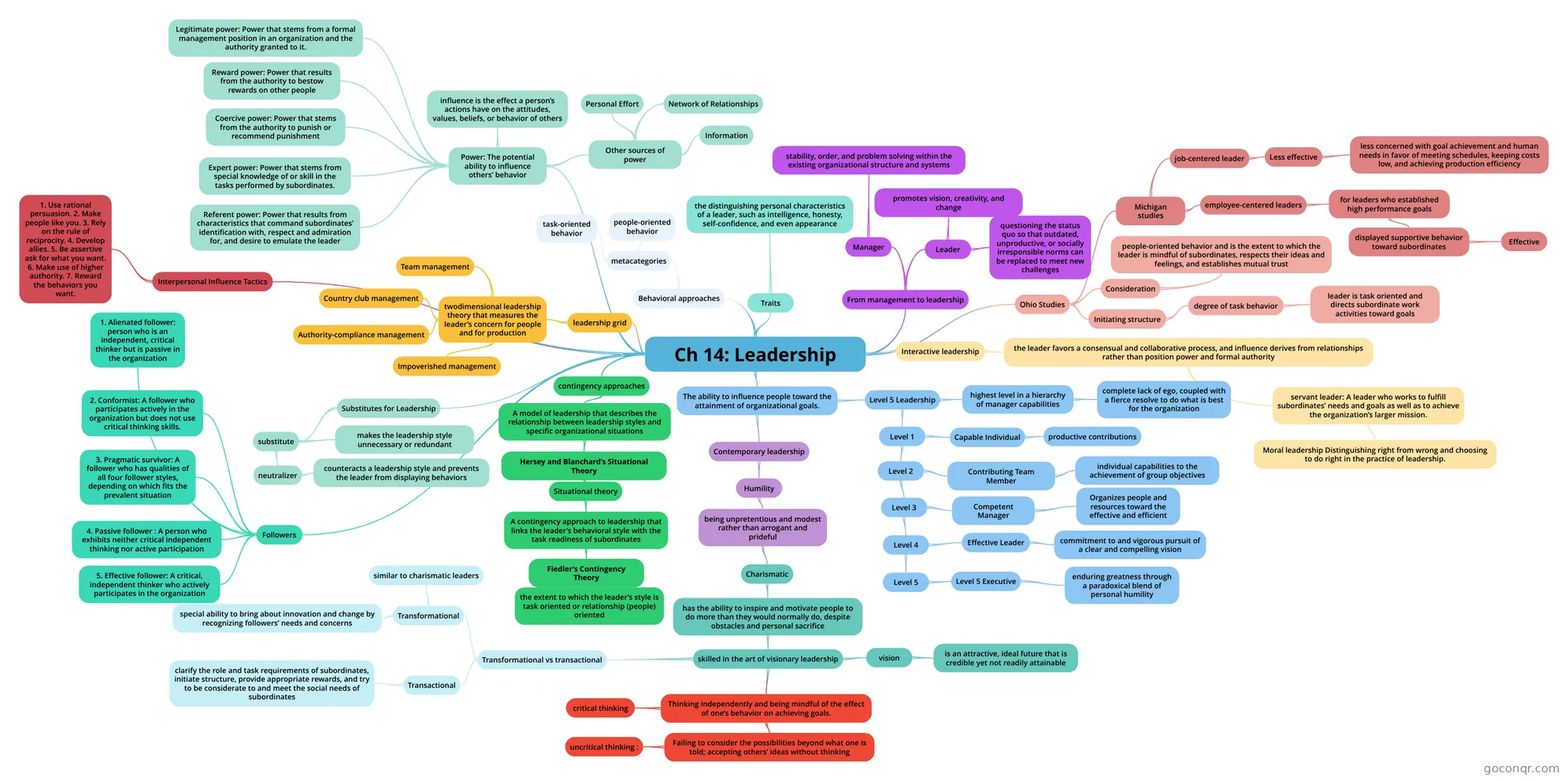
Mind map: leadership
Map content
Ch 14: Leadership
The ability to influence people toward the attainment of organizational goals.
- Contemporary leadership
- Humility
- being unpretentious and modest rather than arrogant and prideful
- Charismatic
- has the ability to inspire and motivate people to do more than they would normally do, despite obstacles and personal sacrifice
- skilled in the art of visionary leadership
- vision
- is an attractive, ideal future that is credible yet not readily attainable
- Transformational vs transactional
- Transformational
- similar to charismatic leaders
- special ability to bring about innovation and change by recognizing followers’ needs and concerns
- Transactional
- clarify the role and task requirements of subordinates, initiate structure, provide appropriate rewards, and try to be considerate to and meet the social needs of subordinates
- Transformational
- Thinking independently and being mindful of the effect of one’s behavior on achieving goals.
- Failing to consider the possibilities beyond what one is told; accepting others’ ideas without thinking
- uncritical thinking :
- critical thinking
- Failing to consider the possibilities beyond what one is told; accepting others’ ideas without thinking
- vision
- skilled in the art of visionary leadership
- has the ability to inspire and motivate people to do more than they would normally do, despite obstacles and personal sacrifice
- Charismatic
- being unpretentious and modest rather than arrogant and prideful
- Humility
- Level 5 Leadership
- Level 1
- Level 2
- Level 3
- Level 4
- Level 5
- Level 5 Executive
- enduring greatness through a paradoxical blend of personal humility
- Level 5 Executive
- Effective Leader
- commitment to and vigorous pursuit of a clear and compelling vision
- Level 5
- Competent Manager
- Organizes people and resources toward the effective and efficient
- Level 4
- Contributing Team Member
- individual capabilities to the achievement of group objectives
- Level 3
- Capable Individual
- productive contributions
- Level 2
- highest level in a hierarchy of manager capabilities
- complete lack of ego, coupled with a fierce resolve to do what is best for the organization
- Level 1
- Contemporary leadership
Interactive leadership
- the leader favors a consensual and collaborative process, and influence derives from relationships rather than position power and formal authority
- servant leader: A leader who works to fulfill subordinates’ needs and goals as well as to achieve the organization’s larger mission.
- Moral leadership Distinguishing right from wrong and choosing to do right in the practice of leadership.
- servant leader: A leader who works to fulfill subordinates’ needs and goals as well as to achieve the organization’s larger mission.
- the leader favors a consensual and collaborative process, and influence derives from relationships rather than position power and formal authority
From management to leadership
- Manager
- stability, order, and problem solving within the existing organizational structure and systems
- Leader
- promotes vision, creativity, and change
- questioning the status quo so that outdated, unproductive, or socially irresponsible norms can be replaced to meet new challenges
- Manager
Traits
- the distinguishing personal characteristics of a leader, such as intelligence, honesty, self-confidence, and even appearance
Behavioral approaches
- metacategories
- task-oriented behavior
- people-oriented behavior
- metacategories
Ohio Studies
- Consideration
- people-oriented behavior and is the extent to which the leader is mindful of subordinates, respects their ideas and feelings, and establishes mutual trust
- Initiating structure
- degree of task behavior
- leader is task oriented and directs subordinate work activities toward goals
- degree of task behavior
- Michigan studies
- employee-centered leaders
- for leaders who established high performance goals
- displayed supportive behavior toward subordinates
- Effective
- displayed supportive behavior toward subordinates
- for leaders who established high performance goals
- job-centered leader
- Less effective
- less concerned with goal achievement and human needs in favor of meeting schedules, keeping costs low, and achieving production efficiency
- Less effective
- employee-centered leaders
- Consideration
leadership grid
- twodimensional leadership theory that measures the leader’s concern for people and for production
- Team management
- Country club management
- Authority-compliance management
- Impoverished management
- twodimensional leadership theory that measures the leader’s concern for people and for production
contingency approaches
- A model of leadership that describes the relationship between leadership styles and specific organizational situations
- Hersey and Blanchard’s Situational Theory
- Situational theory
- A contingency approach to leadership that links the leader’s behavioral style with the task readiness of subordinates
- Fiedler’s Contingency Theory
- the extent to which the leader’s style is task oriented or relationship (people) oriented
- Fiedler’s Contingency Theory
- A contingency approach to leadership that links the leader’s behavioral style with the task readiness of subordinates
- Situational theory
- Hersey and Blanchard’s Situational Theory
- A model of leadership that describes the relationship between leadership styles and specific organizational situations
Substitutes for Leadership
- substitute
- makes the leadership style unnecessary or redundant
- neutralizer
- counteracts a leadership style and prevents the leader from displaying behaviors
- substitute
Followers
- 1. Alienated follower: person who is an independent, critical thinker but is passive in the organization
- 2. Conformist: A follower who participates actively in the organization but does not use critical thinking skills.
- 3. Pragmatic survivor: A follower who has qualities of all four follower styles, depending on which fits the prevalent situation
- 4. Passive follower : A person who exhibits neither critical independent thinking nor active participation
- 5. Effective follower: A critical, independent thinker who actively participates in the organization
Power: The potential ability to influence others’ behavior
- influence is the effect a person’s actions have on the attitudes, values, beliefs, or behavior of others
- Legitimate power: Power that stems from a formal management position in an organization and the authority granted to it.
- Reward power: Power that results from the authority to bestow rewards on other people
- Coercive power: Power that stems from the authority to punish or recommend punishment
- Expert power: Power that stems from special knowledge of or skill in the tasks performed by subordinates.
- Referent power: Power that results from characteristics that command subordinates’ identification with, respect and admiration for, and desire to emulate the leader
- Other sources of power
- Personal Effort
- Network of Relationships
- Information
Interpersonal Influence Tactics
- 1. Use rational persuasion. 2. Make people like you. 3. Rely on the rule of reciprocity. 4. Develop allies. 5. Be assertive ask for what you want. 6. Make use of higher authority. 7. Reward the behaviors you want.
Information
- Description
- Mind Map on Ch 14: Leadership, created by Ana Sofía Treviño De Los Santos on 08/10/2019.
- Created by
- Ana Sofía Treviño De Los Santos
- Views
- 0
- Rating