
Mind map
THE NOUS
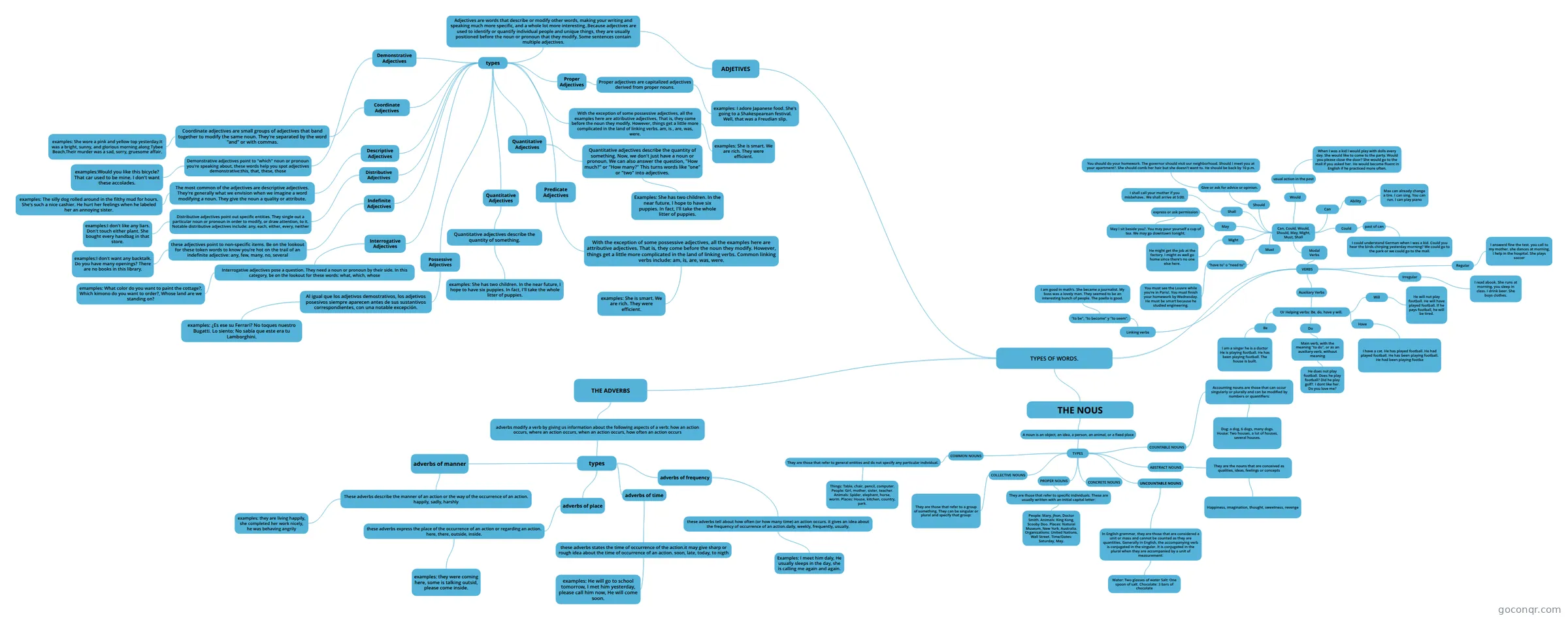
Mind map: The nous
Map content
THE NOUS
A noun is an object, an idea, a person, an animal, or a fixed place
- TYPES
- COMMON NOUNS
- They are those that refer to general entities and do not specify any particular individual.
- Things: Table, chair, pencil, computer. People: Girl, mother, sister, teacher. Animals: Spider, elephant, horse, worm. Places: House, kitchen, country, park.
- They are those that refer to general entities and do not specify any particular individual.
- PROPER NOUNS
- They are those that refer to specific individuals. These are usually written with an initial capital letter:
- People: Mary, Jhon, Doctor Smith. Animals: King Kong, Scooby Doo. Places: Natural Museum, New York, Australia. Organizations: United Nations, Wall Street. Time/Dates: Saturday, May.
- They are those that refer to specific individuals. These are usually written with an initial capital letter:
- CONCRETE NOUNS
- COUNTABLE NOUNS
- Accounting nouns are those that can occur singularly or plurally and can be modified by numbers or quantifiers:
- Dog: a dog, 6 dogs, many dogs. House: Two houses, a lot of houses, several houses.
- Accounting nouns are those that can occur singularly or plurally and can be modified by numbers or quantifiers:
- ABSTRACT NOUNS
- They are the nouns that are conceived as qualities, ideas, feelings or concepts
- Happiness, imagination, thought, sweetness, revenge
- They are the nouns that are conceived as qualities, ideas, feelings or concepts
- UNCOUNTABLE NOUNS
- In English grammar, they are those that are considered a unit or mass and cannot be counted as they are quantities. Generally in English, the accompanying verb is conjugated in the singular. It is conjugated in the plural when they are accompanied by a unit of measurement:
- Water: Two glasses of water Salt: One spoon of salt. Chocolate: 3 bars of chocolate
- In English grammar, they are those that are considered a unit or mass and cannot be counted as they are quantities. Generally in English, the accompanying verb is conjugated in the singular. It is conjugated in the plural when they are accompanied by a unit of measurement:
- COLLECTIVE NOUNS
- They are those that refer to a group of something. They can be singular or plural and specify that group:
- COMMON NOUNS
- TYPES
TYPES OF WORDS.
- THE ADVERBS
- adverbs modify a verb by giving us information about the following aspects of a verb: how an action occurs, where an action occurs, when an action occurs, how often an action occurs
- types
- adverbs of manner
- These adverbs describe the manner of an action or the way of the occurrence of an action. happily, sadly, harshly
- examples: they are living happily, she completed her work nicely, he was behaving angrily
- These adverbs describe the manner of an action or the way of the occurrence of an action. happily, sadly, harshly
- adverbs of place
- these adverbs express the place of the occurrence of an action or regarding an action. here, there, outside, inside.
- examples: they were coming here, some is talking outsid, please come inside.
- these adverbs express the place of the occurrence of an action or regarding an action. here, there, outside, inside.
- adverbs of time
- these adverbs states the time of occurrence of the action.it may give sharp or rough idea about the time of occurrence of an action. soon, late, today, to nigth
- examples: He will go to school tomorrow, I met him yesterday, please call him now, He will come soon.
- these adverbs states the time of occurrence of the action.it may give sharp or rough idea about the time of occurrence of an action. soon, late, today, to nigth
- adverbs of frequency
- these adverbs tell about how often (or how many time) an action occurs. it gives an idea about the frequency of occurrence of an action.daily, weekly, frequently, usually.
- Examples: I meet him daly, He usually sleeps in the day, she is calling me again and again.
- these adverbs tell about how often (or how many time) an action occurs. it gives an idea about the frequency of occurrence of an action.daily, weekly, frequently, usually.
- adverbs of manner
- types
- adverbs modify a verb by giving us information about the following aspects of a verb: how an action occurs, where an action occurs, when an action occurs, how often an action occurs
- VERBS
- Auxiliary Verbs
- Or Helping verbs: Be, do, have y will.
- Be
- I am a singer he is a doctor He is playing football. He has been playing football. The house is built.
- Do
- Main verb, with the meaning "to do", or as an auxiliary verb, without meaning
- He does not play football. Does he play football? Did he play golf?. I dont like her. Do you love me?
- Main verb, with the meaning "to do", or as an auxiliary verb, without meaning
- Have
- I have a cat. He has played football. He had played football. He has been playing football. He had been playing footba
- Will
- He will not play football. He will have played football. If he pays football, he will be tired.
- Be
- Or Helping verbs: Be, do, have y will.
- Modal Verbs
- Can, Could, Would, Should, May, Might, Must, Shall
- Can
- Ability
- Max can already change a tire. I can sing, You can run. I can play piano
- Ability
- Could
- past of can
- I could understand German when I was a kid. Could you hear the birds chirping yesterday morning? We could go to the park or we could go to the mall.
- past of can
- Would
- usual action in the past
- When I was a kid I would play with dolls every day. She would like to come to the party. Would you please close the door? She would go to the mall if you asked her. He would become fluent in English if he practiced more often.
- usual action in the past
- Should
- Give or ask for advice or opinion.
- You should do your homework. The governor should visit our neighborhood. Should I meet you at your apartment?. She should comb her hair but she doesn’t want to. He should be back by 10 p.m.
- Give or ask for advice or opinion.
- May
- express or ask permission
- May I sit beside you?. You may pour yourself a cup of tea. We may go downtown tonight.
- express or ask permission
- Might
- He might get the job at the factory. I might as well go home since there’s no one else here.
- Must
- “have to” o “need to”
- You must see the Louvre while you’re in Paris!. You must finish your homework by Wednesday. He must be smart because he studied engineering.
- “have to” o “need to”
- Shall
- I shall call your mother if you misbehave.. We shall arrive at 5:00.
- Can
- Can, Could, Would, Should, May, Might, Must, Shall
- Irregular
- I read abook. She runs at morning. you sleep in class. I drink beer. She buys clothes.
- Regular
- I answerd fine the test. you call to my mother. she dances at morning, I help in the hospital. She plays soccer
- Linking verbs
- "to be", "to become" y "to seem".
- I am good in math’s. She became a journalist. My boss was a lovely man. They seemed to be an interesting bunch of people. The paella is good.
- "to be", "to become" y "to seem".
- Auxiliary Verbs
- ADJETIVES
- Adjectives are words that describe or modify other words, making your writing and speaking much more specific, and a whole lot more interesting..Because adjectives are used to identify or quantify individual people and unique things, they are usually positioned before the noun or pronoun that they modify. Some sentences contain multiple adjectives.
- types
- Coordinate Adjectives
- Coordinate adjectives are small groups of adjectives that band together to modify the same noun. They're separated by the word "and" or with commas.
- examples: She wore a pink and yellow top yesterday.It was a bright, sunny, and glorious morning along Tybee Beach.Their murder was a sad, sorry, gruesome affair.
- Coordinate adjectives are small groups of adjectives that band together to modify the same noun. They're separated by the word "and" or with commas.
- Demonstrative Adjectives
- Demonstrative adjectives point to "which" noun or pronoun you're speaking about, these words help you spot adjectives demonstrative:this, that, these, those
- examples:Would you like this bicycle? That car used to be mine. I don't want these accolades.
- Demonstrative adjectives point to "which" noun or pronoun you're speaking about, these words help you spot adjectives demonstrative:this, that, these, those
- Descriptive Adjectives
- The most common of the adjectives are descriptive adjectives. They're generally what we envision when we imagine a word modifying a noun. They give the noun a quality or attribute.
- examples: The silly dog rolled around in the filthy mud for hours. She's such a nice cashier. He hurt her feelings when he labeled her an annoying sister.
- The most common of the adjectives are descriptive adjectives. They're generally what we envision when we imagine a word modifying a noun. They give the noun a quality or attribute.
- Distributive Adjectives
- Distributive adjectives point out specific entities. They single out a particular noun or pronoun in order to modify, or draw attention, to it. Notable distributive adjectives include: any, each, either, every, neither
- examples:I don't like any liars. Don't touch either plant. She bought every handbag in that store.
- Distributive adjectives point out specific entities. They single out a particular noun or pronoun in order to modify, or draw attention, to it. Notable distributive adjectives include: any, each, either, every, neither
- Indefinite Adjectives
- these adjectives point to non-specific items. Be on the lookout for these token words to know you're hot on the trail of an indefinite adjective: any, few, many, no, several
- examples:I don't want any backtalk. Do you have many openings? There are no books in this library.
- these adjectives point to non-specific items. Be on the lookout for these token words to know you're hot on the trail of an indefinite adjective: any, few, many, no, several
- Interrogative Adjectives
- Interrogative adjectives pose a question. They need a noun or pronoun by their side. In this category, be on the lookout for these words: what, which, whose
- emamples: What color do you want to paint the cottage?, Which kimono do you want to order?, Whose land are we standing on?
- Interrogative adjectives pose a question. They need a noun or pronoun by their side. In this category, be on the lookout for these words: what, which, whose
- Possessive Adjectives
- Al igual que los adjetivos demostrativos, los adjetivos posesivos siempre aparecen antes de sus sustantivos correspondientes, con una notable excepción.
- examples: ¿Es ese su Ferrari? No toques nuestro Bugatti. Lo siento; No sabía que este era tu Lamborghini.
- Al igual que los adjetivos demostrativos, los adjetivos posesivos siempre aparecen antes de sus sustantivos correspondientes, con una notable excepción.
- Predicate Adjectives
- With the exception of some possessive adjectives, all the examples here are attributive adjectives. That is, they come before the noun they modify. However, things get a little more complicated in the land of linking verbs. Common linking verbs include: am, is, are, was, were.
- examples: She is smart. We are rich. They were efficient.
- With the exception of some possessive adjectives, all the examples here are attributive adjectives. That is, they come before the noun they modify. However, things get a little more complicated in the land of linking verbs. Common linking verbs include: am, is, are, was, were.
- Quantitative Adjectives
- Quantitative adjectives describe the quantity of something. Now, we don't just have a noun or pronoun. We can also answer the question, "How much?" or "How many?" This turns words like "one" or "two" into adjectives.
- Examples: She has two children. In the near future, I hope to have six puppies. In fact, I'll take the whole litter of puppies.
- Quantitative adjectives describe the quantity of something. Now, we don't just have a noun or pronoun. We can also answer the question, "How much?" or "How many?" This turns words like "one" or "two" into adjectives.
- With the exception of some possessive adjectives, all the examples here are attributive adjectives. That is, they come before the noun they modify. However, things get a little more complicated in the land of linking verbs. am, is , are, was, were.
- examples: She is smart. We are rich. They were efficient.
- Proper Adjectives
- Proper adjectives are capitalized adjectives derived from proper nouns.
- examples: I adore Japanese food. She's going to a Shakespearean festival. Well, that was a Freudian slip.
- Proper adjectives are capitalized adjectives derived from proper nouns.
- Quantitative Adjectives
- Quantitative adjectives describe the quantity of something.
- examples: She has two children. In the near future, I hope to have six puppies. In fact, I'll take the whole litter of puppies.
- Quantitative adjectives describe the quantity of something.
- Coordinate Adjectives
- types
- Adjectives are words that describe or modify other words, making your writing and speaking much more specific, and a whole lot more interesting..Because adjectives are used to identify or quantify individual people and unique things, they are usually positioned before the noun or pronoun that they modify. Some sentences contain multiple adjectives.
- THE ADVERBS
Information
- Description
- Contaduría Mind Map on THE NOUS, created by Nestor Nobles on 16/10/2019.
- Created by
- Nestor Nobles
- Views
- 9
- History
-
- Created by Nestor Nobles · Oct 16, 2019
- Copied by Nestor Nobles · Oct 16, 2019
- Rating
More on Types and functions of nouns