
Mind map
Making decisions in Business Ethics
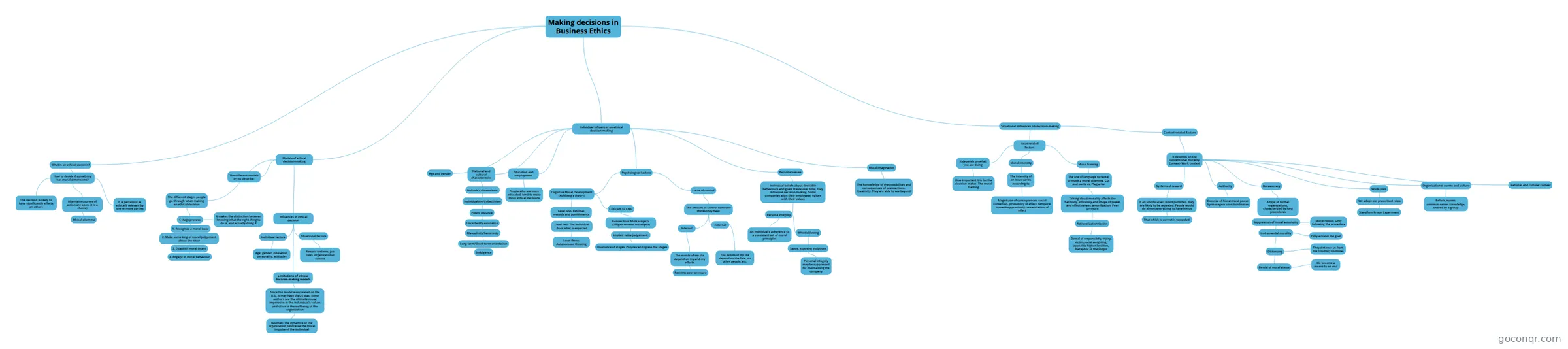
Mind map: Making decisions in Business Ethics
Map content
Making decisions in Business Ethics
What is an ethical decision?
- How to decide if something has moral dimensions?
- The decision is likely to have significantly effects on others
- Alternativ courses of action are open (it is a choice)
- Ethical dilemma
- It is perceived as ethicallt relevant by one or more parties
- How to decide if something has moral dimensions?
Models of ethical decision-making
- The different stages people go through when making an ethical decision
- 4-stage process:
- 1. Recognize a moral issue
- 2. Make some king of moral judgement about the issue
- 3. Establish moral intent
- 4. Engage in moral behaviour
- 3. Establish moral intent
- 2. Make some king of moral judgement about the issue
- It makes the distinction between knowing what the right thing to do is, and actually doing it
- 1. Recognize a moral issue
- 4-stage process:
- The different models try to describe:
- Influences in ethical decision
- Individual factors
- Age, gender, education, personality, attitudes
- Situational factors
- Reward systems, job roles, organizational culture
- Limitations of ethical decision-making models
- Since the model was created on the U.S., it may have theUS bias. Some authors see the ultimate moral imperative in the induvidual's values and other in the wellbeing of the organization
- Bauman: The dynamics of the organization neutralize the moral impulse of the individual
- Since the model was created on the U.S., it may have theUS bias. Some authors see the ultimate moral imperative in the induvidual's values and other in the wellbeing of the organization
- Individual factors
- The different stages people go through when making an ethical decision
Individual influences on ethical decision-making
- Age and gender
- National and cultural characteristics
- Hoftede's dimensions:
- Individualism/Collectivism
- Power distance
- Uncertainty avoidance
- Masculinity/Femininity
- Long-term/Short-term orientation
- Indulgence
- Long-term/Short-term orientation
- Masculinity/Femininity
- Uncertainty avoidance
- Power distance
- Individualism/Collectivism
- Hoftede's dimensions:
- Education and employment
- People who are more educated, tend to make more ethical decisions
- Psychological factors
- Cognitive Moral Development (Kohlberg's theory)
- Level one- External rewards and punishments
- Level two- The individual does what is expected
- Level three: Autonomous thinking
- Level two- The individual does what is expected
- Criticism to CMD
- Gender bias: Male subjects (Gilligan women are angels)
- Implicit value judgement:
- Invariance of stages: People can regress the stages
- Implicit value judgement:
- Gender bias: Male subjects (Gilligan women are angels)
- Level one- External rewards and punishments
- Locus of control
- The amount of control someone thinks they have
- Internal
- The events of my life depend on my and my efforts
- Resist to peer-pressure
- The events of my life depend on my and my efforts
- External
- The events of my life depend on the fate, on other people, etc.
- Internal
- The amount of control someone thinks they have
- Cognitive Moral Development (Kohlberg's theory)
- Personal values
- Individual beliefs about desirable behaviours and goals stable over time, they influence decision-making. Some companies align their employees' values with their values
- Persona integrity
- An individual's adherence to a consistent set of moral principles
- Whistleblowing
- Sapos, exposing violations
- Personal integrity may be suppressed for maintaining the company
- Sapos, exposing violations
- Persona integrity
- Individual beliefs about desirable behaviours and goals stable over time, they influence decision-making. Some companies align their employees' values with their values
- Moral imagination
- The konowledge of the possibilites and consequences of one's actions. Creativity. They are able to see beyond
Situational influences on decision-making
- Issue related factors
- It depends on what you are doing
- How important it is for the decision maker. The moral framing
- Moral intensity
- The intensity of an issue varies according to
- Magnitude of consequences, social consensus, probability of effect, temporal immediacy,proximity,concentration of effect
- Moral framing
- The use of language to reveal or mask a moral dilemma. Cut and paste vs. Plagiarize
- Talking about morality affects the harmony, efficiency and image of power and effectiveness. amorilization: Peer pressure
- Rationalization tactics
- Denial of responsibity, injury, victim,social weighting, appeal to higher loyalties, metaphor of the ledger
- Rationalization tactics
- Talking about morality affects the harmony, efficiency and image of power and effectiveness. amorilization: Peer pressure
- The use of language to reveal or mask a moral dilemma. Cut and paste vs. Plagiarize
- It depends on what you are doing
- Context-related factors
- It depends on the conventional morality. Context- Work context
- Systems of reward
- If an unethical act is not punished, they are likely to be repeated. People would do almost everything to have bonus
- That which is correct is rewarded.
- If an unethical act is not punished, they are likely to be repeated. People would do almost everything to have bonus
- Authority
- Exercise of hierarchical power by managers on subordinates
- Bureaucracy
- A type of formal organizations, characterized by long procedures
- Suppression of moral autonomy
- Instrumental morality
- Only achieve the goal
- Distancing
- They distance us from the results (Columbia)
- Denial of moral status
- We become a means to an end
- Moral robots: Only following the procedure
- Instrumental morality
- Suppression of moral autonomy
- A type of formal organizations, characterized by long procedures
- Work roles
- We adopt our prescribed roles.
- Standforn Prison Experiment
- We adopt our prescribed roles.
- Organizational norms and culture
- Beliefs, norms, common-sense- knowledge, shared by a group
- National and cultural context
- Systems of reward
- It depends on the conventional morality. Context- Work context
- Issue related factors
Information
- Description
- Mind Map on Making decisions in Business Ethics, created by Ana Catalina Ardila on 16/02/2020.
- Created by
- Ana Catalina Ardila
- Views
- 1
- Rating