
Mind map
SOCIAL DEVELOPMENT
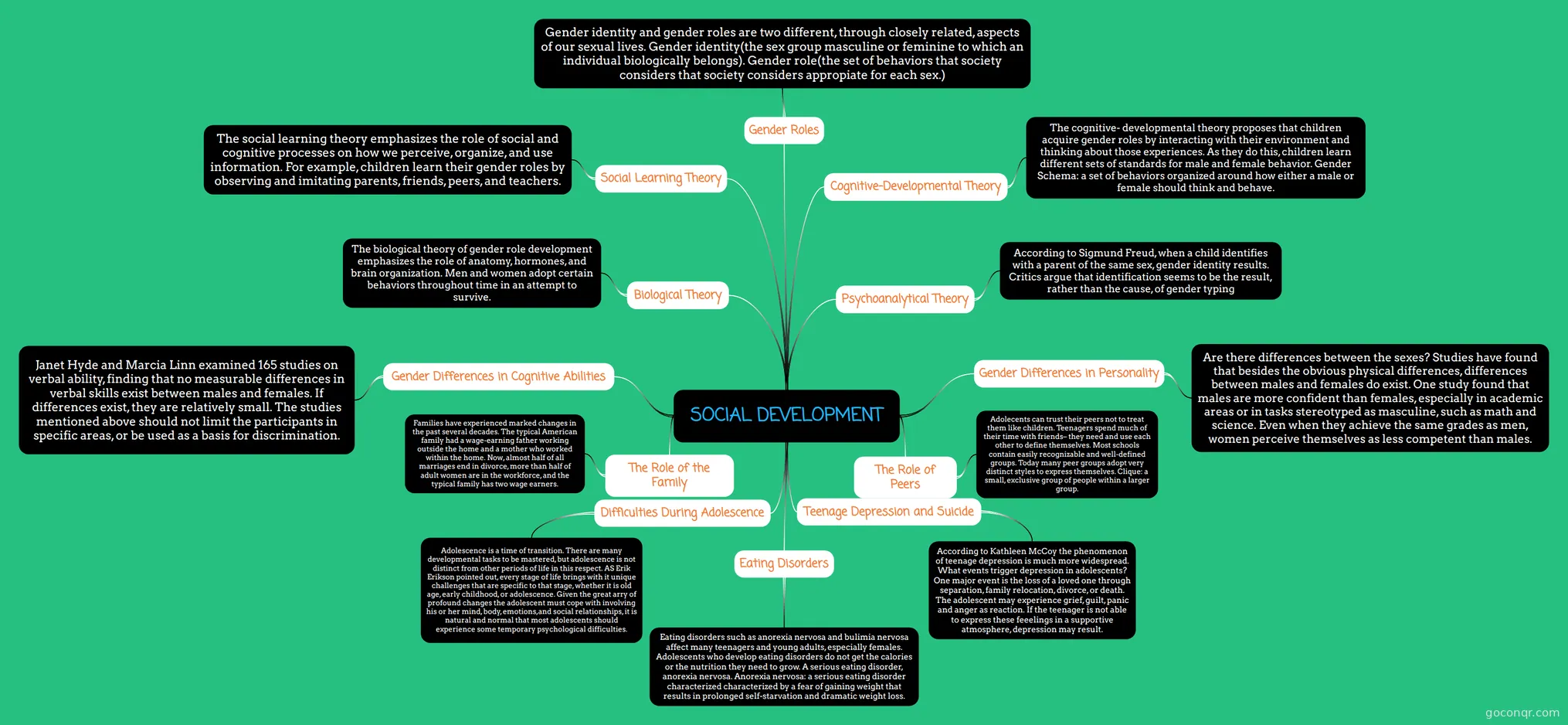
Mind map: Social Development Theories and Challenges
Map content
SOCIAL DEVELOPMENT
The Role of the Family
- Families have experienced marked changes in the past several decades. The typical American family had a wage-earning father working outside the home and a mother who worked within the home. Now, almost half of all marriages end in divorce, more than half of adult women are in the workforce, and the typical family has two wage earners.
The Role of Peers
- Adolecents can trust their peers not to treat them like children. Teenagers spend much of their time with friends– they need and use each other to define themselves. Most schools contain easily recognizable and well-defined groups. Today many peer groups adopt very distinct styles to express themselves. Clique: a small, exclusive group of people within a larger group.
Difficulties During Adolescence
- Adolescence is a time of transition. There are many developmental tasks to be mastered, but adolescence is not distinct from other periods of life in this respect. AS Erik Erikson pointed out, every stage of life brings with it unique challenges that are specific to that stage, whether it is old age, early childhood, or adolescence. Given the great arry of profound changes the adolescent must cope with involving his or her mind, body, emotions,and social relationships, it is natural and normal that most adolescents should experience some temporary psychological difficulties.
Teenage Depression and Suicide
- According to Kathleen McCoy the phenomenon of teenage depression is much more widespread. What events trigger depression in adolescents? One major event is the loss of a loved one through separation, family relocation, divorce, or death. The adolescent may experience grief, guilt, panic and anger as reaction. If the teenager is not able to express these feeelings in a supportive atmosphere, depression may result.
Eating Disorders
- Eating disorders such as anorexia nervosa and bulimia nervosa affect many teenagers and young adults, especially females. Adolescents who develop eating disorders do not get the calories or the nutrition they need to grow. A serious eating disorder, anorexia nervosa. Anorexia nervosa: a serious eating disorder characterized characterized by a fear of gaining weight that results in prolonged self-starvation and dramatic weight loss.
Gender Roles
- Gender identity and gender roles are two different, through closely related, aspects of our sexual lives. Gender identity(the sex group masculine or feminine to which an individual biologically belongs). Gender role(the set of behaviors that society considers that society considers appropiate for each sex.)
Gender Differences in Personality
- Are there differences between the sexes? Studies have found that besides the obvious physical differences, differences between males and females do exist. One study found that males are more confident than females, especially in academic areas or in tasks stereotyped as masculine, such as math and science. Even when they achieve the same grades as men, women perceive themselves as less competent than males.
Psychoanalytical Theory
- According to Sigmund Freud, when a child identifies with a parent of the same sex, gender identity results. Critics argue that identification seems to be the result, rather than the cause, of gender typing
Gender Differences in Cognitive Abilities
- Janet Hyde and Marcia Linn examined 165 studies on verbal ability, finding that no measurable differences in verbal skills exist between males and females. If differences exist, they are relatively small. The studies mentioned above should not limit the participants in specific areas, or be used as a basis for discrimination.
Biological Theory
- The biological theory of gender role development emphasizes the role of anatomy, hormones, and brain organization. Men and women adopt certain behaviors throughout time in an attempt to survive.
Cognitive-Developmental Theory
- The cognitive- developmental theory proposes that children acquire gender roles by interacting with their environment and thinking about those experiences. As they do this, children learn different sets of standards for male and female behavior. Gender Schema: a set of behaviors organized around how either a male or female should think and behave.
Social Learning Theory
- The social learning theory emphasizes the role of social and cognitive processes on how we perceive, organize, and use information. For example, children learn their gender roles by observing and imitating parents, friends, peers, and teachers.
Information
- Description
- Mind Map on SOCIAL DEVELOPMENT, created by suazo amador on 31/03/2020.
- Created by
- suazo amador
- Views
- 0
- Rating
More on Social development in adolescence