
Mind map
BUSINESS MODELS FOR ADDITIVE MANUFACTURING
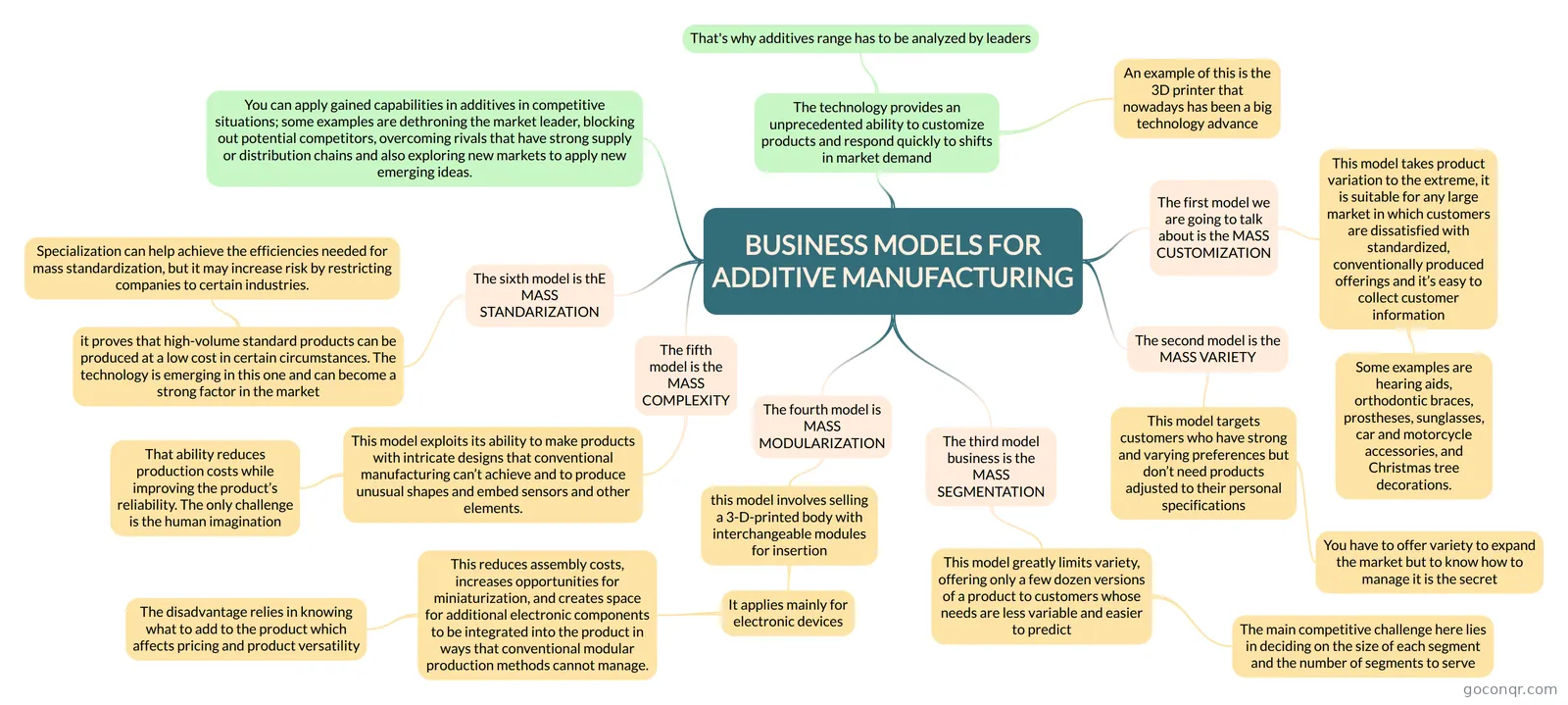
Mind map: Business models for additive manufacturing
Map content
BUSINESS MODELS FOR ADDITIVE MANUFACTURING
The technology provides an unprecedented ability to customize products and respond quickly to shifts in market demand
- That's why additives range has to be analyzed by leaders
- An example of this is the 3D printer that nowadays has been a big technology advance
The first model we are going to talk about is the MASS CUSTOMIZATION
- This model takes product variation to the extreme, it is suitable for any large market in which customers are dissatisfied with standardized, conventionally produced offerings and it’s easy to collect customer information
- Some examples are hearing aids, orthodontic braces, prostheses, sunglasses, car and motorcycle accessories, and Christmas tree decorations.
- This model takes product variation to the extreme, it is suitable for any large market in which customers are dissatisfied with standardized, conventionally produced offerings and it’s easy to collect customer information
The second model is the MASS VARIETY
- This model targets customers who have strong and varying preferences but don’t need products adjusted to their personal specifications
- You have to offer variety to expand the market but to know how to manage it is the secret
- This model targets customers who have strong and varying preferences but don’t need products adjusted to their personal specifications
The third model business is the MASS SEGMENTATION
- This model greatly limits variety, offering only a few dozen versions of a product to customers whose needs are less variable and easier to predict
- The main competitive challenge here lies in deciding on the size of each segment and the number of segments to serve
- This model greatly limits variety, offering only a few dozen versions of a product to customers whose needs are less variable and easier to predict
The fourth model is MASS MODULARIZATION
- this model involves selling a 3-D-printed body with interchangeable modules for insertion
- It applies mainly for electronic devices
- This reduces assembly costs, increases opportunities for miniaturization, and creates space for additional electronic components to be integrated into the product in ways that conventional modular production methods cannot manage.
- The disadvantage relies in knowing what to add to the product which affects pricing and product versatility
- This reduces assembly costs, increases opportunities for miniaturization, and creates space for additional electronic components to be integrated into the product in ways that conventional modular production methods cannot manage.
- It applies mainly for electronic devices
- this model involves selling a 3-D-printed body with interchangeable modules for insertion
The fifth model is the MASS COMPLEXITY
- This model exploits its ability to make products with intricate designs that conventional manufacturing can’t achieve and to produce unusual shapes and embed sensors and other elements.
- That ability reduces production costs while improving the product’s reliability. The only challenge is the human imagination
- This model exploits its ability to make products with intricate designs that conventional manufacturing can’t achieve and to produce unusual shapes and embed sensors and other elements.
The sixth model is thE MASS STANDARIZATION
- it proves that high-volume standard products can be produced at a low cost in certain circumstances. The technology is emerging in this one and can become a strong factor in the market
- Specialization can help achieve the efficiencies needed for mass standardization, but it may increase risk by restricting companies to certain industries.
- it proves that high-volume standard products can be produced at a low cost in certain circumstances. The technology is emerging in this one and can become a strong factor in the market
You can apply gained capabilities in additives in competitive situations; some examples are dethroning the market leader, blocking out potential competitors, overcoming rivals that have strong supply or distribution chains and also exploring new markets to apply new emerging ideas.
Information
- Description
- Mind Map on BUSINESS MODELS FOR ADDITIVE MANUFACTURING, created by Xime Glez on 02/05/2020.
- Created by
- Xime Glez
- Views
- 6
- Rating
More on Digital Business Models and Platforms