
Mind map
OBSERVATION AND RESEARCH IN THE CLASSROOM CONTEXT
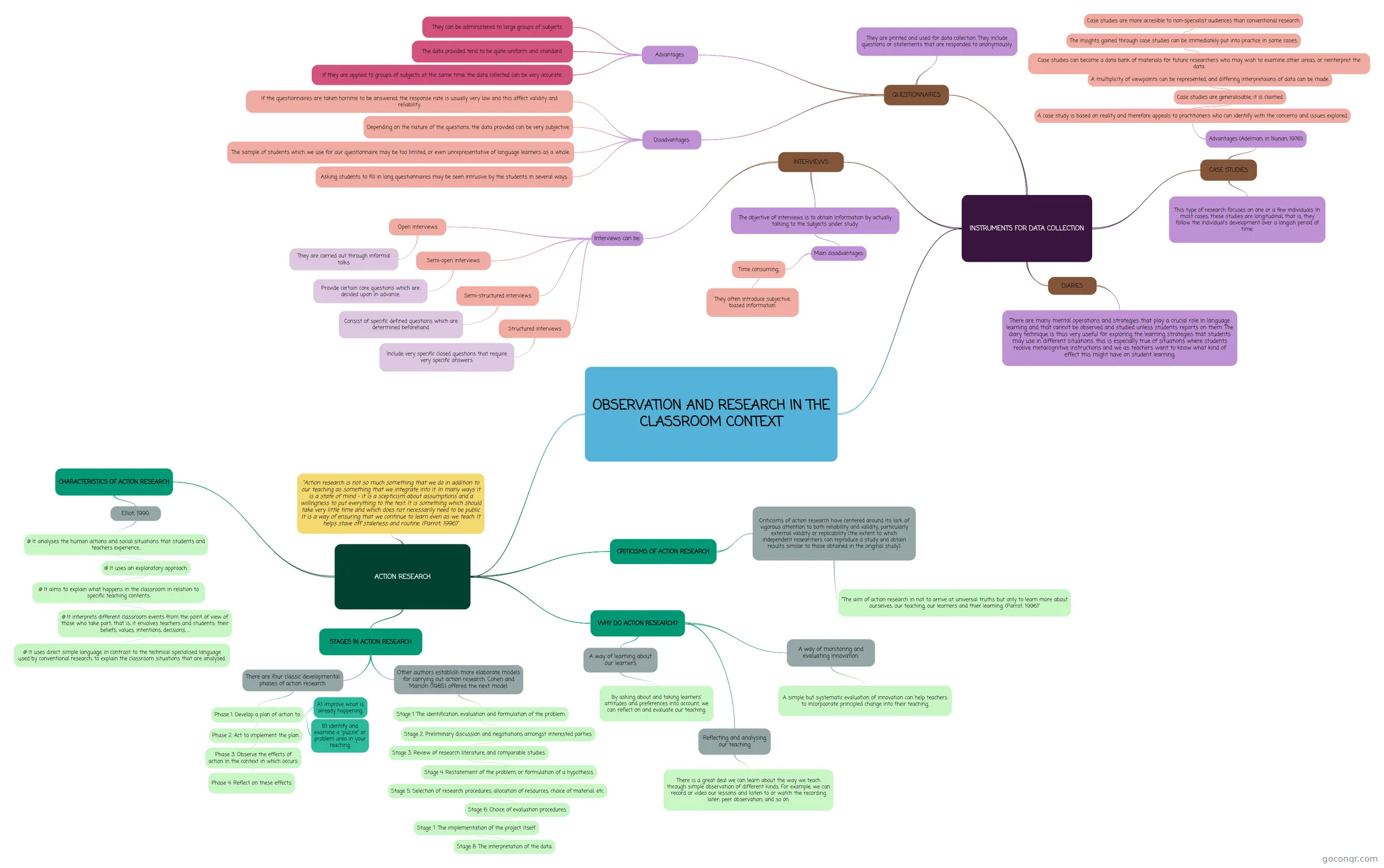
Mind map: Observation and research in the classroom context
Map content
OBSERVATION AND RESEARCH IN THE CLASSROOM CONTEXT
ACTION RESEARCH
- CHARACTERISTICS OF ACTION RESEARCH
- Elliot, 1990:
- @ It analyses the human actions and social situations that students and teachers experience..
- @ It uses an exploratory approach.
- @ It aims to explain what happens in the classroom in relation to specific teaching contents.
- @ It interprets different classroom events from the point of view of those who take part; that is, it envolves teachers and students: their beliefs, values, intentions, decisions, ...
- @ It uses direct simple language, in contrast to the technical specialised language used by conventional research, to explain the classroom situations that are analysed.
- @ It interprets different classroom events from the point of view of those who take part; that is, it envolves teachers and students: their beliefs, values, intentions, decisions, ...
- @ It aims to explain what happens in the classroom in relation to specific teaching contents.
- @ It uses an exploratory approach.
- @ It analyses the human actions and social situations that students and teachers experience..
- Elliot, 1990:
- STAGES IN ACTION RESEARCH
- There are four classic developmental phases of action research:
- Phase 1: Develop a plan of action to:
- Phase 2: Act to implement the plan.
- Phase 3: Observe the effects of action in the context in which occurs.
- Phase 4: Reflect on these effects.
- Phase 3: Observe the effects of action in the context in which occurs.
- A) improve what is already happening.
- B) identify and examine a "puzzle" or problem area in your teaching.
- Phase 2: Act to implement the plan.
- Phase 1: Develop a plan of action to:
- Other authors establish more elaborate models for carrying out action research. Cohen and Manion (1985) offered the next model:
- Stage 1. The identification, evaluation and formulation of the problem.
- Stage 2. Preliminary discussion and negotiations amongst interested parties.
- Stage 3. Review of research literature, and comparable studies.
- Stage 4. Restatement of the problem, or formulation of a hypothesis.
- Stage 5. Selection of research procedures, allocation of resources, choice of material, etc.
- Stage 6. Choice of evaluation procedures.
- Stage 7. The implementation of the project itself.
- Stage 8. The interpretation of the data.
- Stage 7. The implementation of the project itself.
- Stage 6. Choice of evaluation procedures.
- Stage 5. Selection of research procedures, allocation of resources, choice of material, etc.
- Stage 4. Restatement of the problem, or formulation of a hypothesis.
- Stage 3. Review of research literature, and comparable studies.
- Stage 2. Preliminary discussion and negotiations amongst interested parties.
- Stage 1. The identification, evaluation and formulation of the problem.
- There are four classic developmental phases of action research:
- WHY DO ACTION RESEARCH?
- A way of learning about our learners
- By asking about and taking learners' attitudes and preferences into account, we can reflect on and evaluate our teaching.
- Reflecting and analysing our teaching
- There is a great deal we can learn about the way we teach through simple observation of different kinds. For example, we can record or video our lessons and listen to or watch the recording later; peer observation; and so on.
- A way of monitoring and evaluating innovation.
- A simple but systematic evaluation of innovation can help teachers to incorpoorate principled change into their teaching.
- A way of learning about our learners
- CRITICISMS OF ACTION RESEARCH
- Criticisms of action research have centered around its lack of vigorous attention to both reliability and validity, particularly external validity or replicability (the extent to which independent researchers can reproduce a study and obtain results similar to those obtained in the original study).
- "The aim of action research in not to arrive at universal truths but only to learn more about ourselves, our teaching, our learners and thier learning. (Parrot, 1996)"
- Criticisms of action research have centered around its lack of vigorous attention to both reliability and validity, particularly external validity or replicability (the extent to which independent researchers can reproduce a study and obtain results similar to those obtained in the original study).
- "Action research is not so much something that we do in addition to our teaching as something that we integrate into it. In many ways it is a state of mind - it is a scepticism about assumptions and a willingness to put everything to the test. It is something which should take very little time and which does not necessarily need to be public. It is a way of ensuring that we continue to learn even as we teach. It helps stave off staleness and routine. (Parrot, 1996)"
- CHARACTERISTICS OF ACTION RESEARCH
INSTRUMENTS FOR DATA COLLECTION
- DIARIES
- There are many mental operations and strategies that play a crucial role in language learning and that cannot be observed and studied unless students reports on them. The diary technique is thus very useful for exploring the learning strategies that students may use in different situations. this is especially true of situations where students receive metacognitive instructions and we as teachers want to know what kind of effect this might have on student learning.
- INTERVIEWS
- Interviews can be:
- Open interviews
- They are carried out through informal talks.
- Semi-structured interviews
- Consist of specific defined questions which are determined beforehand.
- Semi-open interviews
- Provide certain core questions which are decided upon in advance.
- Structured interviews
- Include very specific closed questions that require very specific answers.
- Open interviews
- The objective of interviews is to obtain information by actually talking to the subjects under study.
- Main disadvantages:
- Time consuming.
- They often introduce subjective, biased information.
- Time consuming.
- Main disadvantages:
- Interviews can be:
- QUESTIONNAIRES
- They are printed and used for data collection. They include questions or statements that are responded to anonymously.
- Disadvantages:
- If the questionnaires are taken homme to be answered, the response rate is usually very low and this affect validity and reliability.
- Depending on the nature of the questions, the data provided can be very subjective.
- The sample of students which we use for our questionnaire may be too limited, or even unrepresentative of language learners as a whole.
- Asking students to fill in long questionnaires may be seen intrusive by the students in several ways.
- Advantages:
- They can be administered to large groups of subjects.
- The data provided tend to be quite uniform and standard.
- If they are applied to groups of subjects at the same time, the data collected can be very accurate.
- CASE STUDIES
- This type of research focuses on one or a few individuals. In most cases, these studies are longitudinal, that is, they follow the individual's development over a longish period of time.
- Advantages (Adelman, in Nunan, 1976):
- A case study is based on reality and therefore appeals to practitioners who can identify with the concerns and issues explored.
- Case studies are generalisable, it is claimed.
- A multiplicity of viewpoints can be represented, and differing interpretaions of data can be made.
- Case studies can become a data bank of materials for future researchers who may wish to examine other areas, or reinterpret the data.
- The insights gained through case studies can be immediately put into practice in some cases.
- Case studies are more accesible to non-specialist audiences than conventional research.
- The insights gained through case studies can be immediately put into practice in some cases.
- Case studies can become a data bank of materials for future researchers who may wish to examine other areas, or reinterpret the data.
- A multiplicity of viewpoints can be represented, and differing interpretaions of data can be made.
- Case studies are generalisable, it is claimed.
- A case study is based on reality and therefore appeals to practitioners who can identify with the concerns and issues explored.
- DIARIES
Information
- Description
- Mind Map on OBSERVATION AND RESEARCH IN THE CLASSROOM CONTEXT, created by Fabián Hernández Castillo on 23/08/2020.
- Created by
- Fabián Hernández Castillo
- Views
- 4
- Rating