
Mind map
UREA CYCLE AND DISORDERS
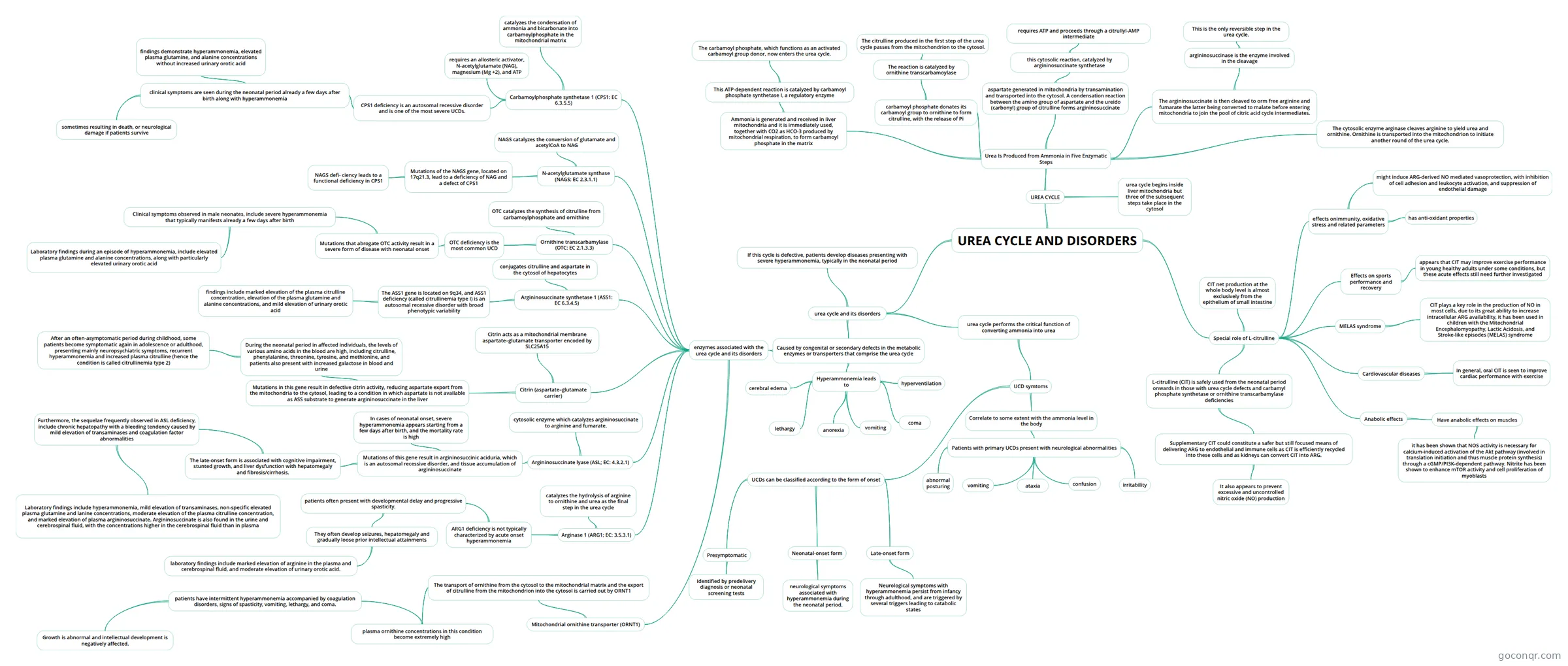
Mind map: urea cycle and disorders
Map content
UREA CYCLE AND DISORDERS
UREA CYCLE
- Urea Is Produced from Ammonia in Five Enzymatic Steps
- Ammonia is generated and received in liver mitochondria and it is immediately used, together with CO2 as HCO-3 produced by mitochondrial respiration, to form carbamoyl phosphate in the matrix
- This ATP-dependent reaction is catalyzed by carbamoyl phosphate synthetase I, a regulatory enzyme
- The carbamoyl phosphate, which functions as an activated carbamoyl group donor, now enters the urea cycle.
- This ATP-dependent reaction is catalyzed by carbamoyl phosphate synthetase I, a regulatory enzyme
- The cytosolic enzyme arginase cleaves arginine to yield urea and ornithine. Ornithine is transported into the mitochondrion to initiate another round of the urea cycle.
- aspartate generated in mitochondria by transamination and transported into the cytosol. A condensation reaction between the amino group of aspartate and the ureido (carbonyl) group of citrulline forms argininosuccinate
- this cytosolic reaction, catalyzed by argininosuccinate synthetase
- requires ATP and proceeds through a citrullyl-AMP intermediate
- this cytosolic reaction, catalyzed by argininosuccinate synthetase
- carbamoyl phosphate donates its carbamoyl group to ornithine to form citrulline, with the release of Pi
- The reaction is catalyzed by ornithine transcarbamoylase
- The citrulline produced in the first step of the urea cycle passes from the mitochondrion to the cytosol.
- The reaction is catalyzed by ornithine transcarbamoylase
- The argininosuccinate is then cleaved to orm free arginine and fumarate the latter being converted to malate before entering mitochondria to join the pool of citric acid cycle intermediates.
- argininosuccinase is the enzyme involved in the cleavage
- This is the only reversible step in the urea cycle.
- argininosuccinase is the enzyme involved in the cleavage
- Ammonia is generated and received in liver mitochondria and it is immediately used, together with CO2 as HCO-3 produced by mitochondrial respiration, to form carbamoyl phosphate in the matrix
- urea cycle begins inside liver mitochondria but three of the subsequent steps take place in the cytosol
- Urea Is Produced from Ammonia in Five Enzymatic Steps
urea cycle and its disorders
- urea cycle performs the critical function of converting ammonia into urea
- UCD symtoms
- Correlate to some extent with the ammonia level in the body
- Patients with primary UCDs present with neurological abnormalities
- abnormal posturing
- vomiting
- ataxia
- confusion
- irritability
- Patients with primary UCDs present with neurological abnormalities
- UCDs can be classified according to the form of onset
- Presymptomatic
- Identified by predelivery diagnosis or neonatal screening tests
- Neonatal-onset form
- neurological symptoms associated with hyperammonemia during the neonatal period.
- Late-onset form
- Neurological symptoms with hyperammonemia persist from infancy through adulthood, and are triggered by several triggers leading to catabolic states
- Presymptomatic
- Correlate to some extent with the ammonia level in the body
- UCD symtoms
- If this cycle is defective, patients develop diseases presenting with severe hyperammonemia, typically in the neonatal period
- Caused by congenital or secondary defects in the metabolic enzymes or transporters that comprise the urea cycle
- Hyperammonemia leads to
- cerebral edema
- lethargy
- vomiting
- anorexia
- hyperventilation
- coma
- enzymes associated with the urea cycle and its disorders
- Carbamoylphosphate synthetase 1 (CPS1: EC 6.3.5.5)
- catalyzes the condensation of ammonia and bicarbonate into carbamoylphosphate in the mitochondrial matrix
- requires an allosteric activator, N-acetylglutamate (NAG), magnesium (Mg +2), and ATP
- CPS1 deficiency is an autosomal recessive disorder and is one of the most severe UCDs.
- clinical symptoms are seen during the neonatal period already a few days after birth along with hyperammonemia
- sometimes resulting in death, or neurological damage if patients survive
- findings demonstrate hyperammonemia, elevated plasma glutamine, and alanine concentrations without increased urinary orotic acid
- clinical symptoms are seen during the neonatal period already a few days after birth along with hyperammonemia
- N-acetylglutamate synthase (NAGS: EC 2.3.1.1)
- NAGS catalyzes the conversion of glutamate and acetylCoA to NAG
- Mutations of the NAGS gene, located on 17q21.3, lead to a deficiency of NAG and a defect of CPS1
- NAGS defi- ciency leads to a functional deficiency in CPS1
- Ornithine transcarbamylase (OTC: EC 2.1.3.3)
- OTC catalyzes the synthesis of citrulline from carbamoylphosphate and ornithine
- OTC deficiency is the most common UCD
- Mutations that abrogate OTC activity result in a severe form of disease with neonatal onset
- Clinical symptoms observed in male neonates, include severe hyperammonemia that typically manifests already a few days after birth
- Laboratory findings during an episode of hyperammonemia, include elevated plasma glutamine and alanine concentrations, along with particularly elevated urinary orotic acid
- Clinical symptoms observed in male neonates, include severe hyperammonemia that typically manifests already a few days after birth
- Mutations that abrogate OTC activity result in a severe form of disease with neonatal onset
- Argininosuccinate synthetase 1 (ASS1: EC 6.3.4.5)
- conjugates citrulline and aspartate in the cytosol of hepatocytes
- The ASS1 gene is located on 9q34, and ASS1 deficiency (called citrullinemia type I) is an autosomal recessive disorder with broad phenotypic variability
- findings include marked elevation of the plasma citrulline concentration, elevation of the plasma glutamine and alanine concentrations, and mild elevation of urinary orotic acid
- Citrin (aspartate–glutamate carrier)
- Citrin acts as a mitochondrial membrane aspartate–glutamate transporter encoded by SLC25A15
- Mutations in this gene result in defective citrin activity, reducing aspartate export from the mitochondria to the cytosol, leading to a condition in which aspartate is not available as ASS substrate to generate argininosuccinate in the liver
- During the neonatal period in affected individuals, the levels of various amino acids in the blood are high, including citrulline, phenylalanine, threonine, tyrosine, and methionine, and patients also present with increased galactose in blood and urine
- After an often-asymptomatic period during childhood, some patients become symptomatic again in adolescence or adulthood, presenting mainly neuropsychiatric symptoms, recurrent hyperammonemia and increased plasma citrulline (hence the condition is called citrullinemia type 2)
- During the neonatal period in affected individuals, the levels of various amino acids in the blood are high, including citrulline, phenylalanine, threonine, tyrosine, and methionine, and patients also present with increased galactose in blood and urine
- Argininosuccinate lyase (ASL; EC: 4.3.2.1)
- cytosolic enzyme which catalyzes argininosuccinate to arginine and fumarate.
- Mutations of this gene result in argininosuccinic aciduria, which is an autosomal recessive disorder, and tissue accumulation of argininosuccinate
- In cases of neonatal onset, severe hyperammonemia appears starting from a few days after birth, and the mortality rate is high
- The late-onset form is associated with cognitive impairment, stunted growth, and liver dysfunction with hepatomegaly and fibrosis/cirrhosis.
- Furthermore, the sequelae frequently observed in ASL deficiency, include chronic hepatopathy with a bleeding tendency caused by mild elevation of transaminases and coagulation factor abnormalities
- Laboratory findings include hyperammonemia, mild elevation of transaminases, non-specific elevated plasma glutamine and lanine concentrations, moderate elevation of the plasma citrulline concentration, and marked elevation of plasma argininosuccinate. Argininosuccinate is also found in the urine and cerebrospinal fluid, with the concentrations higher in the cerebrospinal fluid than in plasma
- Furthermore, the sequelae frequently observed in ASL deficiency, include chronic hepatopathy with a bleeding tendency caused by mild elevation of transaminases and coagulation factor abnormalities
- Arginase 1 (ARG1; EC: 3.5.3.1)
- catalyzes the hydrolysis of arginine to ornithine and urea as the final step in the urea cycle
- ARG1 deficiency is not typically characterized by acute onset hyperammonemia
- patients often present with developmental delay and progressive spasticity.
- They often develop seizures, hepatomegaly and gradually loose prior intellectual attainments
- laboratory findings include marked elevation of arginine in the plasma and cerebrospinal fluid, and moderate elevation of urinary orotic acid.
- They often develop seizures, hepatomegaly and gradually loose prior intellectual attainments
- patients often present with developmental delay and progressive spasticity.
- Mitochondrial ornithine transporter (ORNT1)
- The transport of ornithine from the cytosol to the mitochondrial matrix and the export of citrulline from the mitochondrion into the cytosol is carried out by ORNT1
- plasma ornithine concentrations in this condition become extremely high
- patients have intermittent hyperammonemia accompanied by coagulation disorders, signs of spasticity, vomiting, lethargy, and coma.
- Growth is abnormal and intellectual development is negatively affected.
- patients have intermittent hyperammonemia accompanied by coagulation disorders, signs of spasticity, vomiting, lethargy, and coma.
- plasma ornithine concentrations in this condition become extremely high
- The transport of ornithine from the cytosol to the mitochondrial matrix and the export of citrulline from the mitochondrion into the cytosol is carried out by ORNT1
- Carbamoylphosphate synthetase 1 (CPS1: EC 6.3.5.5)
- Hyperammonemia leads to
- urea cycle performs the critical function of converting ammonia into urea
Special role of L-citrulline
- L-citrulline (CIT) is safely used from the neonatal period onwards in those with urea cycle defects and carbamyl phosphate synthetase or ornithine transcarbamylase deficiencies
- Supplementary CIT could constitute a safer but still focused means of delivering ARG to endothelial and immune cells as CIT is efficiently recycled into these cells and as kidneys can convert CIT into ARG.
- It also appears to prevent excessive and uncontrolled nitric oxide (NO) production
- Supplementary CIT could constitute a safer but still focused means of delivering ARG to endothelial and immune cells as CIT is efficiently recycled into these cells and as kidneys can convert CIT into ARG.
- CIT net production at the whole body level is almost exclusively from the epithelium of small intestine
- effects onimmunity, oxidative stress and related parameters
- might induce ARG-derived NO mediated vasoprotection, with inhibition of cell adhesion and leukocyte activation, and suppression of endothelial damage
- has anti-oxidant properties
- Effects on sports performance and recovery
- appears that CIT may improve exercise performance in young healthy adults under some conditions, but these acute effects still need further investigated
- MELAS syndrome
- CIT plays a key role in the production of NO in most cells, due to its great ability to increase intracellular ARG availability, it has been used in children with the Mitochondrial Encephalomyopathy, Lactic Acidosis, and Stroke-like episodes (MELAS) syndrome
- Cardiovascular diseases
- In general, oral CIT is seen to improve cardiac performance with exercise
- Anabolic effects
- Have anabolic effects on muscles
- it has been shown that NOS activity is necessary for calcium-induced activation of the Akt pathway (involved in translation initiation and thus muscle protein synthesis) through a cGMP/PI3K-dependent pathway. Nitrite has been shown to enhance mTOR activity and cell proliferation of myoblasts
- Have anabolic effects on muscles
- L-citrulline (CIT) is safely used from the neonatal period onwards in those with urea cycle defects and carbamyl phosphate synthetase or ornithine transcarbamylase deficiencies
Information
- Description
- Mind Map on UREA CYCLE AND DISORDERS, created by Cristhian Camilo Lozano Fernandez on 17/11/2020.
- Created by
- Cristhian Camilo Lozano Fernandez
- Views
- 0
- Rating