
Mind map
Acciones, estados y procesos
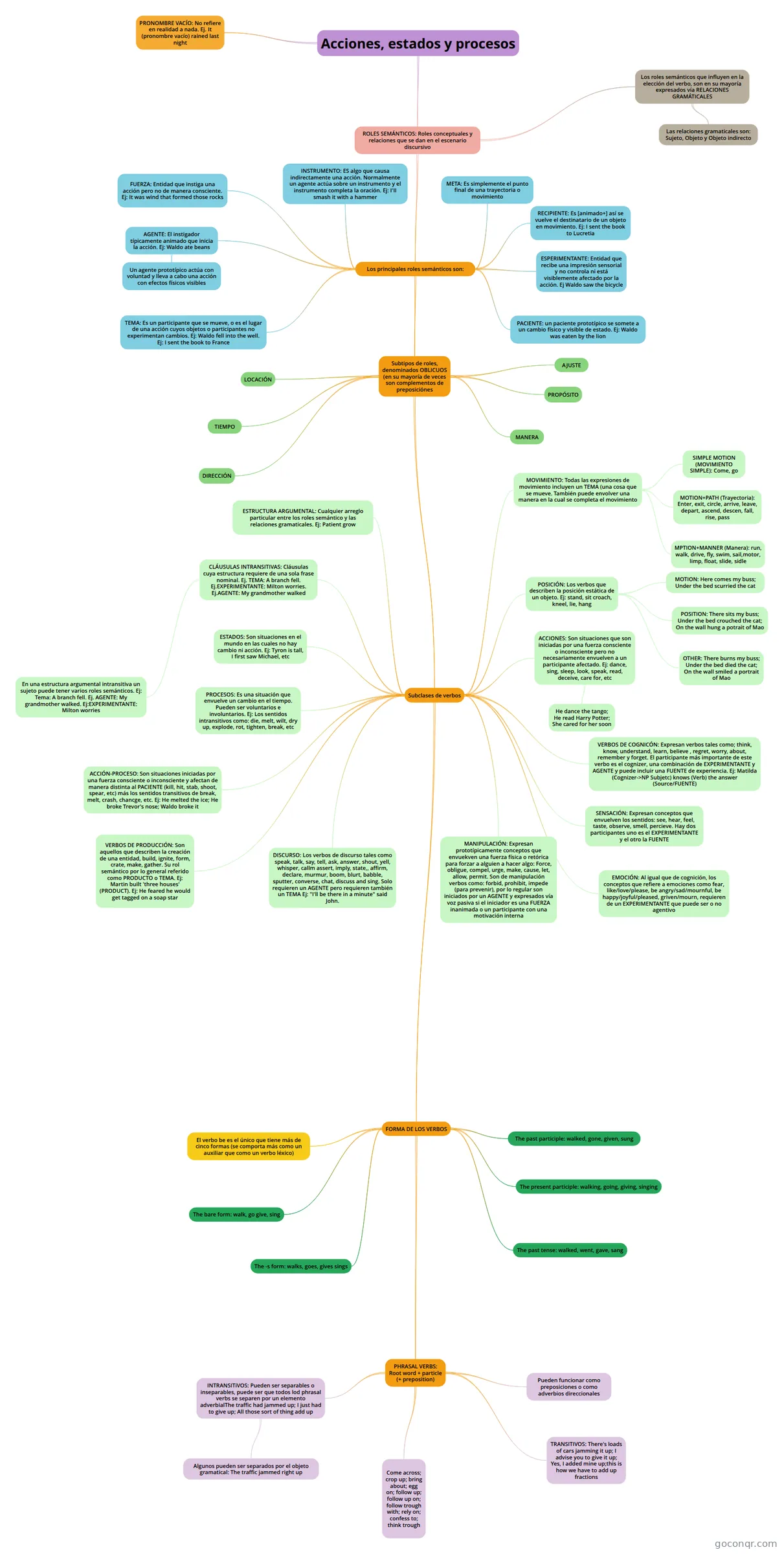
Mapa mental: Acciones, estados y procesos
Map content
Acciones, estados y procesos
ROLES SEMÁNTICOS: Roles conceptuales y relaciones que se dan en el escenario discursivo
- Los roles semánticos que influyen en la elección del verbo, son en su mayoría expresados vía RELACIONES GRAMÁTICALES
- Las relaciones gramaticales son: Sujeto, Objeto y Objeto indirecto
- Los principales roles semánticos son:
- AGENTE: El instigador típicamente animado que inicia la acción. Ej: Waldo ate beans
- Un agente prototípico actúa con voluntad y lleva a cabo una acción con efectos físicos visibles
- TEMA: Es un participante que se mueve, o es el lugar de una acción cuyos objetos o participantes no experimentan cambios. Ej: Waldo fell into the well. Ej: I sent the book to France
- FUERZA: Entidad que instiga una acción pero no de manera consciente. Ej: It was wind that formed those rocks
- INSTRUMENTO: ES algo que causa indirectamente una acción. Normalmente un agente actúa sobre un instrumento y el instrumento completa la oración. Ej: I'II smash it with a hammer
- ESPERIMENTANTE: Entidad que recibe una impresión sensorial y no controla ni está visiblemente afectado por la acción. Ej Waldo saw the bicycle
- PACIENTE: un paciente prototípico se somete a un cambio físico y visible de estado. Ej: Waldo was eaten by the lion
- RECIPIENTE: Es [animado+] así se vuelve el destinatario de un objeto en movimiento. Ej: I sent the book to Lucretia
- META: Es simplemente el punto final de una trayectoria o movimiento
- Subtipos de roles, denominados OBLICUOS (en su mayoría de veces son complementos de preposiciónes
- LOCACIÓN
- DIRECCIÓN
- AJUSTE
- PROPÓSITO
- TIEMPO
- MANERA
- Subclases de verbos
- ESTRUCTURA ARGUMENTAL: Cualquier arreglo particular entre los roles semántico y las relaciones gramaticales. Ej: Patient grow
- CLÁUSULAS INTRANSITIVAS: Cláusulas cuya estructura requiere de una sola frase nominal. Ej. TEMA: A branch fell. Ej.EXPERIMENTANTE: Milton worries. Ej.AGENTE: My grandmother walked
- En una estructura argumental intransitiva un sujeto puede tener varios roles semánticos. Ej: Tema: A branch fell. Ej. AGENTE: My grandmother walked. Ej:EXPERIMENTANTE: Milton worries
- ESTADOS: Son situaciones en el mundo en las cuales no hay cambio ni acción. Ej: Tyron is tall, I first saw Michael, etc
- PROCESOS: Es una situación que envuelve un cambio en el tiempo. Pueden ser voluntarios e involuntarios. Ej: Los sentidos intransitivos como: die, melt, wilt, dry up, explode, rot, tighten, break, etc
- MOVIMIENTO: Todas las expresiones de movimiento incluyen un TEMA (una cosa que se mueve. También puede envolver una manera en la cual se completa el movimiento
- SIMPLE MOTION (MOVIMIENTO SIMPLE): Come, go
- MOTION+PATH (Trayectoria): Enter, exit, circle, arrive, leave, depart, ascend, descen, fall, rise, pass
- MPTION+MANNER (Manera): run, walk, drive, fly, swim, sail,motor, limp, float, slide, sidle
- POSICIÓN: Los verbos que describen la posición estática de un objeto. Ej: stand, sit croach, kneel, lie, hang
- MOTION: Here comes my buss; Under the bed scurried the cat
- POSITION: There sits my buss; Under the bed crouched the cat; On the wall hung a potrait of Mao
- OTHER: There burns my buss; Under the bed died the cat; On the wall smiled a portrait of Mao
- ACCIONES: Son situaciones que son iniciadas por una fuerza consciente o inconsciente pero no necesariamente envuelven a un participante afectado. Ej: dance, sing, sleep, look, speak, read, deceive, care for, etc
- He dance the tango; He read Harry Potter; She cared for her soon
- ACCIÓN-PROCESO: Son situaciones iniciadas por una fuerza consciente o inconsciente y afectan de manera distinta al PACIENTE (kill, hit, stab, shoot, spear, etc) más los sentidos transitivos de break, melt, crash, chancge, etc. Ej: He melted the ice; He broke Trevor's nose; Waldo broke it
- VERBOS DE PRODUCCIÓN: Son aquellos que describen la creación de una entidad, build, ignite, form, crate, make, gather. Su rol semántico por lo general referido como PRODUCTO o TEMA. Ej: Martin built 'three houses' (PRODUCT). Ej: He feared he would get tagged on a soap star
- VERBOS DE COGNICÓN: Expresan verbos tales como; think, know, understand, learn, believe , regret, worry, about, remember y forget. El participante más importante de este verbo es el cognizer, una combinación de EXPERIMENTANTE y AGENTE y puede incluir una FUENTE de experiencia. Ej: Matilda (Cognizer->NP Subjetc) knows (Verb) the answer (Source/FUENTE)
- SENSACIÓN: Expresan conceptos que envuelven los sentidos: see, hear, feel, taste, observe, smell, percieve. Hay dos participantes uno es el EXPERIMENTANTE y el otro la FUENTE
- EMOCIÓN: Al igual que de cognición, los conceptos que refiere a emociones como fear, like/love/please, be angry/sad/mournful, be happy/joyful/pleased, griven/mourn, requieren de un EXPERIMENTANTE que puede ser o no agentivo
- DISCURSO: Los verbos de discurso tales como speak, talk, say, tell, ask, answer, shout, yell, whisper, callm assert, imply, state,, affirm, declare, murmur, boom, blurt, babble, sputter, converse, chat, discuss and sing. Solo requieren un AGENTE pero requieren también un TEMA Ej: "I'll be there in a minute" said John.
- MANIPULACIÓN: Expresan prototípicamente conceptos que envuekven una fuerza física o retórica para forzar a alguien a hacer algo: Force, obligue, compel, urge, make, cause, let, allow, permit. Son de manipulación verbos como: forbid, prohibit, impede (para prevenir), por lo regular son iniciados por un AGENTE y expresados vía voz pasiva si el iniciador es una FUERZA inanimada o un participante con una motivación interna
- FORMA DE LOS VERBOS
- El verbo be es el único que tiene más de cinco formas (se comporta más como un auxiliar que como un verbo léxico)
- The bare form: walk, go give, sing
- The -s form: walks, goes, gives sings
- The past tense: walked, went, gave, sang
- The past participle: walked, gone, given, sung
- The present participle: walking, going, giving, singing
- PHRASAL VERBS: Root word + particle (+ preposition)
- Come across; crop up; bring about; egg on; follow up; follow up on; follow trough with; rely on; confess to; think trough
- Pueden funcionar como preposiciones o como adverbios direccionales
- INTRANSITiVOS: Pueden ser separables o inseparables, puede ser que todos lod phrasal verbs se separen por un elemento adverbialThe traffic had jammed up; I just had to give up; All those sort of thing add up
- Algunos pueden ser separados por el objeto gramatical: The traffic jammed right up
- TRANSITIVOS: There's loads of cars jamming it up; I advise you to give it up; Yes, I added mine up;this is how we have to add up fractions
- AGENTE: El instigador típicamente animado que inicia la acción. Ej: Waldo ate beans
- Los roles semánticos que influyen en la elección del verbo, son en su mayoría expresados vía RELACIONES GRAMÁTICALES
PRONOMBRE VACÍO: No refiere en realidad a nada. Ej. It (pronombre vacío) rained last night
Information
- Description
- Mind Map on Acciones, estados y procesos, created by SAMARA ANDREA RENDON PE�ALOZA on 28/06/2021.
- Created by
- SAMARA ANDREA RENDON PE�ALOZA
- Views
- 0
- Rating