
Mind map
T 18 FUNCTIONS OF GAMES AND CREATIVITY IN THE FLC
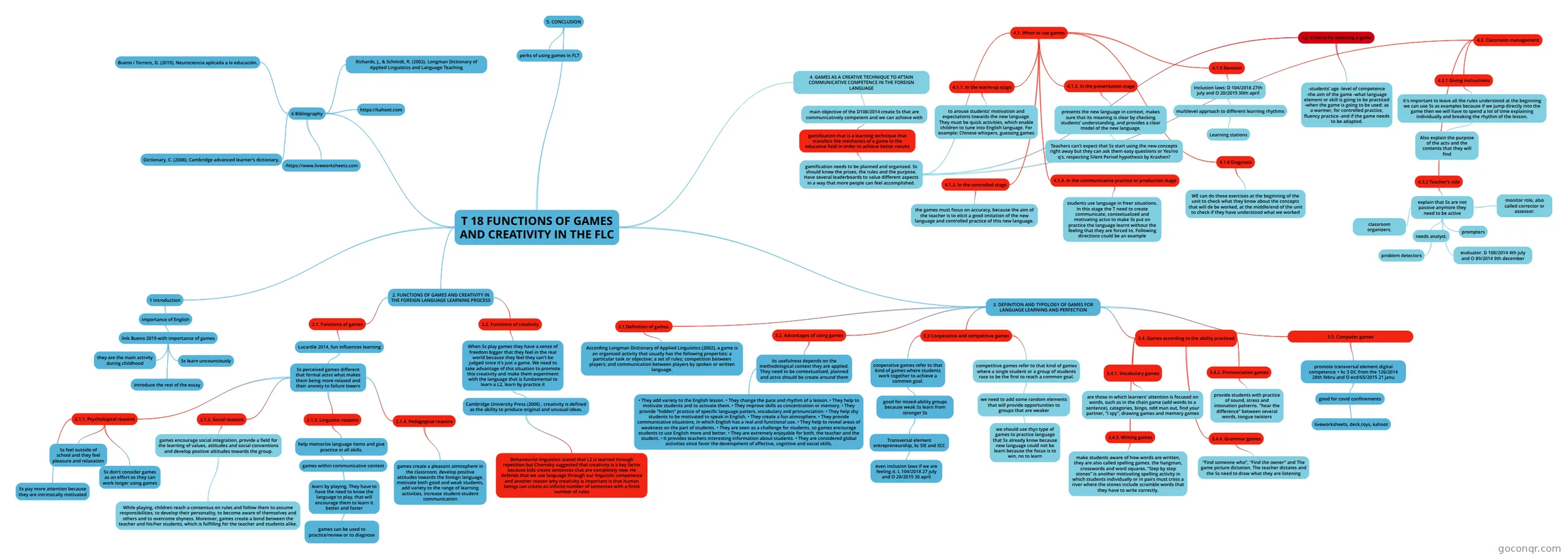
Mind map: Functions of games and creativity in the foreign language classroom
Map content
T 18 FUNCTIONS OF GAMES AND CREATIVITY IN THE FLC
1 Introduction
- importance of English
- link Bueno 2019 with importance of games
- they are the main activity during childhood
- Ss learn uncounciously
- introduce the rest of the essay
- link Bueno 2019 with importance of games
- importance of English
2. FUNCTIONS OF GAMES AND CREATIVITY IN THE FOREIGN LANGUAGE LEARNING PROCESS
- 2.1. Functions of games
- Lucardie 2014, fun influences learning
- Ss perceived games different that formal actvs what makes them being more relaxed and their anxiety to failure lowers
- 2.1.1. Psychological reasons
- Ss feel outside of school and they feel pleasure and relaxation
- Ss don't consider games as an effort so they can work longer using games
- Ss pay more attention because they are intrinsically motivated
- 2.1.2. Social reasons
- games encourage social integration, provide a field for the learning of values, attitudes and social conventions and develop positive attitudes towards the group.
- While playing, children reach a consensus on rules and follow them to assume responsibilities, to develop their personality, to become aware of themselves and others and to overcome shyness. Moreover, games create a bond between the teacher and his/her students, which is fulfilling for the teacher and students alike.
- games encourage social integration, provide a field for the learning of values, attitudes and social conventions and develop positive attitudes towards the group.
- 2.1.3. Linguistic reasons
- help memorize language items and give practice in all skills.
- games within communicative context
- learn by playing. They have to have the need to know the language to play, that will encourage them to learn it better and faster
- games can be used to practice/review or to diagnose
- learn by playing. They have to have the need to know the language to play, that will encourage them to learn it better and faster
- games within communicative context
- help memorize language items and give practice in all skills.
- 2.1.4. Pedagogical reasons
- games create a pleasant atmosphere in the classroom, develop positive attitudes towards the foreign language, motivate both good and weak students, add variety to the range of learning activities, increase student-student communication
- 2.1.1. Psychological reasons
- Ss perceived games different that formal actvs what makes them being more relaxed and their anxiety to failure lowers
- Lucardie 2014, fun influences learning
- 2.2. Functions of creativity
- When Ss play games they have a sense of freedom bigger that they feel in the real world because they feel they can't be judged since it's just a game. We need to take advantage of this situation to promote this creativity and make them experiment with the language that is fundamental to learn a L2, learn by practice it
- Cambridge University Press (2008) , creativity is defined as the ability to produce original and unusual ideas,
- Behaviourist linguistics stated that L2 is learned through repetition but Chomsky suggested that creativity is a key factor because kids create sentences that are completely new. He defends that we use language through our linguistic competence and another reason why creativity is important is that human beings can create an infinite number of sentences with a finite number of rules
- Cambridge University Press (2008) , creativity is defined as the ability to produce original and unusual ideas,
- When Ss play games they have a sense of freedom bigger that they feel in the real world because they feel they can't be judged since it's just a game. We need to take advantage of this situation to promote this creativity and make them experiment with the language that is fundamental to learn a L2, learn by practice it
- 2.1. Functions of games
3. DEFINITION AND TYPOLOGY OF GAMES FOR LANGUAGE LEARNING AND PERFECTION
- 3.1.Definition of games.
- According Longman Dictionary of Applied Linguistics (2002), a game is an organized activity that usually has the following properties: a particular task or objective; a set of rules; competition between players; and communication between players by spoken or written language.
- 3.2. Advantages of using games
- its usefulness depends on the methodological context they are applied. They need to be contextualized, planned and actvs should be create around them
- • They add variety to the English lesson. • They change the pace and rhythm of a lesson. • They help to motivate students and to activate them. • They improve skills as concentration or memory. • They provide “hidden” practice of specific language patters, vocabulary and pronunciation. • They help shy students to be motivated to speak in English. • They create a fun atmosphere. • They provide communicative situations, in which English has a real and functional use. • They help to reveal areas of weakness on the part of students. • They are seen as a challenge for students, so games encourage students to use English more and better. • They are extremely enjoyable for both, the teacher and the student. • It provides teachers interesting information about students. • They are considered global activities since favor the development of affective, cognitive and social skills.
- its usefulness depends on the methodological context they are applied. They need to be contextualized, planned and actvs should be create around them
- 3.3 Cooperative and competitive games
- cooperative games refer to that kind of games where students work together to achieve a common goal.
- good for mixed-ability groups because weak Ss learn from stronger Ss
- Transversal element entrepreneurship, kc SIE and SCC
- even inclusion laws if we are feeling it. L 104/2018 27 july and O 20/2019 30 april
- Transversal element entrepreneurship, kc SIE and SCC
- good for mixed-ability groups because weak Ss learn from stronger Ss
- competitive games refer to that kind of games where a single student or a group of students race to be the first to reach a common goal.
- we need to add some random elements that will provide opportunities to groups that are weaker
- we should use thys type of games to practice language that Ss already know because new language could not be learn because the focus is to win, no to learn
- we need to add some random elements that will provide opportunities to groups that are weaker
- cooperative games refer to that kind of games where students work together to achieve a common goal.
- 3.4. Games according to the ability practiced
- 3.4.1. Vocabulary games
- are those in which learners’ attention is focused on words, such as in the chain game (add words to a sentence), categories, bingo, odd man out, find your partner, “I spy”, drawing games and memory games
- 3.4.2. Pronunciation games
- provide students with practice of sound, stress and intonation patterns. "hear the difference" between several words, tongue twisters
- 3.4.3. Writing games
- make students aware of how words are written, they are also called spelling games. the hangman, crosswords and word squares. “Step by step stones” is another motivating spelling activity in which students individually or in pairs must cross a river where the stones include scramble words that they have to write correctly.
- 3.4.4. Grammar games
- “Find someone who”, “Find the owner” and The game picture dictation. The teacher dictates and the Ss need to draw what they are listening
- 3.4.1. Vocabulary games
- 3.5. Computer games
- promote transversal element digital competence + kc 3 DC from the 126/2014 28th febru and O ecd/65/2015 21 janu
- good for covid confinements
- liveworksheets, deck,toys, kahoot
- good for covid confinements
- promote transversal element digital competence + kc 3 DC from the 126/2014 28th febru and O ecd/65/2015 21 janu
- 3.1.Definition of games.
4. GAMES AS A CREATIVE TECHNIQUE TO ATTAIN COMMUNICATIVE COMPETENCE IN THE FOREIGN LANGUAGE
- main objective of the D108/2014 create Ss that are communicatively competent and we can achieve with
- gamification that is a learning technique that transfers the mechanics of a game to the educative field in order to achieve better results
- gamification needs to be planned and organized. Ss should know the prizes, the rules and the purpose. Have several leaderboards to value different aspects in a way that more people can feel accomplished.
- 4.1. When to use games
- 4.1.1. In the warm-up stage
- to arouse students’ motivation and expectations towards the new language. They must be quick activities, which enable children to tune into English language. For example: Chinese whispers, guessing games
- 4.1.2. In the presentation stage
- presents the new language in context, makes sure that its meaning is clear by checking students’ understanding, and provides a clear model of the new language.
- Teachers can't expect that Ss start using the new concepts right away but they can ask them easy questions or Yes/no q's. respecting Silent Period hypothesis by Krashen?
- presents the new language in context, makes sure that its meaning is clear by checking students’ understanding, and provides a clear model of the new language.
- 4.1.3. In the controlled stage
- the games must focus on accuracy, because the aim of the teacher is to elicit a good imitation of the new language and controlled practice of this new language.
- 4.1.4. In the communicative practice or production stage
- students use language in freer situations. In this stage the T need to create communicate, contextualized and motivating actvs to make Ss put on practice the language learnt without the feeling that they are forced to. Following directions could be an example
- 4.1.5 Revision
- Inclusion laws: D 104/2018 27th july and O 20/2019 30th april
- multilevel approach to different learning rhythms
- Learning stations
- multilevel approach to different learning rhythms
- Inclusion laws: D 104/2018 27th july and O 20/2019 30th april
- 4.1.6 Diagnosis
- WE can do these exercises at the beginning of the unit to check what they know about the concepts that will de be worked, at the middle/end of the unit to check if they have understood what we worked
- 4.1.1. In the warm-up stage
- 4.2. Criteria for selecting a game
- -students’ age -level of competence -the aim of the game -what language element or skill is going to be practiced -when the game is going to be used: as a warmer, for controlled practice, fluency practice -and if the game needs to be adapted.
- 4.3. Classroom management
- 4.3.1 Giving instructions
- it's important to leave all the rules understood at the beginning we can use Ss as examples because if we jump directly into the game then we will have to spend a lot of time explaining individually and breaking the rhythm of the lesson.
- Also explain the purpose of the actv and the contents that they will find
- it's important to leave all the rules understood at the beginning we can use Ss as examples because if we jump directly into the game then we will have to spend a lot of time explaining individually and breaking the rhythm of the lesson.
- 4.3.2 Teacher's role
- explain that Ss are not passive anymore they need to be active
- classroom organizers.
- needs analyst.
- problem detectors
- prompters
- monitor role, also called corrector or assessor.
- evaluator. D 108/2014 4th july and O 89/2014 9th december
- explain that Ss are not passive anymore they need to be active
- 4.3.1 Giving instructions
- 4.1. When to use games
- gamification needs to be planned and organized. Ss should know the prizes, the rules and the purpose. Have several leaderboards to value different aspects in a way that more people can feel accomplished.
- gamification that is a learning technique that transfers the mechanics of a game to the educative field in order to achieve better results
- main objective of the D108/2014 create Ss that are communicatively competent and we can achieve with
5. CONCLUSION
- perks of using games in FLT
6 Bibliography
- Bueno i Torrens, D. (2019). Neurociencia aplicada a la educación.
- Dictionary, C. (2008). Cambridge advanced learner’s dictionary.
- Richards, J., & Schmidt, R. (2002). Longman Dictionary of Applied Linguistics and Language Teaching
- https://kahoot.com
- -https://www.liveworksheets.com
Information
- Description
- C1 Profesores de Primaria (Opos) Mind Map on T 18 FUNCTIONS OF GAMES AND CREATIVITY IN THE FLC, created by Jorge Pomar on 16/05/2022.
- Created by
- Jorge Pomar
- Views
- 16
- Rating