
Mind map
T 25 Learner-centred teaching : foundations and apps. Identifying motivation towards Eng. Pract apps
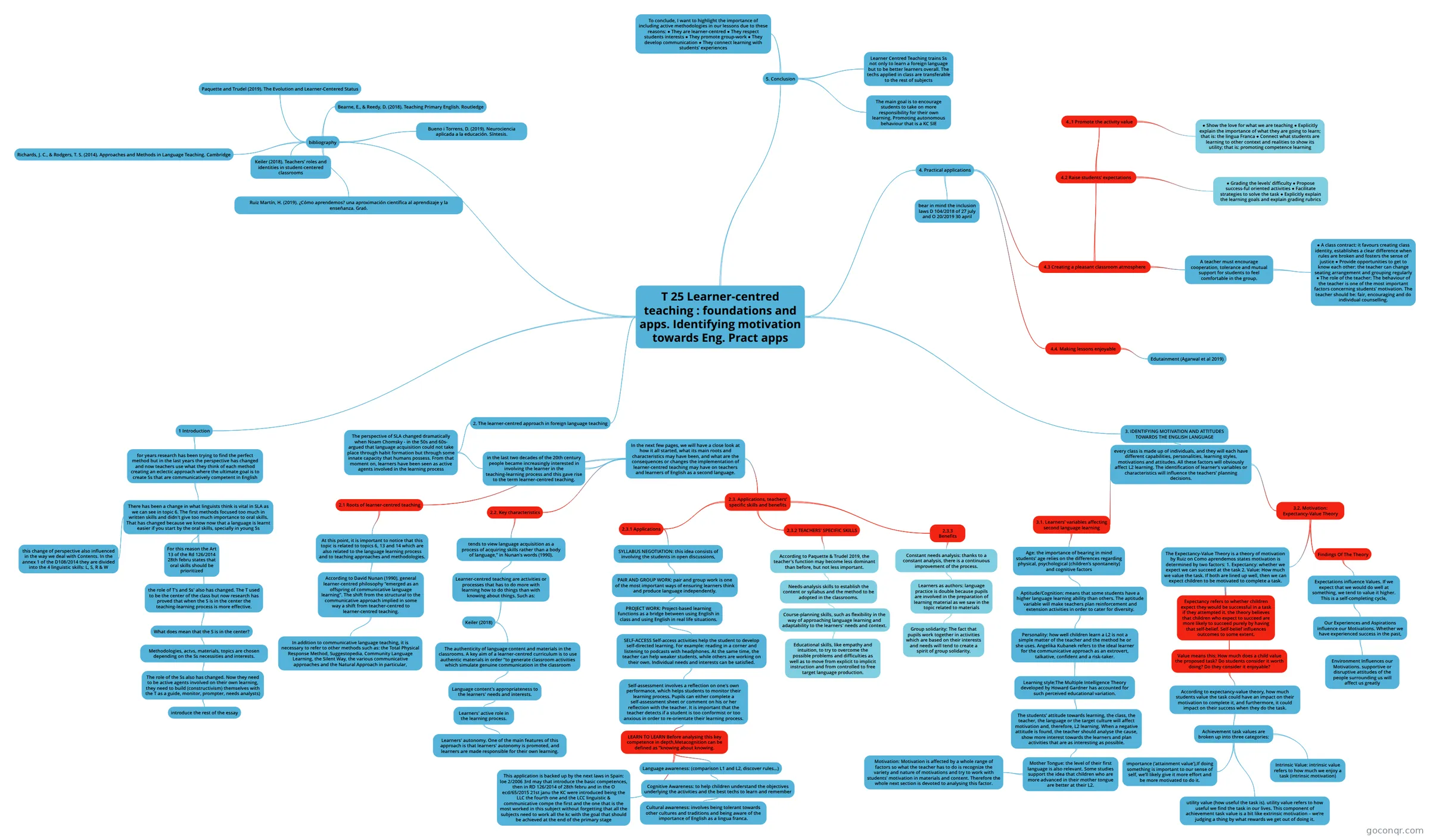
Mind map: Learner-centred teaching
Map content
T 25 Learner-centred teaching : foundations and apps. Identifying motivation towards Eng. Pract apps
1 Introduction
- for years research has been trying to find the perfect method but in the last years the perspective has changed and now teachers use what they think of each method creating an eclectic approach where the ultimate goal is to create Ss that are communicatively competent in English
- There has been a change in what linguists think is vital in SLA as we can see in topic 6. The first methods focused too much in written skills and didn't give too much importance to oral skills. That has changed because we know now that a language is learnt easier if you start by the oral skills, specially in young Ss
- For this reason the Art 13 of the Rd 126/2014 28th febru states that oral skills should be prioritized
- this change of perspective also influenced in the way we deal with Contents. In the annex 1 of the D108/2014 they are divided into the 4 linguistic skills: L, S, R & W
- the role of T's and Ss' also has changed. The T used to be the center of the class but now research has proved that when the S is in the center the teaching-learning process is more effective.
- What does mean that the S is in the center?
- Methodologies, actvs, materials, topics are chosen depending on the Ss necessities and interests.
- The role of the Ss also has changed. Now they need to be active agents involved on their own learning, they need to build (constructivism) themselves with the T as a guide, monitor, prompter, needs analysts)
- introduce the rest of the essay
- The role of the Ss also has changed. Now they need to be active agents involved on their own learning, they need to build (constructivism) themselves with the T as a guide, monitor, prompter, needs analysts)
- Methodologies, actvs, materials, topics are chosen depending on the Ss necessities and interests.
- What does mean that the S is in the center?
- There has been a change in what linguists think is vital in SLA as we can see in topic 6. The first methods focused too much in written skills and didn't give too much importance to oral skills. That has changed because we know now that a language is learnt easier if you start by the oral skills, specially in young Ss
- for years research has been trying to find the perfect method but in the last years the perspective has changed and now teachers use what they think of each method creating an eclectic approach where the ultimate goal is to create Ss that are communicatively competent in English
2. The learner-centred approach in foreign language teaching
- The perspective of SLA changed dramatically when Noam Chomsky - in the 50s and 60s- argued that language acquisition could not take place through habit formation but through some innate capacity that humans possess. From that moment on, learners have been seen as active agents involved in the learning process
- in the last two decades of the 20th century people became increasingly interested in involving the learner in the teaching-learning process and this gave rise to the term learner-centred teaching.
- In the next few pages, we will have a close look at how it all started, what its main roots and characteristics may have been, and what are the consequences or changes the implementation of learner-centred teaching may have on teachers and learners of English as a second language.
- 2.1 Roots of learner-centred teaching
- At this point, it is important to notice that this topic is related to topics 6, 13 and 14 which are also related to the language learning process and to teaching approaches and methodologies.
- According to David Nunan (1990), general learner-centred philosophy “emerged as an offspring of communicative language learning”. The shift from the structural to the communicative approach implied in some way a shift from teacher-centred to learner-centred teaching.
- In addition to communicative language teaching, it is necessary to refer to other methods such as: the Total Physical Response Method, Suggestopedia, Community Language Learning, the Silent Way, the various communicative approaches and the Natural Approach in particular,
- According to David Nunan (1990), general learner-centred philosophy “emerged as an offspring of communicative language learning”. The shift from the structural to the communicative approach implied in some way a shift from teacher-centred to learner-centred teaching.
- At this point, it is important to notice that this topic is related to topics 6, 13 and 14 which are also related to the language learning process and to teaching approaches and methodologies.
- 2.2. Key characteristics
- tends to view language acquisition as a process of acquiring skills rather than a body of language,” in Nunan's words (1990).
- Learner-centred teaching are activities or processes that has to do more with learning how to do things than with knowing about things. Such as:
- Keiler (2018)
- The authenticity of language content and materials in the classrooms. A key aim of a learner-centred curriculum is to use authentic materials in order “to generate classroom activities which simulate genuine communication in the classroom
- Language content's appropriateness to the learners' needs and interests.
- Learners' active role in the learning process.
- Learners' autonomy. One of the main features of this approach is that learners' autonomy is promoted, and learners are made responsible for their own learning.
- Learners' active role in the learning process.
- Language content's appropriateness to the learners' needs and interests.
- The authenticity of language content and materials in the classrooms. A key aim of a learner-centred curriculum is to use authentic materials in order “to generate classroom activities which simulate genuine communication in the classroom
- Keiler (2018)
- Learner-centred teaching are activities or processes that has to do more with learning how to do things than with knowing about things. Such as:
- tends to view language acquisition as a process of acquiring skills rather than a body of language,” in Nunan's words (1990).
- 2.3. Applications, teachers’ specific skills and benefits
- 2.3.2 TEACHERS’ SPECIFIC SKILLS
- According to Paquette & Trudel 2019, the teacher's function may become less dominant than before, but not less important.
- Needs-analysis skills to establish the content or syllabus and the method to be adopted in the classrooms.
- Course-planning skills, such as flexibility in the way of approaching language learning and adaptability to the learners' needs and context.
- Educational skills, like empathy and intuition, to try to overcome the possible problems and difficulties as well as to move from explicit to implicit instruction and from controlled to free target language production.
- Course-planning skills, such as flexibility in the way of approaching language learning and adaptability to the learners' needs and context.
- Needs-analysis skills to establish the content or syllabus and the method to be adopted in the classrooms.
- According to Paquette & Trudel 2019, the teacher's function may become less dominant than before, but not less important.
- 2.3.1 Applications
- SYLLABUS NEGOTIATION: this idea consists of involving the students in open discussions,
- PAIR AND GROUP WORK: pair and group work is one of the most important ways of ensuring learners think and produce language independently.
- PROJECT WORK: Project-based learning functions as a bridge between using English in class and using English in real life situations.
- SELF-ACCESS Self-access activities help the student to develop self-directed learning. For example: reading in a corner and listening to podcasts with headphones. At the same time, the teacher can help weaker students, while others are working on their own. Individual needs and interests can be satisfied.
- Self-assessment involves a reflection on one's own performance, which helps students to monitor their learning process. Pupils can either complete a self-assessment sheet or comment on his or her reflection with the teacher. It is important that the teacher detects if a student is too conformist or too anxious in order to re-orientate their learning process.
- LEARN TO LEARN Before analysing this key competence in depth,Metacognition can be defined as “knowing about knowing.
- Language awareness: (comparison L1 and L2, discover rules…)
- Cognitive Awareness: to help children understand the objectives underlying the activities and the best techs to learn and remember
- Cultural awareness: involves being tolerant towards other cultures and traditions and being aware of the importance of English as a lingua franca.
- Cognitive Awareness: to help children understand the objectives underlying the activities and the best techs to learn and remember
- This application is backed up by the next laws in Spain: loe 2/2006 3rd may that introduce the basic competences, then in RD 126/2014 of 28th febru and in the O ecd/65/2015 21st janu the KC were introduced being the LLC the fourth one and the LCC linguistic & communicative compe the first and the one that is the most worked in this subject without forgetting that all the subjects need to work all the kc with the goal that should be achieved at the end of the primary stage
- Language awareness: (comparison L1 and L2, discover rules…)
- LEARN TO LEARN Before analysing this key competence in depth,Metacognition can be defined as “knowing about knowing.
- Self-assessment involves a reflection on one's own performance, which helps students to monitor their learning process. Pupils can either complete a self-assessment sheet or comment on his or her reflection with the teacher. It is important that the teacher detects if a student is too conformist or too anxious in order to re-orientate their learning process.
- SELF-ACCESS Self-access activities help the student to develop self-directed learning. For example: reading in a corner and listening to podcasts with headphones. At the same time, the teacher can help weaker students, while others are working on their own. Individual needs and interests can be satisfied.
- PROJECT WORK: Project-based learning functions as a bridge between using English in class and using English in real life situations.
- PAIR AND GROUP WORK: pair and group work is one of the most important ways of ensuring learners think and produce language independently.
- SYLLABUS NEGOTIATION: this idea consists of involving the students in open discussions,
- 2.3.3 Benefits
- Constant needs analysis: thanks to a constant analysis, there is a continuous improvement of the process.
- Learners as authors: language practice is double because pupils are involved in the preparation of learning material as we saw in the topic related to materials
- Group solidarity: The fact that pupils work together in activities which are based on their interests and needs will tend to create a spirit of group solidarity.
- Learners as authors: language practice is double because pupils are involved in the preparation of learning material as we saw in the topic related to materials
- Constant needs analysis: thanks to a constant analysis, there is a continuous improvement of the process.
- 2.3.2 TEACHERS’ SPECIFIC SKILLS
- 2.1 Roots of learner-centred teaching
- In the next few pages, we will have a close look at how it all started, what its main roots and characteristics may have been, and what are the consequences or changes the implementation of learner-centred teaching may have on teachers and learners of English as a second language.
- in the last two decades of the 20th century people became increasingly interested in involving the learner in the teaching-learning process and this gave rise to the term learner-centred teaching.
- The perspective of SLA changed dramatically when Noam Chomsky - in the 50s and 60s- argued that language acquisition could not take place through habit formation but through some innate capacity that humans possess. From that moment on, learners have been seen as active agents involved in the learning process
bibliography
- Keiler (2018). Teachers’ roles and identities in student-centered classrooms
- Paquette and Trudel (2019). The Evolution and Learner-Centered Status
- Bearne, E., & Reedy, D. (2018). Teaching Primary English. Routledge
- Bueno i Torrens, D. (2019). Neurociencia aplicada a la educación. Síntesis.
- Richards, J. C., & Rodgers, T. S. (2014). Approaches and Methods in Language Teaching. Cambridge
- Ruiz Martín, H. (2019). ¿Cómo aprendemos? una aproximación científica al aprendizaje y la enseñanza. Graó.
3. IDENTIFYING MOTIVATION AND ATTITUDES TOWARDS THE ENGLISH LANGUAGE
- every class is made up of individuals, and they will each have different capabilities, personalities, learning styles, motivations and attitudes. All these factors will obviously affect L2 learning. The identification of learner’s variables or characteristics will influence the teachers’ planning decisions.
- 3.1. Learners’ variables affecting second language learning
- Age: the importance of bearing in mind students’ age relies on the differences regarding physical, psychological (children’s spontaneity) and cognitive factors
- Aptitude/Cognition: means that some students have a higher language learning ability than others. The aptitude variable will make teachers plan reinforcement and extension activities in order to cater for diversity.
- Personality: how well children learn a L2 is not a simple matter of the teacher and the method he or she uses. Angelika Kubanek refers to the ideal learner for the communicative approach as an extrovert, talkative, confident and a risk-taker.
- Learning style:The Multiple Intelligence Theory developed by Howard Gardner has accounted for such perceived educational variation.
- The students’ attitude towards learning, the class, the teacher, the language or the target culture will affect motivation and, therefore, L2 learning. When a negative attitude is found, the teacher should analyse the cause, show more interest towards the learners and plan activities that are as interesting as possible.
- Mother Tongue: the level of their first language is also relevant. Some studies support the idea that children who are more advanced in their mother tongue are better at their L2.
- Motivation: Motivation is affected by a whole range of factors so what the teacher has to do is recognize the variety and nature of motivations and try to work with students’ motivation in materials and content. Therefore the whole next section is devoted to analysing this factor.
- Mother Tongue: the level of their first language is also relevant. Some studies support the idea that children who are more advanced in their mother tongue are better at their L2.
- The students’ attitude towards learning, the class, the teacher, the language or the target culture will affect motivation and, therefore, L2 learning. When a negative attitude is found, the teacher should analyse the cause, show more interest towards the learners and plan activities that are as interesting as possible.
- Learning style:The Multiple Intelligence Theory developed by Howard Gardner has accounted for such perceived educational variation.
- Personality: how well children learn a L2 is not a simple matter of the teacher and the method he or she uses. Angelika Kubanek refers to the ideal learner for the communicative approach as an extrovert, talkative, confident and a risk-taker.
- Aptitude/Cognition: means that some students have a higher language learning ability than others. The aptitude variable will make teachers plan reinforcement and extension activities in order to cater for diversity.
- Age: the importance of bearing in mind students’ age relies on the differences regarding physical, psychological (children’s spontaneity) and cognitive factors
- 3.2. Motivation: Expectancy-Value Theory
- The Expectancy-Value Theory is a theory of motivation by Ruiz on Como aprendemos states motivation is determined by two factors: 1. Expectancy: whether we expect we can succeed at the task 2. Value: How much we value the task. If both are lined up well, then we can expect children to be motivated to complete a task.
- Expectancy refers to whether children expect they would be successful in a task if they attempted it. the theory believes that children who expect to succeed are more likely to succeed purely by having that self-belief. Self-belief influences outcomes to some extent.
- Value means this: How much does a child value the proposed task? Do students consider it worth doing? Do they consider it enjoyable?
- According to expectancy-value theory, how much students value the task could have an impact on their motivation to complete it, and furthermore, it could impact on their success when they do the task.
- Achievement task values are broken up into three categories:
- importance (‘attainment value’),If doing something is important to our sense of self, we’ll likely give it more effort and be more motivated to do it.
- Intrinsic Value: intrinsic value refers to how much we enjoy a task (intrinsic motivation)
- utility value (how useful the task is). utility value refers to how useful we find the task in our lives. This component of achievement task value is a bit like extrinsic motivation – we’re judging a thing by what rewards we get out of doing it.
- Achievement task values are broken up into three categories:
- According to expectancy-value theory, how much students value the task could have an impact on their motivation to complete it, and furthermore, it could impact on their success when they do the task.
- Findings Of The Theory
- Expectations influence Values. If we expect that we would do well at something, we tend to value it higher. This is a self-completing cycle,
- Our Experiences and Aspirations influence our Motivations. Whether we have experienced success in the past,
- Environment Influences our Motivations. supportive or disruptive attitudes of the people surrounding us will affect us greatly
- Our Experiences and Aspirations influence our Motivations. Whether we have experienced success in the past,
- Expectations influence Values. If we expect that we would do well at something, we tend to value it higher. This is a self-completing cycle,
- The Expectancy-Value Theory is a theory of motivation by Ruiz on Como aprendemos states motivation is determined by two factors: 1. Expectancy: whether we expect we can succeed at the task 2. Value: How much we value the task. If both are lined up well, then we can expect children to be motivated to complete a task.
- 3.1. Learners’ variables affecting second language learning
- every class is made up of individuals, and they will each have different capabilities, personalities, learning styles, motivations and attitudes. All these factors will obviously affect L2 learning. The identification of learner’s variables or characteristics will influence the teachers’ planning decisions.
4. Practical applications
- 4.3 Creating a pleasant classroom atmosphere
- A teacher must encourage cooperation, tolerance and mutual support for students to feel comfortable in the group.
- ● A class contract: it favours creating class identity, establishes a clear difference when rules are broken and fosters the sense of justice ● Provide opportunities to get to know each other: the teacher can change seating arrangement and grouping regularly ● The role of the teacher: The behaviour of the teacher is one of the most important factors concerning students’ motivation. The teacher should be: fair, encouraging and do individual counselling.
- 4.2 Raise students’ expectations
- 4..1 Promote the activity value
- ● Show the love for what we are teaching ● Explicitly explain the importance of what they are going to learn; that is: the lingua Franca ● Connect what students are learning to other context and realities to show its utility; that is: promoting competence learning
- ● Grading the levels’ difficulty ● Propose success-ful oriented activities ● Facilitate strategies to solve the task ● Explicitly explain the learning goals and explain grading rubrics
- 4..1 Promote the activity value
- A teacher must encourage cooperation, tolerance and mutual support for students to feel comfortable in the group.
- bear in mind the inclusion laws D 104/2018 of 27 july and O 20/2019 30 april
- 4.4. Making lessons enjoyable
- Edutainment (Agarwal et al 2019)
- 4.3 Creating a pleasant classroom atmosphere
5. Conclusion
- Learner Centred Teaching trains Ss not only to learn a foreign language but to be better learners overall. The techs applied in class are transferable to the rest of subjects
- The main goal is to encourage students to take on more responsibility for their own learning. Promoting autonomous behaviour that is a KC SIE
- To conclude, I want to highlight the importance of including active methodologies in our lessons due to these reasons: ● They are learner-centred ● They respect students interests ● They promote group-work ● They develop communication ● They connect learning with students’ experiences
Information
- Description
- C1 Profesores de Primaria (Opos) Mind Map on T 25 Learner-centred teaching : foundations and apps. Identifying motivation towards Eng. Pract apps, created by Jorge Pomar on 27/05/2022.
- Created by
- Jorge Pomar
- Views
- 9
- Rating