
Mind map
TYPES OF LOGISTICS
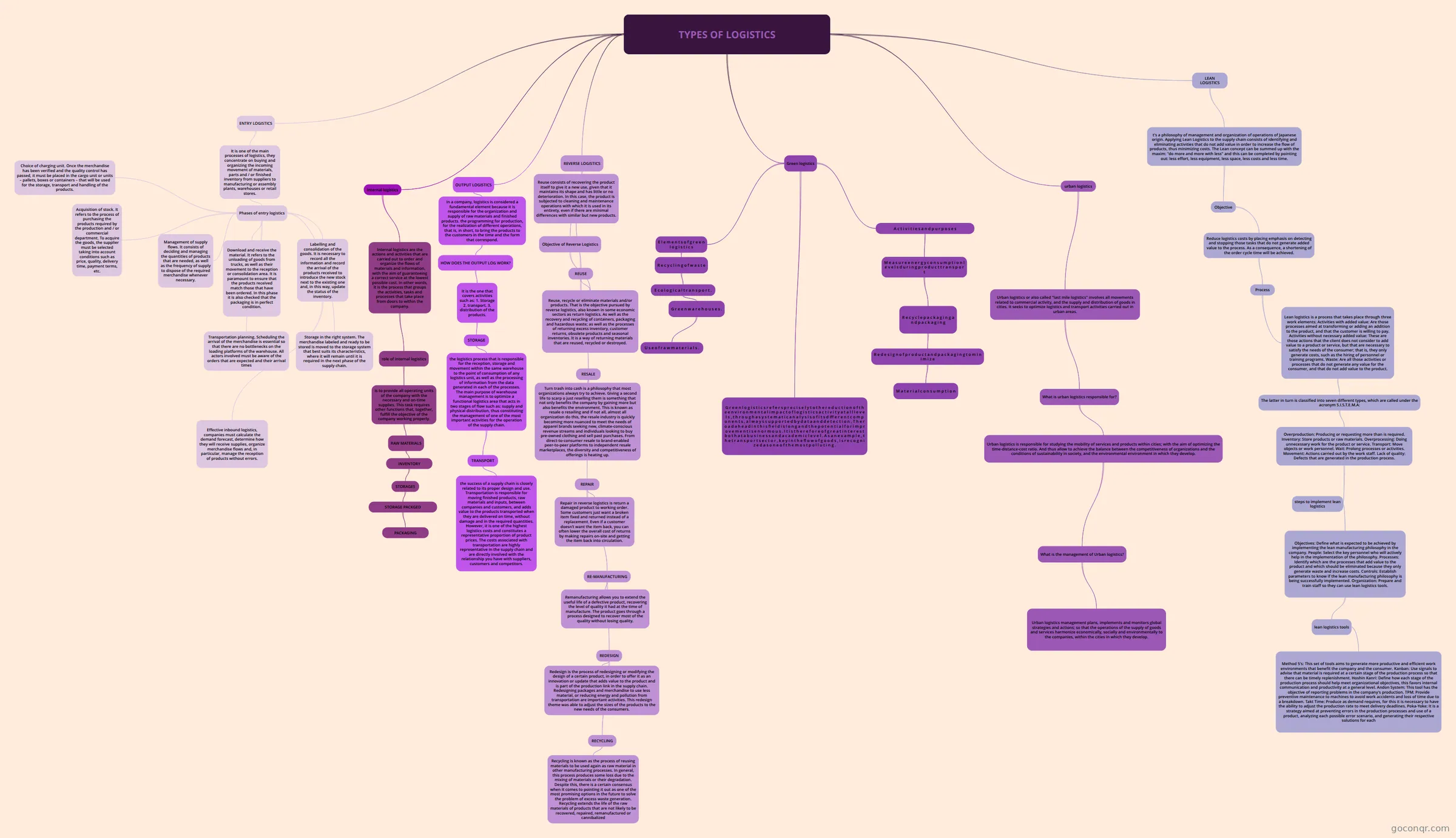
Mind map: Types of logistics
Map content
TYPES OF LOGISTICS
ENTRY LOGISTICS
- It is one of the main processes of logistics, they concentrate on buying and organizing the incoming movement of materials, parts and / or finished inventory from suppliers to manufacturing or assembly plants, warehouses or retail stores.
- Phases of entry logistics
- Management of supply flows. It consists of deciding and managing the quantities of products that are needed, as well as the frequency of supply to dispose of the required merchandise whenever necessary.
- Acquisition of stock. It refers to the process of purchasing the products required by the production and / or commercial department. To acquire the goods, the supplier must be selected taking into account conditions such as price, quality, delivery time, payment terms, etc.
- Transportation planning. Scheduling the arrival of the merchandise is essential so that there are no bottlenecks on the loading platforms of the warehouse. All actors involved must be aware of the orders that are expected and their arrival times
- Download and receive the material. It refers to the unloading of goods from trucks, as well as their movement to the reception or consolidation area. It is paramount to ensure that the products received match those that have been ordered. In this phase it is also checked that the packaging is in perfect condition.
- Labelling and consolidation of the goods. It is necessary to record all the information and record the arrival of the products received to introduce the new stock next to the existing one and, in this way, update the status of the inventory.
- Effective inbound logistics, companies must calculate the demand forecast, determine how they will receive supplies, organize merchandise flows and, in particular, manage the reception of products without errors.
- Choice of charging unit. Once the merchandise has been verified and the quality control has passed, it must be placed in the cargo unit or units – pallets, boxes or containers – that will be used for the storage, transport and handling of the products.
- Storage in the right system. The merchandise labeled and ready to be stored is moved to the storage system that best suits its characteristics, where it will remain until it is required in the next phase of the supply chain.
- Phases of entry logistics
- It is one of the main processes of logistics, they concentrate on buying and organizing the incoming movement of materials, parts and / or finished inventory from suppliers to manufacturing or assembly plants, warehouses or retail stores.
Internal logístics
- Internal logistics are the actions and activities that are carried out to order and organize the flows of materials and information, with the aim of guaranteeing a correct service at the lowest possible cost. In other words, it is the process that groups the activities, tasks and processes that take place from doors to within the company.
- role of internal logistics
- is to provide all operating units of the company with the necessary and on-time supplies. This task requires other functions that, together, fulfill the objective of the company working properly.
- RAW MATERIALS
- INVENTORY
- STORAGES
- STORAGE PACKGED
- PACKAGING
- STORAGE PACKGED
- STORAGES
- INVENTORY
- RAW MATERIALS
- is to provide all operating units of the company with the necessary and on-time supplies. This task requires other functions that, together, fulfill the objective of the company working properly.
- role of internal logistics
- Internal logistics are the actions and activities that are carried out to order and organize the flows of materials and information, with the aim of guaranteeing a correct service at the lowest possible cost. In other words, it is the process that groups the activities, tasks and processes that take place from doors to within the company.
OUTPUT LOGISTICS
- In a company, logistics is considered a fundamental element because it is responsible for the organization and supply of raw materials and finished products. the programming for production, for the realization of different operations, that is, in short, to bring the products to the customers in the time and the form that correspond.
- HOW DOES THE OUTPUT LOG WORK?
- It is the one that covers activities such as: 1. Storage 2. transport. 3. distribution of the products.
- STORAGE
- the logistics process that is responsible for the reception, storage and movement within the same warehouse to the point of consumption of any logistics unit, as well as the processing of information from the data generated in each of the processes. The main purpose of warehouse management is to optimize a functional logistics area that acts in two stages of flow such as: supply and physical distribution, thus constituting the management of one of the most important activities for the operation of the supply chain.
- TRANSPORT
- the success of a supply chain is closely related to its proper design and use. Transportation is responsible for moving finished products, raw materials and inputs, between companies and customers, and adds value to the products transported when they are delivered on time, without damage and in the required quantities. However, it is one of the highest logistics costs and constitutes a representative proportion of product prices. The costs associated with transportation are highly representative in the supply chain and are directly involved with the relationship you have with suppliers, customers and competitors.
- TRANSPORT
- the logistics process that is responsible for the reception, storage and movement within the same warehouse to the point of consumption of any logistics unit, as well as the processing of information from the data generated in each of the processes. The main purpose of warehouse management is to optimize a functional logistics area that acts in two stages of flow such as: supply and physical distribution, thus constituting the management of one of the most important activities for the operation of the supply chain.
- STORAGE
- It is the one that covers activities such as: 1. Storage 2. transport. 3. distribution of the products.
- HOW DOES THE OUTPUT LOG WORK?
- In a company, logistics is considered a fundamental element because it is responsible for the organization and supply of raw materials and finished products. the programming for production, for the realization of different operations, that is, in short, to bring the products to the customers in the time and the form that correspond.
REVERSE LOGISTICS
- Objective of Reverse Logistics
- Reuse, recycle or eliminate materials and/or products. That is the objective pursued by reverse logistics, also known in some economic sectors as return logistics. As well as the recovery and recycling of containers, packaging and hazardous waste; as well as the processes of returning excess inventory, customer returns, obsolete products and seasonal inventories. It is a way of returning materials that are reused, recycled or destroyed.
- REUSE
- Reuse consists of recovering the product itself to give it a new use, given that it maintains its shape and has little or no deterioration. In this case, the product is subjected to cleaning and maintenance operations with which it is used in its entirety, even if there are minimal differences with similar but new products.
- RESALE
- Turn trash into cash is a philosophy that most organizations always try to achieve. Giving a second life to scarp o just reselling them is something that not only benefits the company by gaining more but also benefits the environment. This is known as resale o resailing and if not all, almost all organization do this, the resale industry is quickly becoming more nuanced to meet the needs of apparel brands seeking new, climate-conscious revenue streams and individuals looking to buy pre-owned clothing and sell past purchases. From direct-to-consumer resale to brand-enabled peer-to-peer platforms to independent resale marketplaces, the diversity and competitiveness of offerings is heating up.
- REPAIR
- Repair in reverse logistics is return a damaged product to working order. Some customers just want a broken item fixed and returned instead of a replacement. Even if a customer doesn’t want the item back, you can often lower the overall cost of returns by making repairs on-site and getting the item back into circulation.
- RE-MANUFACTURING
- Remanufacturing allows you to extend the useful life of a defective product, recovering the level of quality it had at the time of manufacture. The product goes through a process designed to recover most of the quality without losing quality.
- REDESIGN
- Redesign is the process of redesigning or modifying the design of a certain product, in order to offer it as an innovation or update that adds value to the product and is part of the production link in the supply chain. Redesigning packages and merchandise to use less material, or reducing energy and pollution from transportation are important activities. This redesign theme was able to adjust the sizes of the products to the new needs of the consumers.
- RECYCLING
- Recycling is known as the process of reusing materials to be used again as raw material in other manufacturing processes. In general, this process produces some loss due to the mixing of materials or their degradation. Despite this, there is a certain consensus when it comes to pointing it out as one of the most promising options in the future to solve the problem of excess waste generation. Recycling extends the life of the raw materials of products that are not likely to be recovered, repaired, remanufactured or cannibalized
- REUSE
- Reuse, recycle or eliminate materials and/or products. That is the objective pursued by reverse logistics, also known in some economic sectors as return logistics. As well as the recovery and recycling of containers, packaging and hazardous waste; as well as the processes of returning excess inventory, customer returns, obsolete products and seasonal inventories. It is a way of returning materials that are reused, recycled or destroyed.
- Objective of Reverse Logistics
Green logistics
- G r e e n l o g i s t i c s r e f e r s p r e c i s e l y t o t h e r e d u c t i o n o f t h e e n v i r o n m e n t a l i m p a c t o f l o g i s t i c s a c t i v i t y a t a l l l e v e l s , t h r o u g h a s y s t e m a t i c a n a l y s i s o f i t s d iff e r e n t c o m p o n e n t s , a l w a y s s u p p o r t e d b y d a t a a n d d e t e c t i o n . T h e r o a d a h e a d i n t h i s fi e l d i s l o n g a n d t h e p o t e n t i a l f o r i m p r o v e m e n t i s e n o r m o u s . I t i s t h e r e f o r e o f g r e a t i n t e r e s t b o t h a t a b u s i n e s s a n d a c a d e m i c l e v e l . A s a n e x a m p l e , t h e t r a n s p o r t s e c t o r , k e y i n t h e fl o w o f g o o d s , i s r e c o g n i z e d a s o n e o f t h e m o s t p o l l u t i n g .
- E l e m e n t s o f g r e e n l o g i s t i c s
- R e c y c l i n g o f w a s t e
- E c o l o g i c a l t r a n s p o r t .
- G r e e n w a r e h o u s e s .
- U s e o f r a w m a t e r i a l s .
- G r e e n w a r e h o u s e s .
- E c o l o g i c a l t r a n s p o r t .
- R e c y c l i n g o f w a s t e
- A c t i v i t i e s a n d p u r p o s e s
- M e a s u r e e n e r g y c o n s u m p t i o n l e v e l s d u r i n g p r o d u c t t r a n s p o r t
- R e c y c l e p a c k a g i n g a n d p a c k a g i n g
- R e d e s i g n o f p r o d u c t a n d p a c k a g i n g t o m i n i m i z e
- M a t e r i a l c o n s u m p t i o n
- R e d e s i g n o f p r o d u c t a n d p a c k a g i n g t o m i n i m i z e
- R e c y c l e p a c k a g i n g a n d p a c k a g i n g
- M e a s u r e e n e r g y c o n s u m p t i o n l e v e l s d u r i n g p r o d u c t t r a n s p o r t
urban logistics
- Urban logistics or also called "last mile logistics" involves all movements related to commercial activity, and the supply and distribution of goods in cities. It seeks to optimize logistics and transport activities carried out in urban areas.
- What is urban logistics responsible for?
- Urban logistics is responsible for studying the mobility of services and products within cities; with the aim of optimizing the time-distance-cost ratio. And thus allow to achieve the balance between the competitiveness of organizations and the conditions of sustainability in society, and the environmental environment in which they develop.
- What is the management of Urban logistics?
- Urban logistics management plans, implements and monitors global strategies and actions; so that the operations of the supply of goods and services harmonize economically, socially and environmentally to the companies, within the cities in which they develop.
- What is the management of Urban logistics?
- Urban logistics is responsible for studying the mobility of services and products within cities; with the aim of optimizing the time-distance-cost ratio. And thus allow to achieve the balance between the competitiveness of organizations and the conditions of sustainability in society, and the environmental environment in which they develop.
- What is urban logistics responsible for?
- Urban logistics or also called "last mile logistics" involves all movements related to commercial activity, and the supply and distribution of goods in cities. It seeks to optimize logistics and transport activities carried out in urban areas.
LEAN LOGISTICS
- t's a philosophy of management and organization of operations of Japanese origin. Applying Lean Logistics to the supply chain consists of identifying and eliminating activities that do not add value in order to increase the flow of products, thus minimizing costs. The Lean concept can be summed up with the maxim: "do more and more with less" and this can be completed by pointing out: less effort, less equipment, less space, less costs and less time.
- Objective
- Reduce logistics costs by placing emphasis on detecting and stopping those tasks that do not generate added value to the process. As a consequence, a shortening of the order cycle time will be achieved.
- Process
- Lean logistics is a process that takes place through three work elements: Activities with added value: Are those processes aimed at transforming or adding an addition to the product, and that the customer is willing to pay. Activities without necessary added value: These are those actions that the client does not consider to add value to a product or service, but that are necessary to satisfy the needs of the consumer; that is, they only generate costs, such as the hiring of personnel or training programs. Waste: Are all those activities or processes that do not generate any value for the consumer, and that do not add value to the product.
- The latter in turn is classified into seven different types, which are called under the acronym S.I.S.T.E.M.A:
- Overproduction: Producing or requesting more than is required. Inventory: Store products or raw materials. Overprocessing: Doing unnecessary work for the product or service. Transport: Move objects or work personnel. Wait: Prolong processes or activities. Movement: Actions carried out by the work staff. Lack of quality: Defects that are generated in the production process.
- steps to implement lean logistics
- Objectives: Define what is expected to be achieved by implementing the lean manufacturing philosophy in the company. People: Select the key personnel who will actively help in the implementation of the philosophy. Processes: Identify which are the processes that add value to the product and which should be eliminated because they only generate waste and increase costs. Controls: Establish parameters to know if the lean manufacturing philosophy is being successfully implemented. Organization: Prepare and train staff so they can use lean logistics tools.
- lean logistics tools
- Method 5's: This set of tools aims to generate more productive and efficient work environments that benefit the company and the consumer. Kanban: Use signals to advise that material is required at a certain stage of the production process so that there can be timely replenishment. Hoshin Kanri: Define how each stage of the production process should help meet organizational objectives, this favors internal communication and productivity at a general level. Andon System: This tool has the objective of reporting problems in the company's production. TPM: Provide preventive maintenance to machines to avoid work accidents and loss of time due to a breakdown. Takt Time: Produce as demand requires, for this it is necessary to have the ability to adjust the production rate to meet delivery deadlines. Poka-Yoke: It is a strategy aimed at preventing errors in the production processes and use of a product, analyzing each possible error scenario, and generating their respective solutions for each
- lean logistics tools
- Objectives: Define what is expected to be achieved by implementing the lean manufacturing philosophy in the company. People: Select the key personnel who will actively help in the implementation of the philosophy. Processes: Identify which are the processes that add value to the product and which should be eliminated because they only generate waste and increase costs. Controls: Establish parameters to know if the lean manufacturing philosophy is being successfully implemented. Organization: Prepare and train staff so they can use lean logistics tools.
- steps to implement lean logistics
- Overproduction: Producing or requesting more than is required. Inventory: Store products or raw materials. Overprocessing: Doing unnecessary work for the product or service. Transport: Move objects or work personnel. Wait: Prolong processes or activities. Movement: Actions carried out by the work staff. Lack of quality: Defects that are generated in the production process.
- The latter in turn is classified into seven different types, which are called under the acronym S.I.S.T.E.M.A:
- Lean logistics is a process that takes place through three work elements: Activities with added value: Are those processes aimed at transforming or adding an addition to the product, and that the customer is willing to pay. Activities without necessary added value: These are those actions that the client does not consider to add value to a product or service, but that are necessary to satisfy the needs of the consumer; that is, they only generate costs, such as the hiring of personnel or training programs. Waste: Are all those activities or processes that do not generate any value for the consumer, and that do not add value to the product.
- Process
- Reduce logistics costs by placing emphasis on detecting and stopping those tasks that do not generate added value to the process. As a consequence, a shortening of the order cycle time will be achieved.
- Objective
- t's a philosophy of management and organization of operations of Japanese origin. Applying Lean Logistics to the supply chain consists of identifying and eliminating activities that do not add value in order to increase the flow of products, thus minimizing costs. The Lean concept can be summed up with the maxim: "do more and more with less" and this can be completed by pointing out: less effort, less equipment, less space, less costs and less time.
Information
- Description
- Otro Inglés Mind Map on TYPES OF LOGISTICS, created by SANDRA RUMINA GAYTAN RAMIREZ on 25/06/2022.
- Created by
- SANDRA RUMINA GAYTAN RAMIREZ
- Views
- 3
- History
-
- Created by SANDRA RUMINA GAYTAN RAMIREZ · Jun 25, 2022
- Copied by SANDRA RUMINA GAYTAN RAMIREZ · Jun 25, 2022
- Rating