
Mind map
Inventory and Warehouse Management Best Practices
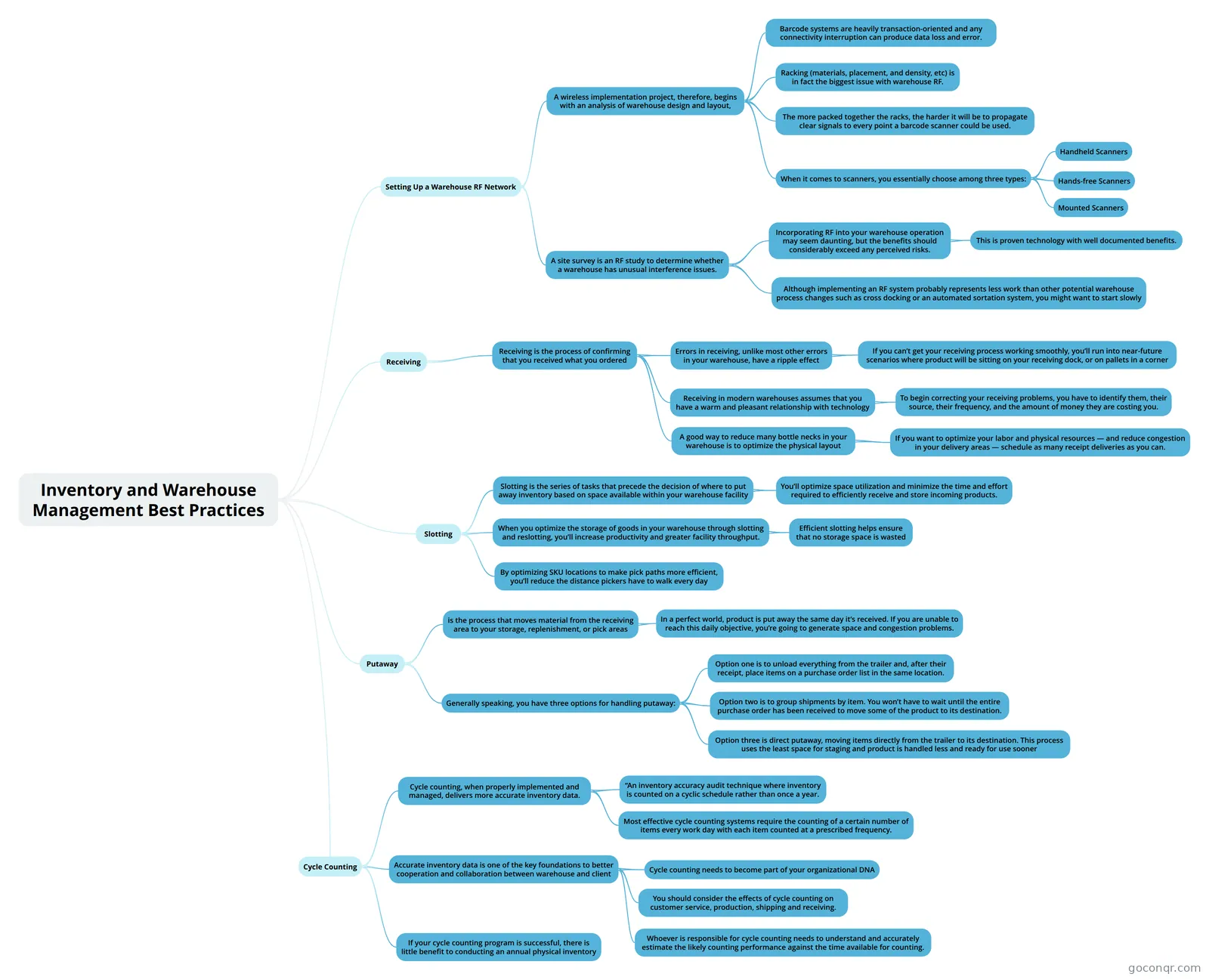
Mind map: Inventory and warehouse management best practices
Map content
Inventory and Warehouse Management Best Practices
Setting Up a Warehouse RF Network
- A wireless implementation project, therefore, begins with an analysis of warehouse design and layout,
- Barcode systems are heavily transaction-oriented and any connectivity interruption can produce data loss and error.
- Racking (materials, placement, and density, etc) is in fact the biggest issue with warehouse RF.
- The more packed together the racks, the harder it will be to propagate clear signals to every point a barcode scanner could be used.
- When it comes to scanners, you essentially choose among three types:
- Handheld Scanners
- Hands-free Scanners
- Mounted Scanners
- A site survey is an RF study to determine whether a warehouse has unusual interference issues.
- Incorporating RF into your warehouse operation may seem daunting, but the benefits should considerably exceed any perceived risks.
- This is proven technology with well documented benefits.
- Although implementing an RF system probably represents less work than other potential warehouse process changes such as cross docking or an automated sortation system, you might want to start slowly
- Incorporating RF into your warehouse operation may seem daunting, but the benefits should considerably exceed any perceived risks.
- A wireless implementation project, therefore, begins with an analysis of warehouse design and layout,
Receiving
- Receiving is the process of confirming that you received what you ordered
- Errors in receiving, unlike most other errors in your warehouse, have a ripple effect
- If you can’t get your receiving process working smoothly, you’ll run into near-future scenarios where product will be sitting on your receiving dock, or on pallets in a corner
- Receiving in modern warehouses assumes that you have a warm and pleasant relationship with technology
- To begin correcting your receiving problems, you have to identify them, their source, their frequency, and the amount of money they are costing you.
- A good way to reduce many bottle necks in your warehouse is to optimize the physical layout
- If you want to optimize your labor and physical resources — and reduce congestion in your delivery areas — schedule as many receipt deliveries as you can.
- Errors in receiving, unlike most other errors in your warehouse, have a ripple effect
- Receiving is the process of confirming that you received what you ordered
Slotting
- Slotting is the series of tasks that precede the decision of where to put away inventory based on space available within your warehouse facility
- You’ll optimize space utilization and minimize the time and effort required to efficiently receive and store incoming products.
- When you optimize the storage of goods in your warehouse through slotting and reslotting, you’ll increase productivity and greater facility throughput.
- Efficient slotting helps ensure that no storage space is wasted
- By optimizing SKU locations to make pick paths more efficient, you’ll reduce the distance pickers have to walk every day
- Slotting is the series of tasks that precede the decision of where to put away inventory based on space available within your warehouse facility
Putaway
- is the process that moves material from the receiving area to your storage, replenishment, or pick areas
- In a perfect world, product is put away the same day it’s received. If you are unable to reach this daily objective, you’re going to generate space and congestion problems.
- Generally speaking, you have three options for handling putaway:
- Option one is to unload everything from the trailer and, after their receipt, place items on a purchase order list in the same location.
- Option two is to group shipments by item. You won’t have to wait until the entire purchase order has been received to move some of the product to its destination.
- Option three is direct putaway, moving items directly from the trailer to its destination. This process uses the least space for staging and product is handled less and ready for use sooner
- is the process that moves material from the receiving area to your storage, replenishment, or pick areas
Cycle Counting
- Cycle counting, when properly implemented and managed, delivers more accurate inventory data.
- “An inventory accuracy audit technique where inventory is counted on a cyclic schedule rather than once a year.
- Most effective cycle counting systems require the counting of a certain number of items every work day with each item counted at a prescribed frequency.
- Accurate inventory data is one of the key foundations to better cooperation and collaboration between warehouse and client
- Cycle counting needs to become part of your organizational DNA
- You should consider the effects of cycle counting on customer service, production, shipping and receiving.
- Whoever is responsible for cycle counting needs to understand and accurately estimate the likely counting performance against the time available for counting.
- If your cycle counting program is successful, there is little benefit to conducting an annual physical inventory
- Cycle counting, when properly implemented and managed, delivers more accurate inventory data.
Information
- Description
- Mind Map on Inventory and Warehouse Management Best Practices, created by Tania Usi on 12/08/2022.
- Created by
- Tania Usi
- Views
- 0
- Rating