
Mind map
UNIT 3 - TOPIC 2 Phonology and intonation
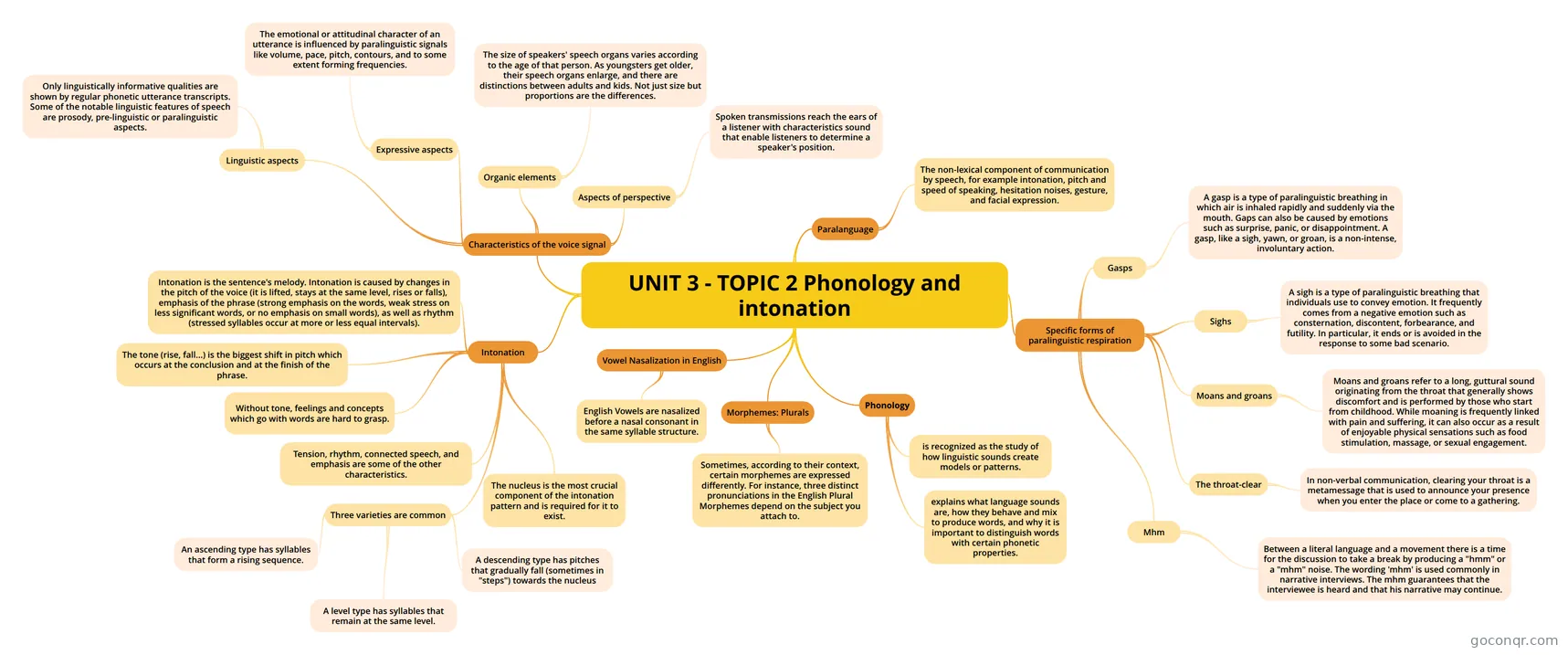
Mind map: Phonology and intonation
Map content
UNIT 3 - TOPIC 2 Phonology and intonation
Phonology
- is recognized as the study of how linguistic sounds create models or patterns.
- explains what language sounds are, how they behave and mix to produce words, and why it is important to distinguish words with certain phonetic properties.
Morphemes: Plurals
- Sometimes, according to their context, certain morphemes are expressed differently. For instance, three distinct pronunciations in the English Plural Morphemes depend on the subject you attach to.
Vowel Nasalization in English
- English Vowels are nasalized before a nasal consonant in the same syllable structure.
Intonation
- Without tone, feelings and concepts which go with words are hard to grasp.
- Tension, rhythm, connected speech, and emphasis are some of the other characteristics.
- Intonation is the sentence's melody. Intonation is caused by changes in the pitch of the voice (it is lifted, stays at the same level, rises or falls), emphasis of the phrase (strong emphasis on the words, weak stress on less significant words, or no emphasis on small words), as well as rhythm (stressed syllables occur at more or less equal intervals).
- The tone (rise, fall...) is the biggest shift in pitch which occurs at the conclusion and at the finish of the phrase.
- The nucleus is the most crucial component of the intonation pattern and is required for it to exist.
- Three varieties are common
- A descending type has pitches that gradually fall (sometimes in "steps") towards the nucleus
- An ascending type has syllables that form a rising sequence.
- A level type has syllables that remain at the same level.
Paralanguage
- The non-lexical component of communication by speech, for example intonation, pitch and speed of speaking, hesitation noises, gesture, and facial expression.
Characteristics of the voice signal
- Aspects of perspective
- Spoken transmissions reach the ears of a listener with characteristics sound that enable listeners to determine a speaker's position.
- Organic elements
- The size of speakers' speech organs varies according to the age of that person. As youngsters get older, their speech organs enlarge, and there are distinctions between adults and kids. Not just size but proportions are the differences.
- Expressive aspects
- The emotional or attitudinal character of an utterance is influenced by paralinguistic signals like volume, pace, pitch, contours, and to some extent forming frequencies.
- Linguistic aspects
- Only linguistically informative qualities are shown by regular phonetic utterance transcripts. Some of the notable linguistic features of speech are prosody, pre-linguistic or paralinguistic aspects.
- Aspects of perspective
Specific forms of paralinguistic respiration
- Gasps
- A gasp is a type of paralinguistic breathing in which air is inhaled rapidly and suddenly via the mouth. Gaps can also be caused by emotions such as surprise, panic, or disappointment. A gasp, like a sigh, yawn, or groan, is a non-intense, involuntary action.
- Sighs
- A sigh is a type of paralinguistic breathing that individuals use to convey emotion. It frequently comes from a negative emotion such as consternation, discontent, forbearance, and futility. In particular, it ends or is avoided in the response to some bad scenario.
- Moans and groans
- Moans and groans refer to a long, guttural sound originating from the throat that generally shows discomfort and is performed by those who start from childhood. While moaning is frequently linked with pain and suffering, it can also occur as a result of enjoyable physical sensations such as food stimulation, massage, or sexual engagement.
- The throat-clear
- In non-verbal communication, clearing your throat is a metamessage that is used to announce your presence when you enter the place or come to a gathering.
- Mhm
- Between a literal language and a movement there is a time for the discussion to take a break by producing a "hmm" or a "mhm" noise. The wording 'mhm' is used commonly in narrative interviews. The mhm guarantees that the interviewee is heard and that his narrative may continue.
- Gasps
Information
- Description
- Mind Map on UNIT 3 - TOPIC 2 Phonology and intonation, created by Kimberly Falconi on 11/09/2022.
- Created by
- Kimberly Falconi
- Views
- 1
- Rating
More on Stress, Intonation and Suprasegmental Features