
Mind map
Security Metrics in the Supply Chain
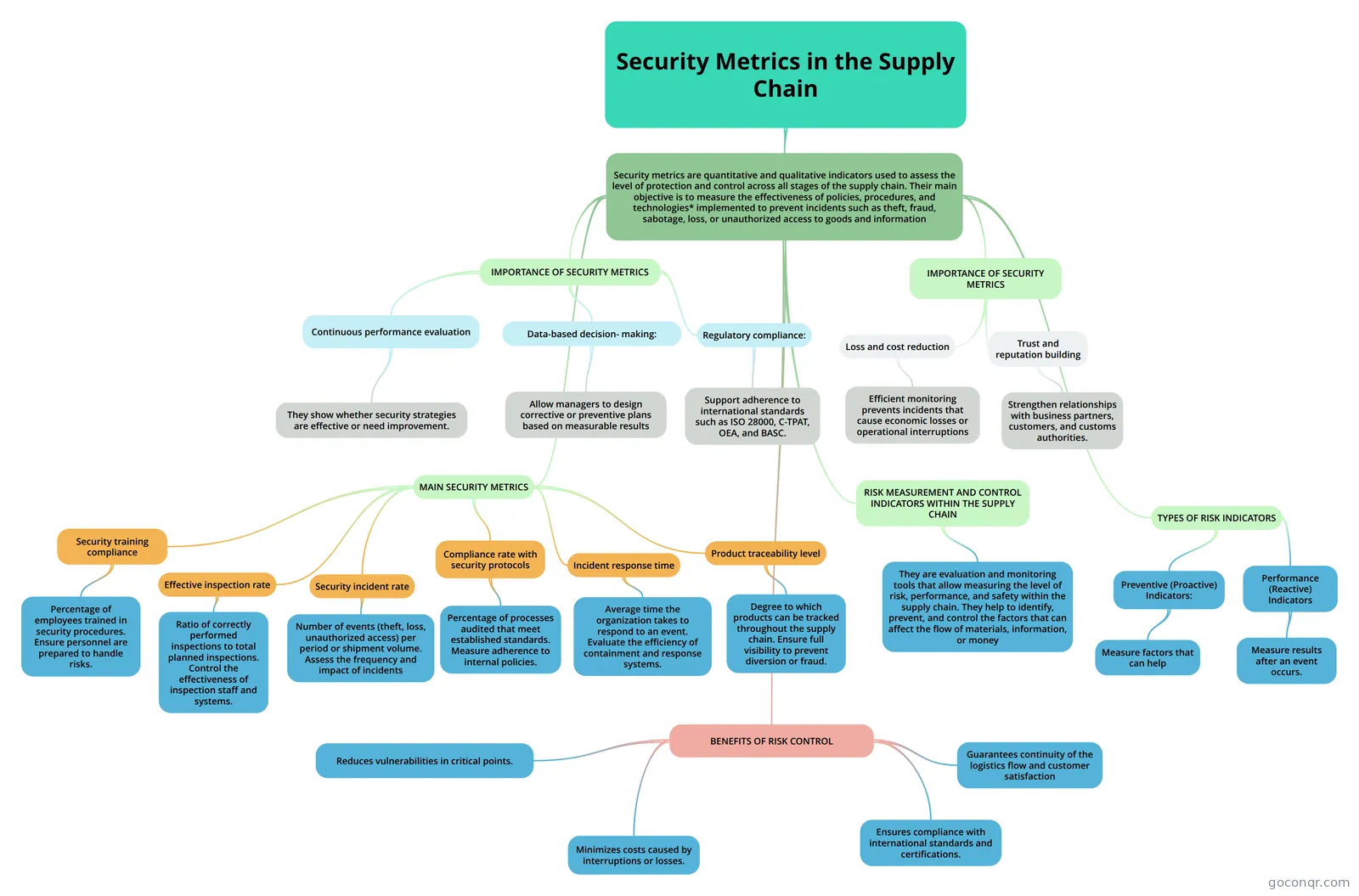
Mind map: Security Metrics in the Supply Chain
Map content
Security Metrics in the Supply Chain
Security metrics are quantitative and qualitative indicators used to assess the level of protection and control across all stages of the supply chain. Their main objective is to measure the effectiveness of policies, procedures, and technologies* implemented to prevent incidents such as theft, fraud, sabotage, loss, or unauthorized access to goods and information
- IMPORTANCE OF SECURITY METRICS
- Continuous performance evaluation
- They show whether security strategies are effective or need improvement.
- Data-based decision- making:
- Allow managers to design corrective or preventive plans based on measurable results
- Regulatory compliance:
- Support adherence to international standards such as ISO 28000, C-TPAT, OEA, and BASC.
- Continuous performance evaluation
- IMPORTANCE OF SECURITY METRICS
- Loss and cost reduction
- Efficient monitoring prevents incidents that cause economic losses or operational interruptions
- Trust and reputation building
- Strengthen relationships with business partners, customers, and customs authorities.
- Loss and cost reduction
- MAIN SECURITY METRICS
- Security incident rate
- Number of events (theft, loss, unauthorized access) per period or shipment volume. Assess the frequency and impact of incidents
- Compliance rate with security protocols
- Percentage of processes audited that meet established standards. Measure adherence to internal policies.
- Incident response time
- Average time the organization takes to respond to an event. Evaluate the efficiency of containment and response systems.
- Effective inspection rate
- Ratio of correctly performed inspections to total planned inspections. Control the effectiveness of inspection staff and systems.
- Product traceability level
- Degree to which products can be tracked throughout the supply chain. Ensure full visibility to prevent diversion or fraud.
- Security training compliance
- Percentage of employees trained in security procedures. Ensure personnel are prepared to handle risks.
- Security incident rate
- RISK MEASUREMENT AND CONTROL INDICATORS WITHIN THE SUPPLY CHAIN
- They are evaluation and monitoring tools that allow measuring the level of risk, performance, and safety within the supply chain. They help to identify, prevent, and control the factors that can affect the flow of materials, information, or money
- TYPES OF RISK INDICATORS
- Performance (Reactive) Indicators
- Measure results after an event occurs.
- Preventive (Proactive) Indicators:
- Measure factors that can help
- Performance (Reactive) Indicators
- BENEFITS OF RISK CONTROL
- Reduces vulnerabilities in critical points.
- Minimizes costs caused by interruptions or losses.
- Ensures compliance with international standards and certifications.
- Guarantees continuity of the logistics flow and customer satisfaction
- IMPORTANCE OF SECURITY METRICS
Information
- Description
- Mind Map on Security Metrics in the Supply Chain, created by ISAAC RIVERA SANCHEZ on 26/11/2025.
- Created by
- ISAAC RIVERA SANCHEZ
- Views
- 4
- Rating