
Mind map
1_Headwords
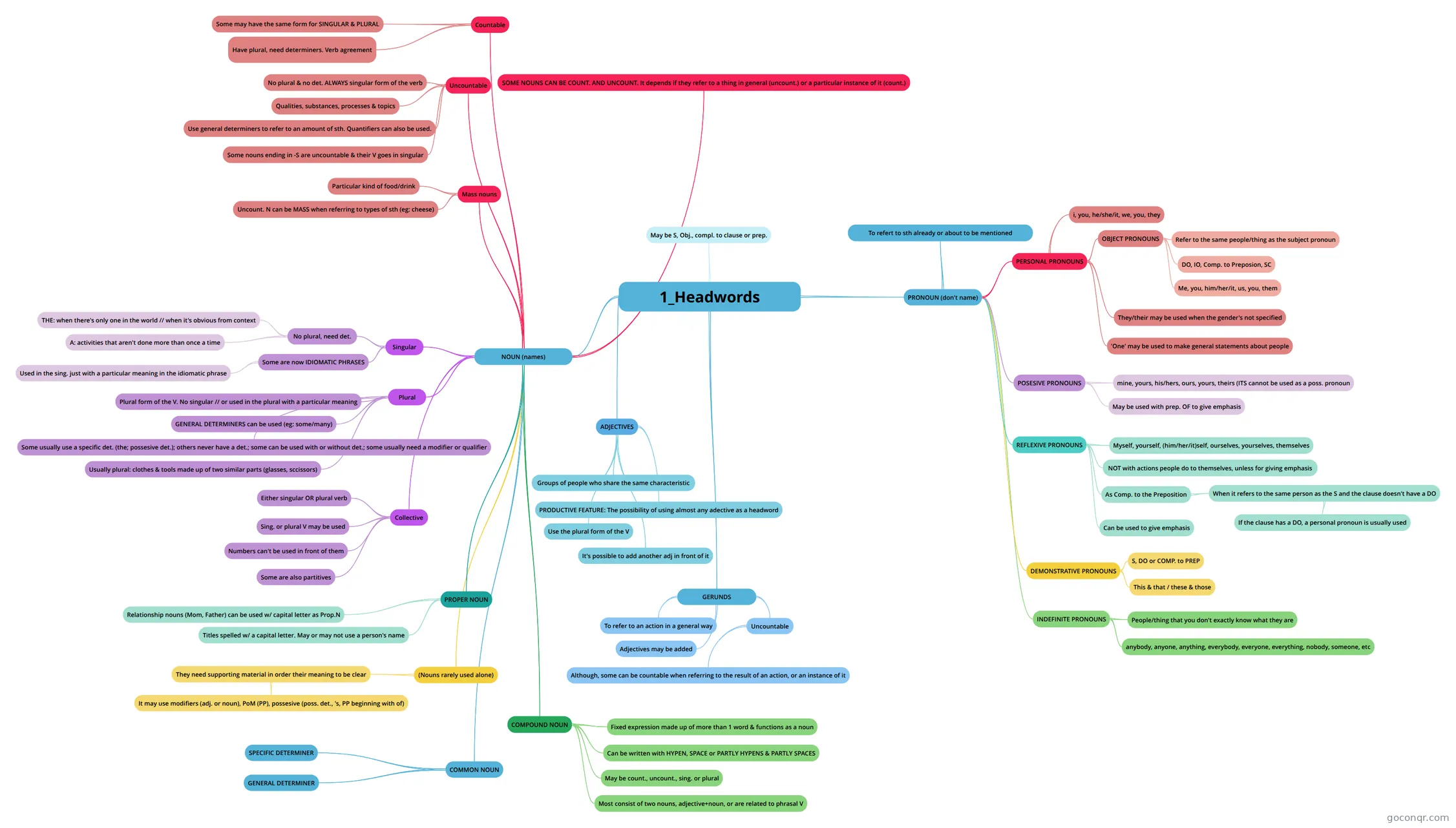
Mind map: Headwords in English grammar
Map content
1_Headwords
NOUN (names)
- PROPER NOUN
- Relationship nouns (Mom, Father) can be used w/ capital letter as Prop.N
- Titles spelled w/ a capital letter. May or may not use a person's name
- COMMON NOUN
- SPECIFIC DETERMINER
- GENERAL DETERMINER
- Countable
- Have plural, need determiners. Verb agreement
- Some may have the same form for SINGULAR & PLURAL
- Uncountable
- No plural & no det. ALWAYS singular form of the verb
- Qualities, substances, processes & topics
- Use general determiners to refer to an amount of sth. Quantifiers can also be used.
- Some nouns ending in -S are uncountable & their V goes in singular
- Singular
- No plural, need det.
- THE: when there's only one in the world // when it's obvious from context
- A: activities that aren't done more than once a time
- Some are now IDIOMATIC PHRASES
- Used in the sing. just with a particular meaning in the idiomatic phrase
- No plural, need det.
- Plural
- Plural form of the V. No singular // or used in the plural with a particular meaning
- GENERAL DETERMINERS can be used (eg: some/many)
- Some usually use a specific det. (the; possesive det.); others never have a det.; some can be used with or without det.; some usually need a modifier or qualifier
- Usually plural: clothes & tools made up of two similar parts (glasses, sccissors)
- Collective
- Either singular OR plural verb
- Sing. or plural V may be used
- Numbers can't be used in front of them
- Some are also partitives
- Mass nouns
- Particular kind of food/drink
- Uncount. N can be MASS when referring to types of sth (eg: cheese)
- SOME NOUNS CAN BE COUNT. AND UNCOUNT. It depends if they refer to a thing in general (uncount.) or a particular instance of it (count.)
- (Nouns rarely used alone)
- They need supporting material in order their meaning to be clear
- It may use modifiers (adj. or noun), PoM (PP), possesive (poss. det., 's, PP beginning with of)
- They need supporting material in order their meaning to be clear
- COMPOUND NOUN
- Fixed expression made up of more than 1 word & functions as a noun
- Can be written with HYPEN, SPACE or PARTLY HYPENS & PARTLY SPACES
- May be count., uncount., sing. or plural
- Most consist of two nouns, adjective+noun, or are related to phrasal V
- PROPER NOUN
PRONOUN (don't name)
- To refert to sth already or about to be mentioned
- PERSONAL PRONOUNS
- i, you, he/she/it, we, you, they
- OBJECT PRONOUNS
- Refer to the same people/thing as the subject pronoun
- DO, IO, Comp. to Preposion, SC
- Me, you, him/her/it, us, you, them
- They/their may be used when the gender's not specified
- 'One' may be used to make general statements about people
- POSESIVE PRONOUNS
- mine, yours, his/hers, ours, yours, theirs (ITS cannot be used as a poss. pronoun
- May be used with prep. OF to give emphasis
- REFLEXIVE PRONOUNS
- Myself, yourself, (him/her/it)self, ourselves, yourselves, themselves
- NOT with actions people do to themselves, unless for giving emphasis
- As Comp. to the Preposition
- When it refers to the same person as the S and the clause doesn't have a DO
- If the clause has a DO, a personal pronoun is usually used
- When it refers to the same person as the S and the clause doesn't have a DO
- Can be used to give emphasis
- DEMONSTRATIVE PRONOUNS
- S, DO or COMP. to PREP
- This & that / these & those
- INDEFINITE PRONOUNS
- People/thing that you don't exactly know what they are
- anybody, anyone, anything, everybody, everyone, everything, nobody, someone, etc
May be S, Obj., compl. to clause or prep.
ADJECTIVES
- Groups of people who share the same characteristic
- PRODUCTIVE FEATURE: The possibility of using almost any adective as a headword
- Use the plural form of the V
- It's possible to add another adj in front of it
GERUNDS
- To refer to an action in a general way
- Uncountable
- Although, some can be countable when referring to the result of an action, or an instance of it
- Adjectives may be added
Information
- Description
- Gramática Inglesa I Mind Map on 1_Headwords, created by María Melina on 27/07/2016.
- Created by
- María Melina
- Views
- 0
- History
-
- Created by María Melina · Jul 27, 2016
- Copied by María Melina · Jul 27, 2016
- Rating
More on Types and functions of nouns