
Mind map
COUNTRY INDIA THE BASIC
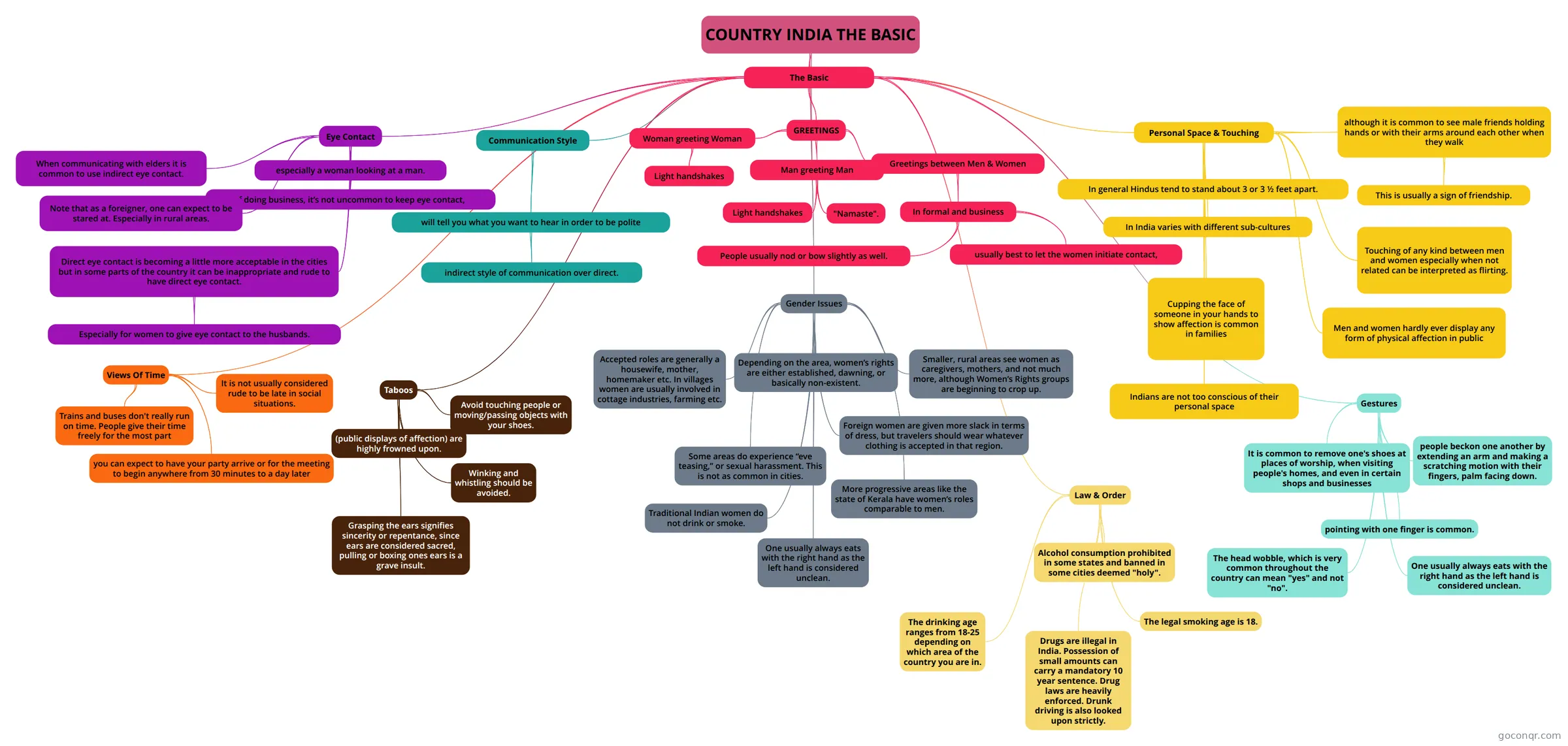
Mind map: Country India the basic
Map content
COUNTRY INDIA THE BASIC
The Basic
- GREETINGS
- Man greeting Man
- Light handshakes
- "Namaste".
- Woman greeting Woman
- Light handshakes
- Greetings between Men & Women
- In formal and business
- usually best to let the women initiate contact,
- People usually nod or bow slightly as well.
- In formal and business
- Man greeting Man
- Communication Style
- will tell you what you want to hear in order to be polite
- indirect style of communication over direct.
- will tell you what you want to hear in order to be polite
- Personal Space & Touching
- In general Hindus tend to stand about 3 or 3 ½ feet apart.
- In India varies with different sub-cultures
- Indians are not too conscious of their personal space
- although it is common to see male friends holding hands or with their arms around each other when they walk
- This is usually a sign of friendship.
- Men and women hardly ever display any form of physical affection in public
- Touching of any kind between men and women especially when not related can be interpreted as flirting.
- Cupping the face of someone in your hands to show affection is common in families
- Eye Contact
- especially a woman looking at a man.
- If doing business, it’s not uncommon to keep eye contact,
- Note that as a foreigner, one can expect to be stared at. Especially in rural areas.
- When communicating with elders it is common to use indirect eye contact.
- Direct eye contact is becoming a little more acceptable in the cities but in some parts of the country it can be inappropriate and rude to have direct eye contact.
- Especially for women to give eye contact to the husbands.
- especially a woman looking at a man.
- Views Of Time
- you can expect to have your party arrive or for the meeting to begin anywhere from 30 minutes to a day later
- It is not usually considered rude to be late in social situations.
- Trains and buses don't really run on time. People give their time freely for the most part
- Gestures
- It is common to remove one's shoes at places of worship, when visiting people's homes, and even in certain shops and businesses
- people beckon one another by extending an arm and making a scratching motion with their fingers, palm facing down.
- The head wobble, which is very common throughout the country can mean "yes" and not "no".
- pointing with one finger is common.
- One usually always eats with the right hand as the left hand is considered unclean.
- Taboos
- (public displays of affection) are highly frowned upon.
- Avoid touching people or moving/passing objects with your shoes.
- Winking and whistling should be avoided.
- Grasping the ears signifies sincerity or repentance, since ears are considered sacred, pulling or boxing ones ears is a grave insult.
- Law & Order
- Alcohol consumption prohibited in some states and banned in some cities deemed "holy".
- The drinking age ranges from 18-25 depending on which area of the country you are in.
- The legal smoking age is 18.
- Drugs are illegal in India. Possession of small amounts can carry a mandatory 10 year sentence. Drug laws are heavily enforced. Drunk driving is also looked upon strictly.
- GREETINGS
Gender Issues
- Depending on the area, women’s rights are either established, dawning, or basically non-existent.
- Smaller, rural areas see women as caregivers, mothers, and not much more, although Women’s Rights groups are beginning to crop up.
- More progressive areas like the state of Kerala have women’s roles comparable to men.
- Foreign women are given more slack in terms of dress, but travelers should wear whatever clothing is accepted in that region.
- Some areas do experience “eve teasing,” or sexual harassment. This is not as common in cities.
- Accepted roles are generally a housewife, mother, homemaker etc. In villages women are usually involved in cottage industries, farming etc.
- Traditional Indian women do not drink or smoke.
- One usually always eats with the right hand as the left hand is considered unclean.
Information
- Description
- conceptual map of India Part 1 Present by: Angela Prada C
- Created by
- Angela Prada Casas
- Views
- 14
- Rating