
Mind map
Population Growth
Map content
Population Growth
The concept of Exponential Growth
- During cell division one cell becomes two.
- Many Bacteria have minimum generation times of 0.5-6 h
- Exponential Growth
- It beginning with a single cell having a doubling time of 30 min.
- Where the number of cells doubles during a constant time interval
- Semilogarithic graphs are also convenient to use to estimate the generation time of a microbial culture.
- The consequences of exponential growth
- The increase in cell number is initially rather slow.
- Increases at an ever faster rate.
- For a nonsterile and nutrient-rich food product
- For a nonsterile and nutrient-rich food product to stand at room temperature for a few hours during the early stages of exponential growth, is not detrimental
- These harmless organisms grow only very slowly at refrigeration temperatures (-4°C)
- For a nonsterile and nutrient-rich food product to stand at room temperature for a few hours during the early stages of exponential growth, is not detrimental
- The increase in cell number is initially rather slow.
- The consequences of exponential growth
The mathematics of Exponential Growth
- The increase in cell number in an exponentially growing bacterial culture approaches a geometric progression of the number 2.
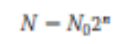
- A fixed relationship exists between the initial number of cells in the culture and the number present after a period of exponential growth:
- N is the final cell number, N0 is the initial cell number, and n is the number of generations during the period of exponential growth
- The generation time of the exponentially growing population is t/n ( t is the duration of exponential growth).
- Other Growth Expressions
- g can be calculated from the slope of the straight-line function obtained in a semilogarithmic plot of exponential growth
- The slope is equal to 0.301*n/t
- g can be calculated from the slope of the straight-line function obtained in a semilogarithmic plot of exponential growth
- Other Growth Expressions
- A fixed relationship exists between the initial number of cells in the culture and the number present after a period of exponential growth:
- The increase in cell number in an exponentially growing bacterial culture approaches a geometric progression of the number 2.
The Microbial Growth Cycle
- An organism growing in an enclosed vessel, cannot grow exponentially indefinitely.
- Instead, a typical growth curve for the population is obtained.
- Lag phase
- When a microbial culture is inoculated into a fresh medium, growth usually begins only after a period of time.
- If the inoculum is taken from an old culture and transferred into the same medium, there is usually a lag .
- A lag also ensues when the inoculum consists of cell that have been damaged by significant temperature shifts, radiation or toxic chemicals.
- Exponential Phases
- Cells in exponential growth
- Are typically in their healthiest state and most desirable for studies of their enzymes or other cell components.
- Rates of exponential growth vary greatly.
- It is influenced by environmental conditions, as well as by genetic characteristics of the organism itself.
- Stationary Phase
- In a batch culture exponential growth is limited.
- Typically, either one or both of two situations limit growth
- An essential nutrient of the culture medium is used up
- A waste product of the organism accumulates in the medium and inhibits growth.
- Death Phase
- If incubation continues after a population reaches the stationary phase, the cells may remain alive and continue to metabolize
- They eventually die.
- If incubation continues after a population reaches the stationary phase, the cells may remain alive and continue to metabolize
- Cells in exponential growth
Images and files in the map
Information
- Description
- Mind Map on Population Growth, created by Susana Aparicio on 07/02/2017.
- Created by
- Susana Aparicio
- Views
- 0
- Rating