
Mind map
Justification of currency hedging
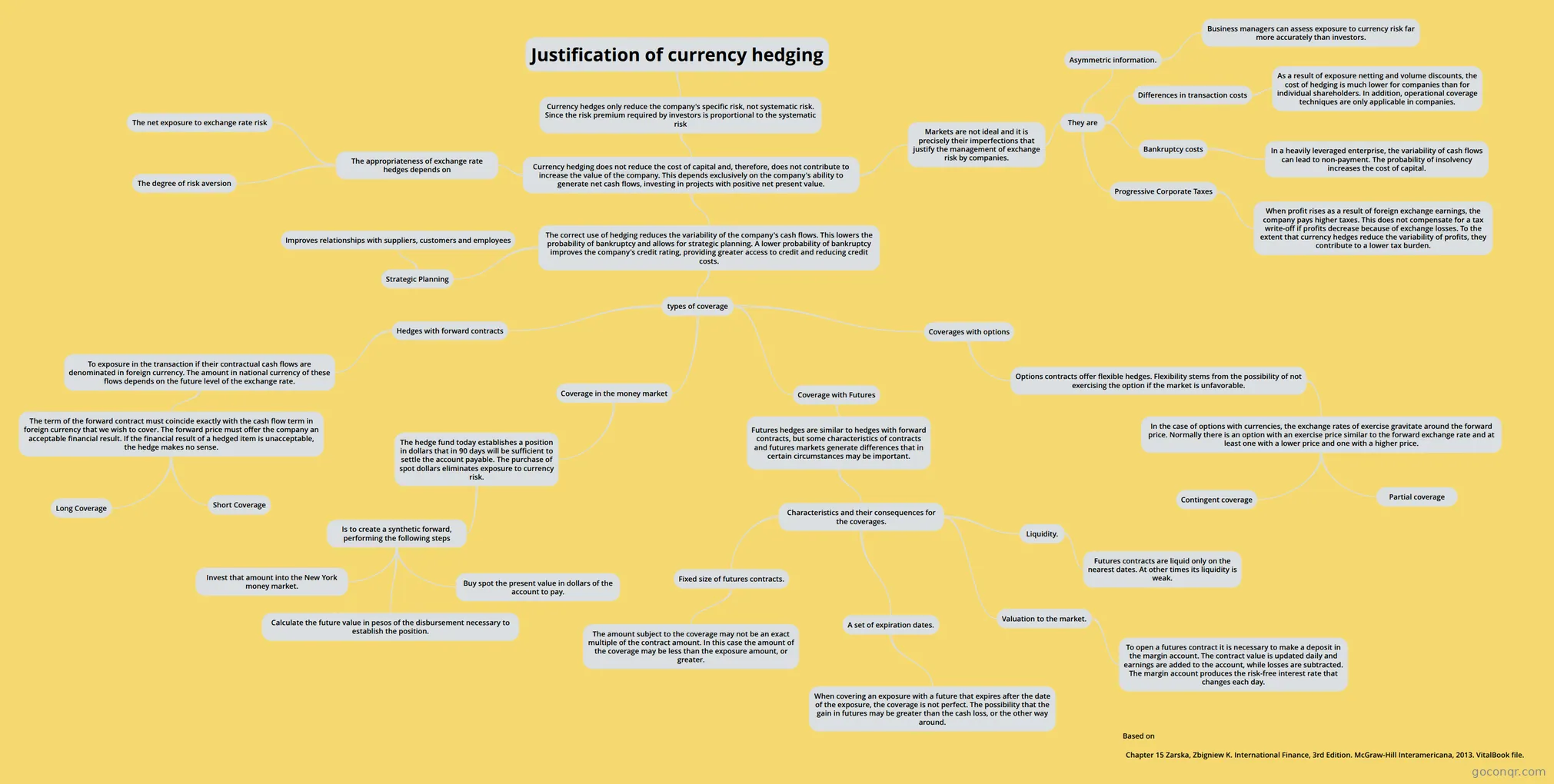
Mind map: Justification of currency hedging
Map content
Justification of currency hedging
Currency hedges only reduce the company's specific risk, not systematic risk. Since the risk premium required by investors is proportional to the systematic risk
- Currency hedging does not reduce the cost of capital and, therefore, does not contribute to increase the value of the company. This depends exclusively on the company's ability to generate net cash flows, investing in projects with positive net present value.
- The appropriateness of exchange rate hedges depends on
- The net exposure to exchange rate risk
- The degree of risk aversion
- Markets are not ideal and it is precisely their imperfections that justify the management of exchange risk by companies.
- They are
- Asymmetric information.
- Business managers can assess exposure to currency risk far more accurately than investors.
- Differences in transaction costs
- As a result of exposure netting and volume discounts, the cost of hedging is much lower for companies than for individual shareholders. In addition, operational coverage techniques are only applicable in companies.
- Bankruptcy costs
- In a heavily leveraged enterprise, the variability of cash flows can lead to non-payment. The probability of insolvency increases the cost of capital.
- Progressive Corporate Taxes
- When profit rises as a result of foreign exchange earnings, the company pays higher taxes. This does not compensate for a tax write-off if profits decrease because of exchange losses. To the extent that currency hedges reduce the variability of profits, they contribute to a lower tax burden.
- Asymmetric information.
- They are
- The correct use of hedging reduces the variability of the company's cash flows. This lowers the probability of bankruptcy and allows for strategic planning. A lower probability of bankruptcy improves the company's credit rating, providing greater access to credit and reducing credit costs.
- Strategic Planning
- Improves relationships with suppliers, customers and employees
- types of coverage
- Hedges with forward contracts
- To exposure in the transaction if their contractual cash flows are denominated in foreign currency. The amount in national currency of these flows depends on the future level of the exchange rate.
- The term of the forward contract must coincide exactly with the cash flow term in foreign currency that we wish to cover. The forward price must offer the company an acceptable financial result. If the financial result of a hedged item is unacceptable, the hedge makes no sense.
- Long Coverage
- Short Coverage
- The term of the forward contract must coincide exactly with the cash flow term in foreign currency that we wish to cover. The forward price must offer the company an acceptable financial result. If the financial result of a hedged item is unacceptable, the hedge makes no sense.
- To exposure in the transaction if their contractual cash flows are denominated in foreign currency. The amount in national currency of these flows depends on the future level of the exchange rate.
- Coverage in the money market
- The hedge fund today establishes a position in dollars that in 90 days will be sufficient to settle the account payable. The purchase of spot dollars eliminates exposure to currency risk.
- Is to create a synthetic forward, performing the following steps
- Buy spot the present value in dollars of the account to pay.
- Invest that amount into the New York money market.
- Calculate the future value in pesos of the disbursement necessary to establish the position.
- Is to create a synthetic forward, performing the following steps
- The hedge fund today establishes a position in dollars that in 90 days will be sufficient to settle the account payable. The purchase of spot dollars eliminates exposure to currency risk.
- Coverage with Futures
- Futures hedges are similar to hedges with forward contracts, but some characteristics of contracts and futures markets generate differences that in certain circumstances may be important.
- Characteristics and their consequences for the coverages.
- Fixed size of futures contracts.
- The amount subject to the coverage may not be an exact multiple of the contract amount. In this case the amount of the coverage may be less than the exposure amount, or greater.
- A set of expiration dates.
- When covering an exposure with a future that expires after the date of the exposure, the coverage is not perfect. The possibility that the gain in futures may be greater than the cash loss, or the other way around.
- Liquidity.
- Futures contracts are liquid only on the nearest dates. At other times its liquidity is weak.
- Valuation to the market.
- To open a futures contract it is necessary to make a deposit in the margin account. The contract value is updated daily and earnings are added to the account, while losses are subtracted. The margin account produces the risk-free interest rate that changes each day.
- Based on
- Chapter 15 Zarska, Zbigniew K. International Finance, 3rd Edition. McGraw-Hill Interamericana, 2013. VitalBook file.
- Based on
- To open a futures contract it is necessary to make a deposit in the margin account. The contract value is updated daily and earnings are added to the account, while losses are subtracted. The margin account produces the risk-free interest rate that changes each day.
- Fixed size of futures contracts.
- Characteristics and their consequences for the coverages.
- Futures hedges are similar to hedges with forward contracts, but some characteristics of contracts and futures markets generate differences that in certain circumstances may be important.
- Coverages with options
- Options contracts offer flexible hedges. Flexibility stems from the possibility of not exercising the option if the market is unfavorable.
- In the case of options with currencies, the exchange rates of exercise gravitate around the forward price. Normally there is an option with an exercise price similar to the forward exchange rate and at least one with a lower price and one with a higher price.
- Contingent coverage
- Partial coverage
- In the case of options with currencies, the exchange rates of exercise gravitate around the forward price. Normally there is an option with an exercise price similar to the forward exchange rate and at least one with a lower price and one with a higher price.
- Options contracts offer flexible hedges. Flexibility stems from the possibility of not exercising the option if the market is unfavorable.
- Hedges with forward contracts
- Strategic Planning
- The appropriateness of exchange rate hedges depends on
- Currency hedging does not reduce the cost of capital and, therefore, does not contribute to increase the value of the company. This depends exclusively on the company's ability to generate net cash flows, investing in projects with positive net present value.
Information
- Description
- Mind Map on Justification of currency hedging, created by chrystian fontecha on 20/03/2017.
- Created by
- chrystian fontecha
- Views
- 3
- Rating
More on Currency Risk Management