
Mind map
America Before Columbus (APUSH)
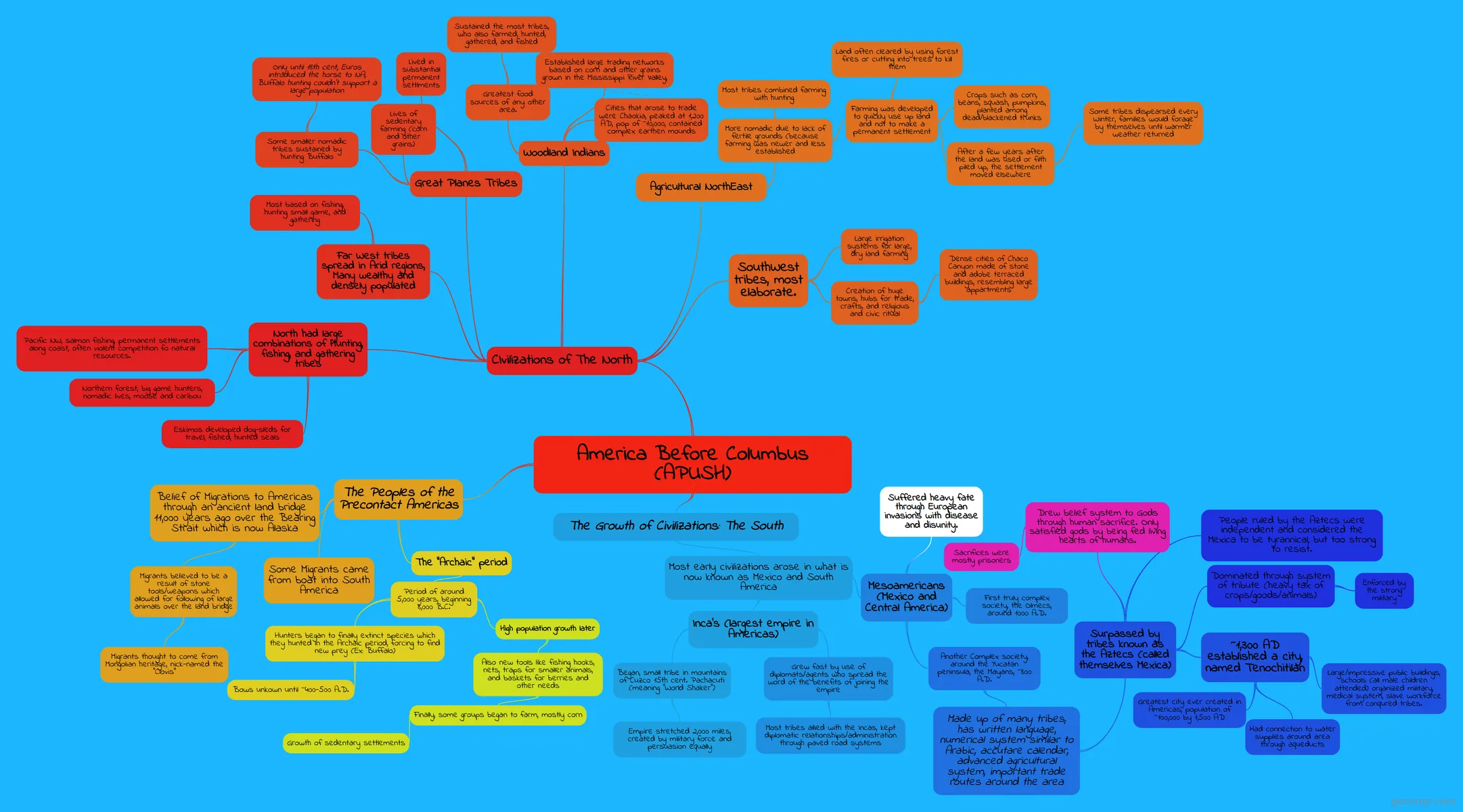
Mind map: America before Columbus APUSH
Map content
America Before Columbus (APUSH)
The Peoples of the Precontact Americas
- Belief of Migrations to Americas through an ancient land bridge 11,000 years ago over the Bearing Strait which is now Alaska
- Migrants believed to be a result of stone tools/weapons which allowed for following of large animals over the land bridge
- Migrants thought to come from Mongolian heritage, nick-named the "Clovis"
- Migrants believed to be a result of stone tools/weapons which allowed for following of large animals over the land bridge
- Some Migrants came from boat into South America
- The "Archaic" period
- Period of around 5,000 years, beginning 8,000 B.C.
- Hunters began to finally extinct species which they hunted in the Archaic period, forcing to find new prey (Ex: Buffalo)
- Bows unkown until ~400-500 A.D.
- High population growth later
- Also new tools like fishing hooks, nets, traps for smaller animals, and baskets for berries and other needs
- Finally, some groups began to farm, mostly corn
- Growth of sedentary settlements
- Finally, some groups began to farm, mostly corn
- Also new tools like fishing hooks, nets, traps for smaller animals, and baskets for berries and other needs
- Hunters began to finally extinct species which they hunted in the Archaic period, forcing to find new prey (Ex: Buffalo)
- Period of around 5,000 years, beginning 8,000 B.C.
- Belief of Migrations to Americas through an ancient land bridge 11,000 years ago over the Bearing Strait which is now Alaska
The Growth of Civilizations: The South
- Most early civilizations arose in what is now known as Mexico and South America
- Inca's (largest empire in Americas)
- Began, small tribe in mountains of Cuzco 15th cent. Pachacuti (meaning "World Shaker")
- Empire stretched 2,000 miles, created by military force and persuasion equally
- Grew fast by use of diplomats/agents who spread the word of the benefits of joining the empire
- Most tribes allied with the Incas, kept diplomatic relationships/administration through paved road systems
- Began, small tribe in mountains of Cuzco 15th cent. Pachacuti (meaning "World Shaker")
- Mesoamericans (Mexico and Central America)
- First truly complex society, the Olmecs, around 1000 A.D.
- Another Complex society, around the Yucatan peninsula, the Mayans, ~800 A.D.
- Made up of many tribes, has written language, numerical system similar to Arabic, accutare calendar, advanced agricultural system, important trade routes around the area
- Surpassed by tribes known as the Aztecs (called themselves Mexica)
- ~1,300 AD established a city, named Tenochitilan
- Greatest city ever created in Americas, population of ~100,000 by 1,500 AD
- Had connection to water supplies around area through aqueducts
- Large/impressive public buildings, schools (all male children attended) organized military, medical system, slave workforce from conqured tribes.
- Dominated through system of tribute (heavy tax of crops/goods/animals)
- Enforced by the strong military
- People ruled by the Aztecs were independent and considered the Mexica to be tyrannical, but too strong to resist.
- Drew belief system to Gods through human sacrifice. Only satisfied gods by being fed living hearts of humans.
- Sacrifices were mostly prisoners
- ~1,300 AD established a city, named Tenochitilan
- Surpassed by tribes known as the Aztecs (called themselves Mexica)
- Made up of many tribes, has written language, numerical system similar to Arabic, accutare calendar, advanced agricultural system, important trade routes around the area
- Suffered heavy fate through European invasions with disease and disunity.
- Inca's (largest empire in Americas)
- Most early civilizations arose in what is now known as Mexico and South America
CIvilizations of The North
- North had large combinations of Hunting, fishing, and gathering tribes
- Eskimos developed dog-sleds for travel, fished, hunted seals
- Northern forest, big game hunters, nomadic lives, moose and caribou
- Pacific NW, salmon fishing, permanent settlements along coast, often violent competition fo natural resources.
- Far West tribes spread in Arid regions, Many wealthy and densely populated
- Most based on fishing, hunting small game, and gathering
- SouthWest tribes, most elaborate.
- Large irrigation systems for large, dry land farming
- Creation of huge towns, hubs for trade, crafts, and religious and civic ritual
- Dense cities of Chaco Canyon made of stone and adobe terraced buildings, resembling large appartments
- Great Planes Tribes
- Lives of sedentary farming (corn and other grains)
- Lived in substantial permanent settlments
- Some smaller nomadic tribes sustained by hunting Buffalo
- Only until 18th cent, Euros introduced the horse to NA, BUffalo hunting couldn't support a large population
- Woodland Indians
- Greatest food sources of any other area.
- Sustained the most tribes, who also farmed, hunted, gathered, and fished
- Established large trading networks based on corn and other grains grown in the Mississippi River Valley,
- Cities that arose to trade were Chaokia, peaked at 1,200 AD, pop of ~10,000, contained complex earthen mounds
- Greatest food sources of any other area.
- Agricultural NorthEast
- More nomadic due to lack of fertile grounds (because farming was newer and less established
- Most tribes combined farming with hunting
- Farming was developed to quickly use up land and not to make a permanent settlement
- Land often cleared by using forest fires or cutting into trees to kill them
- Crops such as corn, beans, squash, pumpkins, planted among dead/blackened trunks
- After a few years after the land was used or filth piled up, the settlement moved elsewhere
- Some tribes dispearsed every Winter, families would forage by themselves until warmer weather returned
- More nomadic due to lack of fertile grounds (because farming was newer and less established
- North had large combinations of Hunting, fishing, and gathering tribes