
Mind map
Loco: 4. The Chef's Back
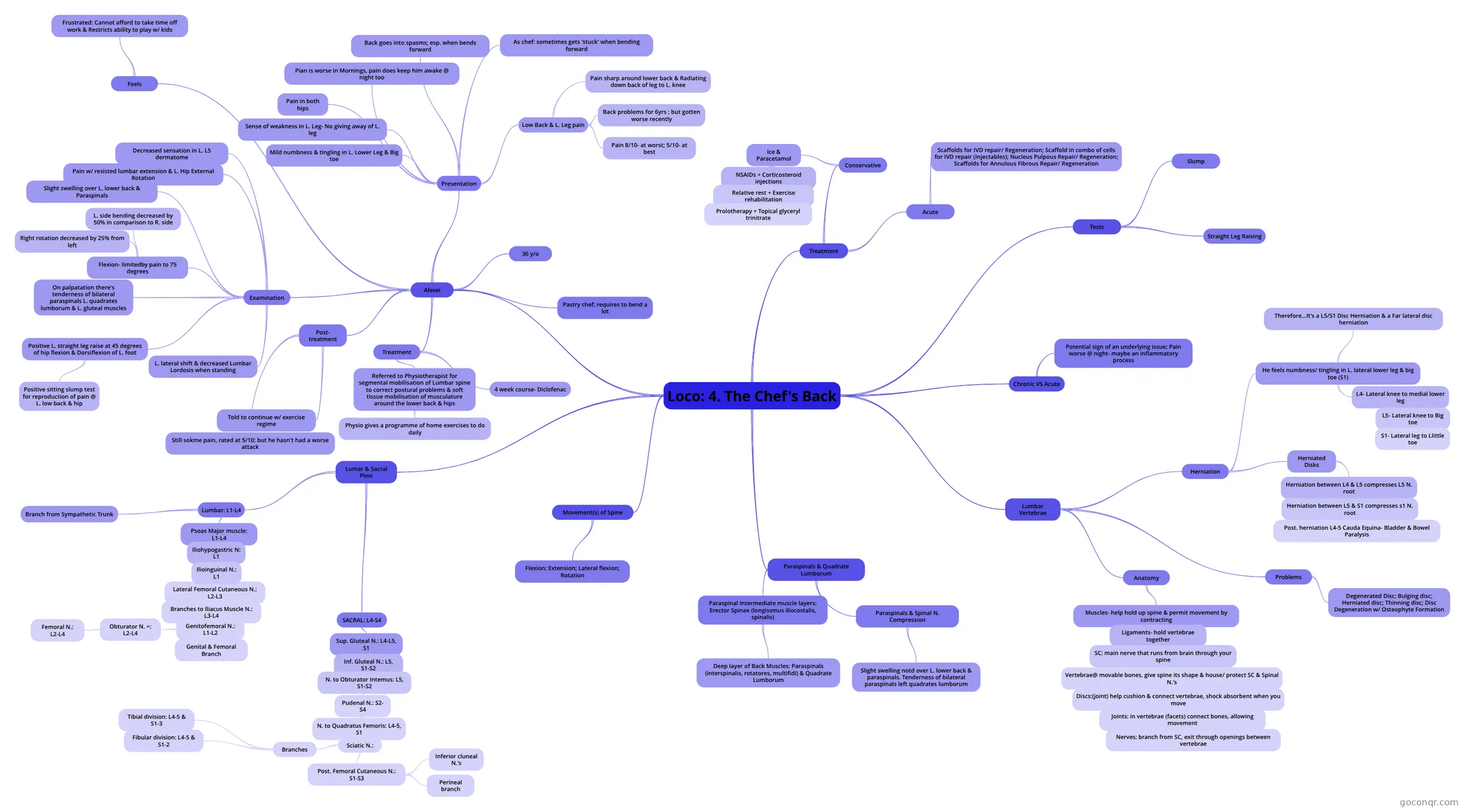
Mind map: Loco: 4. The Chef's Back
Map content
Loco: 4. The Chef's Back
Alexei
- 36 y/o
- Presentation
- Low Back & L. Leg pain
- Back problems for 6yrs ; but gotten worse recently
- Pain 8/10- at worst; 5/10- at best
- Pain sharp around lower back & Radiating down back of leg to L. knee
- Pain in both hips
- Back goes into spasms; esp. when bends forward
- As chef: sometimes gets 'stuck' when bending forward
- Mild numbness & tingling in L. Lower Leg & Big toe
- Sense of weakness in L. Leg- No giving away of L. leg
- Pian is worse in Mornings, pain does keep him awake @ night too
- Low Back & L. Leg pain
- Pastry chef; requires to bend a lot
- Feels
- Frustrated: Cannot afford to take time off work & Restricts ability to play w/ kids
- Examination
- L. lateral shift & decreased Lumbar Lordosis when standing
- Slight swelling over L. lower back & Paraspinals
- Flexion- limitedby pain to 75 degrees
- L. side bending decreased by 50% in comparison to R. side
- Right rotation decreased by 25% from left
- Pain w/ resisted lumbar extension & L. Hip External Rotation
- On palpatation there's tenderness of bilateral paraspinals L. quadrates lumborum & L. gluteal muscles
- Positive L. straight leg raise at 45 degrees of hip flexion & Dorsiflexion of L. foot
- Positive sitting slump test for reproduction of pain @ L. low back & hip
- Decreased sensation in L. L5 dermatome
- Treatment
- 4 week course- Diclofenac
- Referred to Physiotherapist for segmental mobilisation of Lumbar spine to correct postural problems & soft tissue mobilisation of musculature around the lower back & hips
- Physio gives a programme of home exercises to do daily
- Post- treatment
- Still sokme pain, rated at 5/10; but he hasn't had a worse attack
- Told to continue w/ exercise regime
Lumar & Sacral Plexi
- Lumbar: L1-L4
- Psoas Major muscle: L1-L4
- Iliohypogastric N: L1
- Ilioinguinal N.: L1
- Lateral Femoral Cutaneous N.: L2-L3
- Branches to Iliacus Muscle N.: L3-L4
- Genitofemoral N.: L1-L2
- Genital & Femoral Branch
- Obturator N. =: L2-L4
- Femoral N.: L2-L4
- Genitofemoral N.: L1-L2
- Branches to Iliacus Muscle N.: L3-L4
- Lateral Femoral Cutaneous N.: L2-L3
- Ilioinguinal N.: L1
- Iliohypogastric N: L1
- Branch from Sympathetic Trunk
- Psoas Major muscle: L1-L4
- SACRAL: L4-S4
- Sup. Gluteal N.: L4-L5, S1
- Inf. Gluteal N.: L5, S1-S2
- N. to Obturator Intemus: L5, S1-S2
- Pudenal N.: S2- S4
- N. to Quadratus Femoris: L4-5, S1
- Sciatic N.:
- Branches
- Fibular division: L4-5 & S1-2
- Tibial division: L4-5 & S1-3
- Post. Femoral Cutaneous N.: S1-S3
- Inferior cluneal N.'s
- Perineal branch
- Branches
- Sciatic N.:
- N. to Quadratus Femoris: L4-5, S1
- Pudenal N.: S2- S4
- N. to Obturator Intemus: L5, S1-S2
- Inf. Gluteal N.: L5, S1-S2
- Sup. Gluteal N.: L4-L5, S1
- Lumbar: L1-L4
Movement(s) of Spine
- Flexion; Extension; Lateral flexion; Rotation
Paraspinals & Quadrate Lumborum
- Paraspinal Intermediate muscle layers: Erector Spinae (longissmus iliocostalis, spinalis)
- Deep layer of Back Muscles: Paraspinals (interspinalis, rotatores, multifidi) & Quadrate Lumborum
- Paraspinals & Spinal N. Compression
- Slight swelling notd over L. lower back & paraspinals. Tenderness of bilateral paraspinals left quadrates lumborum
- Paraspinal Intermediate muscle layers: Erector Spinae (longissmus iliocostalis, spinalis)
Lumbar Vertebrae
- Problems
- Degenerated Disc; Bulging disc; Herniated disc; Thinning disc; Disc Degeneration w/ Osteophyte Formation
- Herniation
- Herniated Disks
- Herniation between L4 & L5 compresses L5 N. root
- Herniation between L5 & S1 compresses s1 N. root
- Post. herniation L4-5 Cauda Equina- Bladder & Bowel Paralysis
- Herniation between L5 & S1 compresses s1 N. root
- Herniation between L4 & L5 compresses L5 N. root
- He feels numbness/ tingling in L. lateral lower leg & big toe (S1)
- L4- Lateral knee to medial lower leg
- L5- Lateral knee to Big toe
- S1- Lateral leg to Llittle toe
- L5- Lateral knee to Big toe
- Therefore...It's a L5/S1 Disc Herniation & a Far lateral disc herniation
- L4- Lateral knee to medial lower leg
- Herniated Disks
- Anatomy
- Muscles- help hold up spine & permit movement by contracting
- Ligaments- hold vertebrae together
- SC: main nerve that runs from brain through your spine
- Vertebrae@ movable bones, give spine its shape & house/ protect SC & Spinal N.'s
- Discs:(joint) help cushion & connect vertebrae, shock absorbent when you move
- Joints: in vertebrae (facets) connect bones, allowing movement
- Nerves: branch from SC, exit through openings between vertebrae
- Joints: in vertebrae (facets) connect bones, allowing movement
- Discs:(joint) help cushion & connect vertebrae, shock absorbent when you move
- Vertebrae@ movable bones, give spine its shape & house/ protect SC & Spinal N.'s
- SC: main nerve that runs from brain through your spine
- Ligaments- hold vertebrae together
- Muscles- help hold up spine & permit movement by contracting
- Problems
Tests
- Slump
- Straight Leg Raising
Treatment
- Conservative
- Ice & Paracetamol
- NSAIDs + Corticosteroid injections
- Relative rest + Exercise rehabilitation
- Prolotherapy + Topical glyceryl trinitrate
- Relative rest + Exercise rehabilitation
- NSAIDs + Corticosteroid injections
- Ice & Paracetamol
- Acute
- Scaffolds for IVD repair/ Regeneration; Scaffold in combo of cells for IVD repair (Injectables); Nucleus Pulpous Repair/ Regeneration; Scaffolds for Annulous Fibrous Repair/ Regeneration
- Conservative
Chronic VS Acute
- Potential sign of an underlying issue; Pain worse @ night- maybe an inflammatory process
Information
- Description
- Mind Map on Loco: 4. The Chef's Back, created by daniwumiash on 20/07/2014.
- Created by
- daniwumiash
- Views
- 21
- Rating