
Mind map
PROJECT COST MANAGEMENT
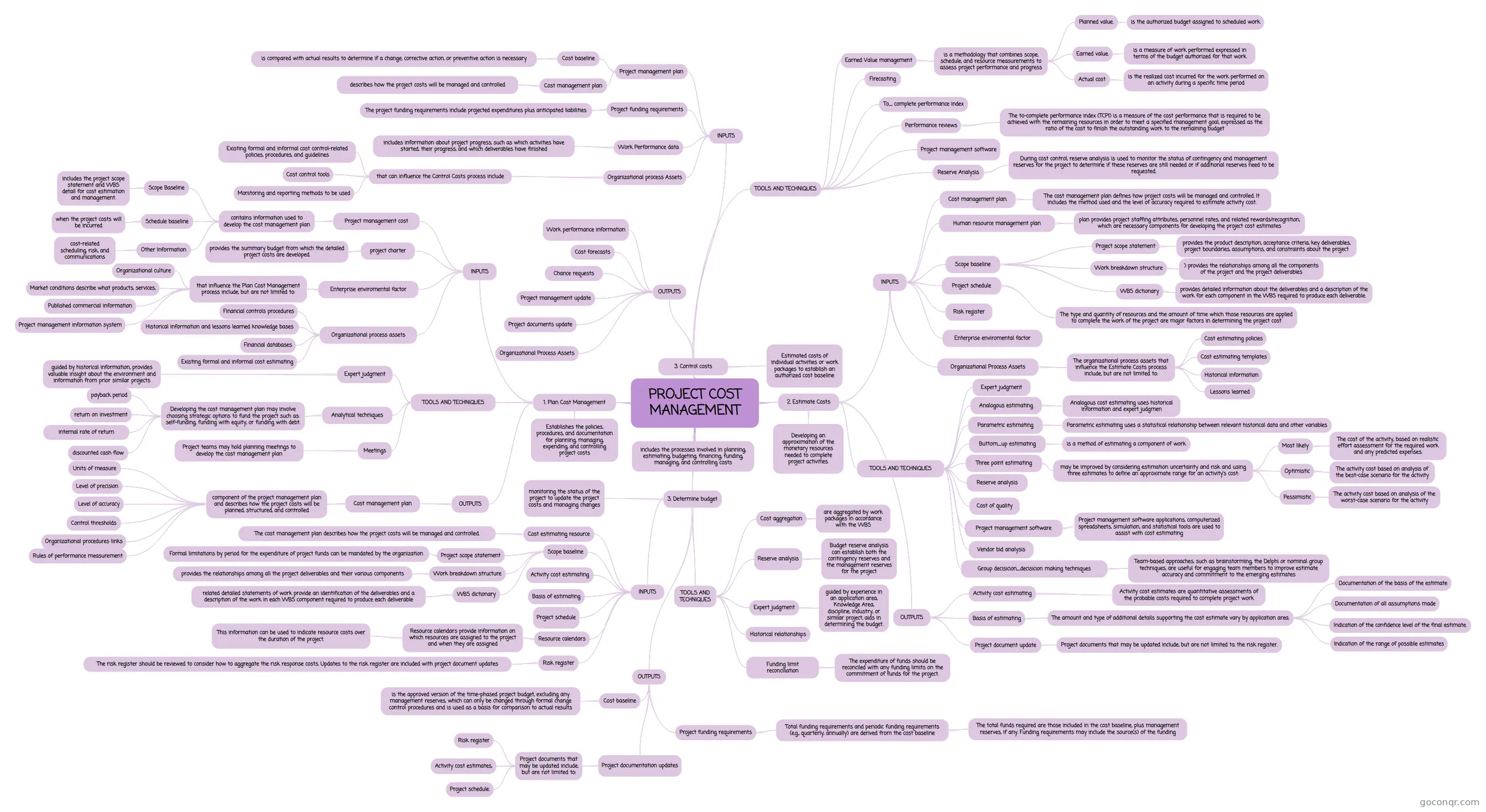
Mind map: Project cost management
Map content
PROJECT COST MANAGEMENT
includes the processes involved in planning, estimating, budgeting, financing, funding, managing, and controlling costs
1. Plan Cost Management
- Establishes the policies, procedures, and documentation for planning, managing, expending, and controlling project costs
- INPUTS
- Project management cost
- contains information used to develop the cost management plan
- Scope Baseline
- includes the project scope statement and WBS detail for cost estimation and management.
- Schedule baseline
- when the project costs will be incurred
- Other Information
- cost-related scheduling, risk, and communications
- Scope Baseline
- contains information used to develop the cost management plan
- project charter
- provides the summary budget from which the detailed project costs are developed.
- Enterprise enviromental factor
- that influence the Plan Cost Management process include, but are not limited to:
- Organizational culture
- Market conditions describe what products, services,
- Published commercial information
- Project management information system
- that influence the Plan Cost Management process include, but are not limited to:
- Organizational process assets
- Financial controls procedures
- Historical information and lessons learned knowledge bases
- Financial databases
- Existing formal and informal cost estimating
- Project management cost
- TOOLS AND TECHNIQUES
- Expert judgment
- guided by historical information, provides valuable insight about the environment and information from prior similar projects
- Analytical techniques
- Developing the cost management plan may involve choosing strategic options to fund the project such as: self-funding, funding with equity, or funding with debt.
- payback period
- return on investment
- internal rate of return
- discounted cash flow
- Developing the cost management plan may involve choosing strategic options to fund the project such as: self-funding, funding with equity, or funding with debt.
- Meetings
- Project teams may hold planning meetings to develop the cost management plan
- Expert judgment
- OUTPUTS
- Cost management plan
- component of the project management plan and describes how the project costs will be planned, structured, and controlled
- Units of measure
- Level of precision
- Level of accuracy
- Organizational procedures links
- Control thresholds
- Rules of performance measurement
- component of the project management plan and describes how the project costs will be planned, structured, and controlled
- Cost management plan
2. Estimate Costs
- Developing an approximation of the monetary resources needed to complete project activities.
- INPUTS
- Cost management plan.
- The cost management plan defines how project costs will be managed and controlled. It includes the method used and the level of accuracy required to estimate activity cost.
- Human resource management plan
- plan provides project staffing attributes, personnel rates, and related rewards/recognition, which are necessary components for developing the project cost estimates
- Scope baseline
- Project scope statement
- provides the product description, acceptance criteria, key deliverables, project boundaries, assumptions, and constraints about the project
- Work breakdown structure
- ) provides the relationships among all the components of the project and the project deliverables
- WBS dictionary
- provides detailed information about the deliverables and a description of the work for each component in the WBS required to produce each deliverable.
- Project scope statement
- Project schedule
- The type and quantity of resources and the amount of time which those resources are applied to complete the work of the project are major factors in determining the project cost
- Risk register
- Enterprise enviromental factor
- Organizational Process Assets
- The organizational process assets that influence the Estimate Costs process include, but are not limited to:
- Cost estimating policies
- Cost estimating templates
- Historical information
- Lessons learned
- The organizational process assets that influence the Estimate Costs process include, but are not limited to:
- Cost management plan.
- TOOLS AND TECHNIQUES
- Expert judgment
- Analogous estimating
- Analogous cost estimating uses historical information and expert judgmen
- Parametric estimating
- Parametric estimating uses a statistical relationship between relevant historical data and other variables
- Buttom_up estimating
- is a method of estimating a component of work
- Three point estimating
- may be improved by considering estimation uncertainty and risk and using three estimates to define an approximate range for an activity’s cost:
- Most likely
- The cost of the activity, based on realistic effort assessment for the required work and any predicted expenses.
- Optimistic
- The activity cost based on analysis of the best-case scenario for the activity
- Pessimistic
- The activity cost based on analysis of the worst-case scenario for the activity
- Most likely
- may be improved by considering estimation uncertainty and risk and using three estimates to define an approximate range for an activity’s cost:
- Reserve analysis
- Cost of quality
- Project management software
- Project management software applications, computerized spreadsheets, simulation, and statistical tools are used to assist with cost estimating
- Vendor bid analysis
- Group decisicion_decisicion making techniques
- Team-based approaches, such as brainstorming, the Delphi or nominal group techniques, are useful for engaging team members to improve estimate accuracy and commitment to the emerging estimates
- OUTPUTS
- Activity cost estimating
- Activity cost estimates are quantitative assessments of the probable costs required to complete project work
- Basis of estimating
- The amount and type of additional details supporting the cost estimate vary by application area.
- Documentation of the basis of the estimate
- Documentation of all assumptions made
- Indication of the confidence level of the final estimate.
- Indication of the range of possible estimates
- The amount and type of additional details supporting the cost estimate vary by application area.
- Project document update
- Project documents that may be updated include, but are not limited to, the risk register.
- Activity cost estimating
3. Control costs
- Estimated costs of individual activities or work packages to establish an authorized cost baseline
- INPUTS
- Project management plan
- Cost baseline
- is compared with actual results to determine if a change, corrective action, or preventive action is necessary
- Cost management plan
- describes how the project costs will be managed and controlled
- Cost baseline
- Project funding requirements
- The project funding requirements include projected expenditures plus anticipated liabilities
- Work Performance data
- includes information about project progress, such as which activities have started, their progress, and which deliverables have finished
- Organizational process Assets
- that can influence the Control Costs process include
- Existing formal and informal cost control-related policies, procedures, and guidelines
- Cost control tools
- Monitoring and reporting methods to be used
- that can influence the Control Costs process include
- Project management plan
- TOOLS AND TECHNIQUES
- Earned Value management
- is a methodology that combines scope, schedule, and resource measurements to assess project performance and progress
- Planned value.
- is the authorized budget assigned to scheduled work
- Earned value.
- is a measure of work performed expressed in terms of the budget authorized for that work
- Actual cost
- is the realized cost incurred for the work performed on an activity during a specific time period
- Planned value.
- is a methodology that combines scope, schedule, and resource measurements to assess project performance and progress
- Firecasting
- To_ complete performance index
- Performance reviews
- The to-complete performance index (TCPI) is a measure of the cost performance that is required to be achieved with the remaining resources in order to meet a specified management goal, expressed as the ratio of the cost to finish the outstanding work to the remaining budget
- Project management software
- Reserve Analysis
- During cost control, reserve analysis is used to monitor the status of contingency and management reserves for the project to determine if these reserves are still needed or if additional reserves need to be requested.
- Earned Value management
- OUTPUTS
- Work performance information
- Cost forecasts
- Chance requests
- Project management update
- Project documents update
- Organizational Process Assets
3. Determine budget
- monitoring the status of the project to update the project costs and managing changes
- INPUTS
- Cost estimating resource
- The cost management plan describes how the project costs will be managed and controlled.
- Scope baseline
- Project scope statement
- Formal limitations by period for the expenditure of project funds can be mandated by the organization
- Work breakdown structure
- provides the relationships among all the project deliverables and their various components
- WBS dictionary
- related detailed statements of work provide an identification of the deliverables and a description of the work in each WBS component required to produce each deliverable
- Project scope statement
- Activity cost estimating
- Basis of estimating
- Project schedule
- Resource calendars
- Resource calendars provide information on which resources are assigned to the project and when they are assigned
- This information can be used to indicate resource costs over the duration of the project.
- Resource calendars provide information on which resources are assigned to the project and when they are assigned
- Risk register
- The risk register should be reviewed to consider how to aggregate the risk response costs. Updates to the risk register are included with project document updates
- Cost estimating resource
- TOOLS AND TECHNIQUES
- Cost aggregation
- are aggregated by work packages in accordance with the WBS
- Reserve analysis
- Budget reserve analysis can establish both the contingency reserves and the management reserves for the project
- Expert judgment
- guided by experience in an application area, Knowledge Area, discipline, industry, or similar project, aids in determining the budget.
- Historical relationships
- Funding limit reconciliation
- The expenditure of funds should be reconciled with any funding limits on the commitment of funds for the project.
- Cost aggregation
- OUTPUTS
- Cost baseline
- is the approved version of the time-phased project budget, excluding any management reserves, which can only be changed through formal change control procedures and is used as a basis for comparison to actual results
- Project funding requirements
- Total funding requirements and periodic funding requirements (e.g., quarterly, annually) are derived from the cost baseline
- The total funds required are those included in the cost baseline, plus management reserves, if any. Funding requirements may include the source(s) of the funding
- Total funding requirements and periodic funding requirements (e.g., quarterly, annually) are derived from the cost baseline
- Project documentation updates
- Project documents that may be updated include, but are not limited to:
- Risk register
- Activity cost estimates,
- Project schedule.
- Project documents that may be updated include, but are not limited to:
- Cost baseline
Information
- Description
- Mind Map on PROJECT COST MANAGEMENT, created by GABRIELA BERMUDO on 16/10/2017.
- Created by
- GABRIELA BERMUDO
- Views
- 0
- Rating