
Mind map
Diet and nutrition
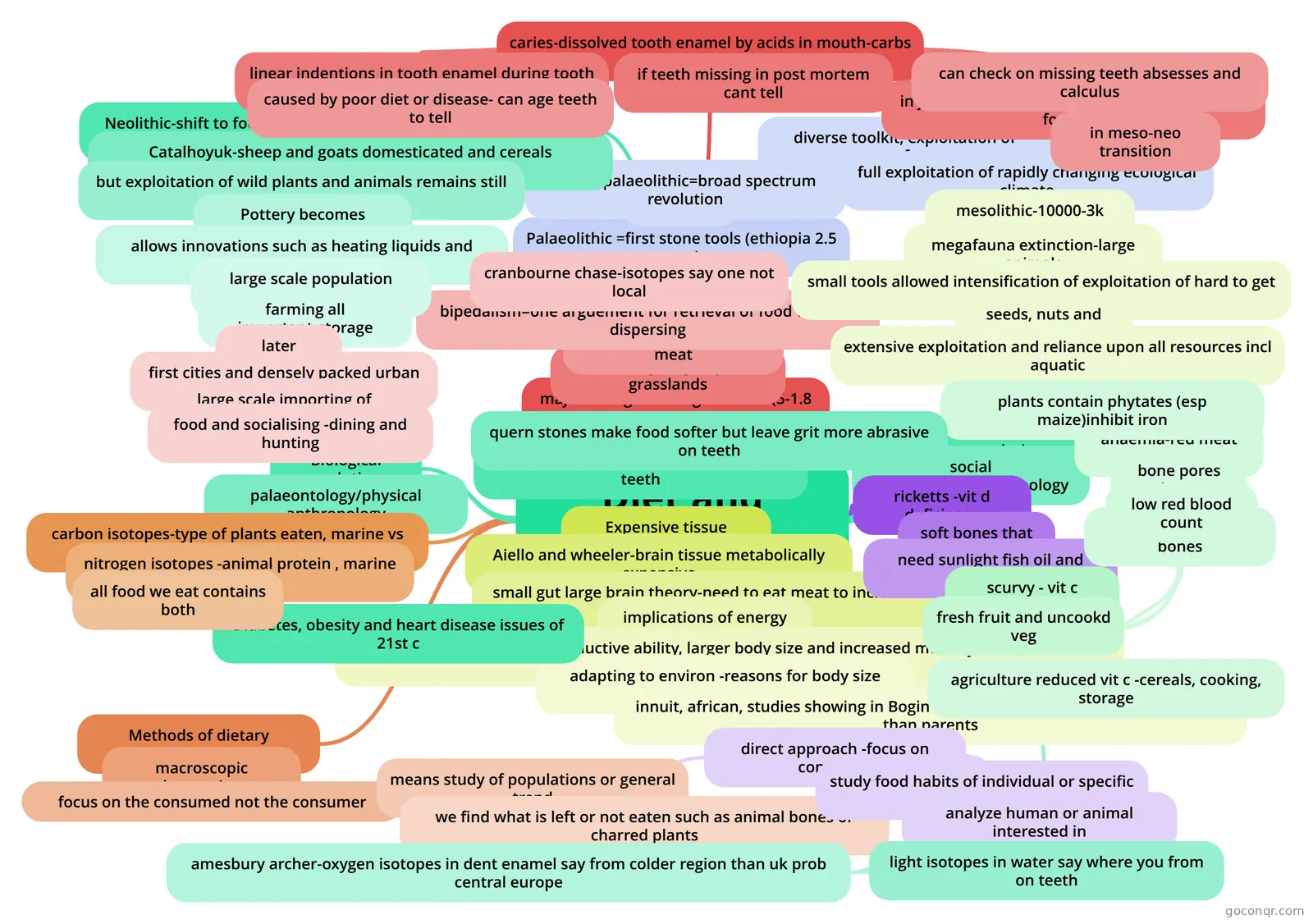
Mind map: Diet and nutrition
Map content
Diet and nutrition
Biological evolution
- palaeontology/physical anthropology
cultural evolution
- social anthropology/archaeology
major changes during Pliocene (5-1.8 mya)
- forests giving way to grasslands
- ancestors starting to eat meat
- bipedalism=one arguement for retrieval of food which is dispersing
- Palaeolithic =first stone tools (ethiopia 2.5 mya)
- first meat
- upper palaeolithic=broad spectrum revolution
- diverse toolkit, exploitation of megafauna
- full exploitation of rapidly changing ecological climate
- mesolithic-10000-3k approx
- megafauna extinction-large animals
- small tools allowed intensification of exploitation of hard to get resources
- seeds, nuts and berries
- extensive exploitation and reliance upon all resources incl aquatic
- seeds, nuts and berries
- small tools allowed intensification of exploitation of hard to get resources
- megafauna extinction-large animals
- mesolithic-10000-3k approx
- full exploitation of rapidly changing ecological climate
- diverse toolkit, exploitation of megafauna
- upper palaeolithic=broad spectrum revolution
- first meat
- cranbourne chase-isotopes say one not local
- Palaeolithic =first stone tools (ethiopia 2.5 mya)
- bipedalism=one arguement for retrieval of food which is dispersing
- ancestors starting to eat meat
- forests giving way to grasslands
Expensive tissue hypothesis
- Aiello and wheeler-brain tissue metabolically expensive
- small gut large brain theory-need to eat meat to increase brain size
- implications of energy saving
- larger brain=increased reproductive ability, larger body size and increased mobility -7ft 2 in woman basketball player
- adapting to environ -reasons for body size differences
- innuit, african, studies showing in Bogin immigrants to Americas children bigger than parents
- adapting to environ -reasons for body size differences
- larger brain=increased reproductive ability, larger body size and increased mobility -7ft 2 in woman basketball player
- implications of energy saving
- small gut large brain theory-need to eat meat to increase brain size
- Aiello and wheeler-brain tissue metabolically expensive
Neolithic-shift to food production-slow intro of domestic plants, animals later
- Catalhoyuk-sheep and goats domesticated and cereals grown-farming estd
- but exploitation of wild plants and animals remains still important
- Pottery becomes widespread
- allows innovations such as heating liquids and presentation
- large scale population expansion
- farming all important-storage
- later pre-history
- first cities and densely packed urban areas
- large scale importing of food
- food and socialising -dining and hunting
- large scale importing of food
- first cities and densely packed urban areas
- later pre-history
- farming all important-storage
- large scale population expansion
- allows innovations such as heating liquids and presentation
- Pottery becomes widespread
- but exploitation of wild plants and animals remains still important
- Catalhoyuk-sheep and goats domesticated and cereals grown-farming estd
Diabetes, obesity and heart disease issues of 21st c
Methods of dietary reconstruction
- macroscopic observations
- focus on the consumed not the consumer
- means study of populations or general trend
- we find what is left or not eaten such as animal bones or charred plants
- direct approach -focus on consumer
- study food habits of individual or specific group
- analyze human or animal interested in
- study food habits of individual or specific group
- direct approach -focus on consumer
- we find what is left or not eaten such as animal bones or charred plants
- means study of populations or general trend
- focus on the consumed not the consumer
- macroscopic observations
ricketts -vit d deficiency
- soft bones that bend
- need sunlight fish oil and animal fat
- scurvy - vit c deficiency
- fresh fruit and uncookd veg
- need it for iron and bones
- agriculture reduced vit c -cereals, cooking, storage
- anaemia-red meat plants
- plants contain phytates (esp maize)inhibit iron
- bone pores large
- low red blood count
- need it for iron and bones
- fresh fruit and uncookd veg
- scurvy - vit c deficiency
- need sunlight fish oil and animal fat
- soft bones that bend
caries-dissolved tooth enamel by acids in mouth-carbs cause
- if teeth missing in post mortem cant tell
- in japan agriculturalists more tooth decay than foragers
- in meso-neo transition
- can check on missing teeth absesses and calculus
- linear indentions in tooth enamel during tooth develop
- caused by poor diet or disease- can age teeth to tell
microscope observ-food leaves traces on teeth
- quern stones make food softer but leave grit more abrasive on teeth
- light isotopes in water say where you from on teeth
- amesbury archer-oxygen isotopes in dent enamel say from colder region than uk prob central europe
- light isotopes in water say where you from on teeth
- quern stones make food softer but leave grit more abrasive on teeth
carbon isotopes-type of plants eaten, marine vs terrestrial
- nitrogen isotopes -animal protein , marine protein
- all food we eat contains both
- nitrogen isotopes -animal protein , marine protein
Information
- Description
- Mind Map on Diet and nutrition, created by Emma Freeman on 27/05/2013.
- Created by
- Emma Freeman
- Views
- 40
- Rating