
Mind map
NSTEMI
Map content
NSTEMI
Pathophysiology
- Occurs as a result of sustained ischemia, which leads to irreversible myocardial cell death (text book)
- Partial or complete coronary artery blockage (White & Chew, 2008)
- 80-90% of MI's occur secondary to thrombus formation (Textbook)
- This thrombotic process decreases circulation to to coronary arteries leading to necrosis (White & Chew, 2008)
- The heart stops contracting in these necrotic areas (Textbook)
- Cardiac cells can last up to 20 minutes before cellular death takes place (Textbook)
- The most inner layer of the heart, subendocardium, becomes ischemic first (Textbook)
- If this ischemia continues the entire thickness of the heart will become necrossed in roughly 5 to 6 hours (Textbook)
- This thrombotic process decreases circulation to to coronary arteries leading to necrosis (White & Chew, 2008)
- Atherosclerosis is a build of plaque in the artery wall (Heart & Stroke, ?)
- Artery can narrow and become blocked
- Can lead to blood clots, which can block the blood from getting to the heart
- Artery can narrow and become blocked
Diagnostic Studies
- Electrocardiogram
- 12 Lead ECG
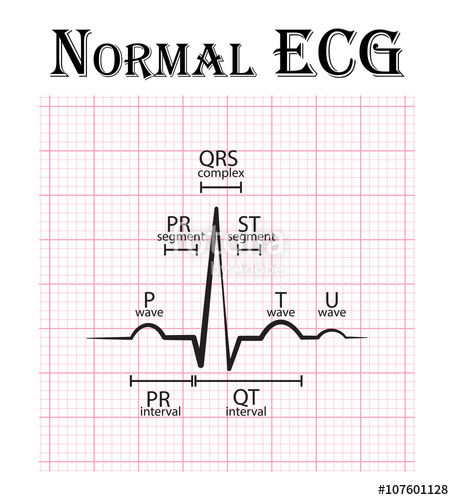
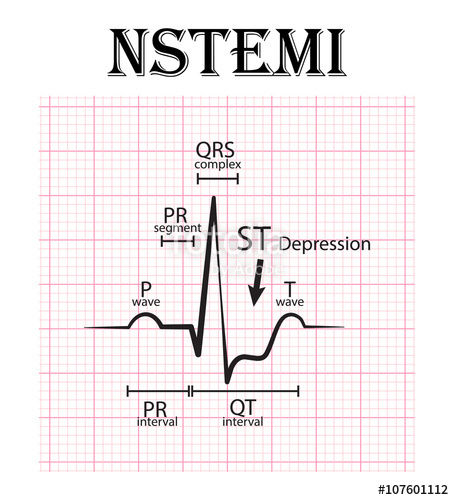
- Will reveal ST segement depression
- Primary tool in detecting Myocardial Infarctions
- Reveals the time sequence of ischemia, infarction and the resolution of the infarction
- No pathalogical Q waves are developed (Text)
- Serum Cardiac Markers
- Creatine Kinase (CK-MB)
- In an MI, plasma CK-MB levels rise about 4-6 after the onset of chest pain and typically peaks 12-24 hours after (Coven, 2016)
- Levels typically return to baseline after 24-48 hours (Coven, 2016)
- In an MI, plasma CK-MB levels rise about 4-6 after the onset of chest pain and typically peaks 12-24 hours after (Coven, 2016)
- Troponin
- Regulatory protiens that are found in skeletal and cardiac muscle (Coven, 2016)
- A positive result is noted 4-8 hours after the onset of symptoms, and remains elevated for 7-10 days after (Coven, 2016)
- Cardiac Specific troponin is a myocardial muscle protein released into circulation after an myocardial injury (Text)
- Two different sub types: cardiac specific troponin I (cTnI) & cardiac specific troponin T (cTnT) (Text)
- Highly specific indicators of MI and have a greater sensitivity to detect (text)
- Creatine Kinase (CK-MB)
- Coronary Angiography
- Is an X-ray to determine if there are any blockages in the coronary arteries (NLH, 2016)
- A small catheter is inserted through an artery
- Determines most therapeutic treatment (text)
- Percutaneous Intervention (PCI) may be performed at this time (Text)
- intervention used to treat CAD
- A catheter with a balloon on the end is insterted and the inflated into the artery that is narrowed (Text)
- Elective procedure once the patient is stabilized (Text)
- Is an X-ray to determine if there are any blockages in the coronary arteries (NLH, 2016)
- Electrocardiogram
Nursing Assessments
- Subjective Data
- Important health history
- Current health history
- Family history of heart disease (text)
- a sedentary lifestyle
- Use of tobacco
- Past health history/ history of
- CAD
- Hypertension
- Aortic Stenosis
- Diabetes
- MI
- Angina
- Heart failure
- Lung disease
- Hyperlipidemia
- Medications
- The use of:
- Aspirin
- Nitrates
- Beta Blockers and Calcium Channel Blockers
- ACE Inhibitors
- Herbal supplements or vitamins
- Anti-Hypertensive and Cholesterol Lowering medications
- The use of:
- Current health history
- Symptoms
- Chest pressure or pain
- May radiate to jaw, neck, shoulders, arms or back
- Heartburn, N/V, indigestion
- Dyspnea
- Dizziness and weakness
- Anxiety, heart palpatations and tiredness
- Chest pressure or pain
- Important health history
- Objective Data
- General
- Anxiety
- Restlessness
- Fear
- Integumentary System
- Cool, clammy and pale (text)
- Cardiac System
- Bradycardia or Tachycardia
- Pulses will alternate from weak to strong
- S3 & S4
- High or Low Blood Pressure
- Potential Findings
- Non-elevated or elevated cardiac serum markers
- Increased WBCs and serum lipids
- Cardiac enlargement
- Positive stress test results
- ECG abnormalities
- Pulmonary congestion or calcification seen on chest radiograph
- Positive findings on the coronary angiogram
- General
- Subjective Data
Images and files in the map
Information
- Description
- Mind Map on NSTEMI, created by Jessica Caswell on 25/10/2017.
- Created by
- Jessica Caswell
- Views
- 440
- Rating