
Mind map
Math 141 chapter 3 and 4
Map content
Math 141 chapter 3 and 4
Chapter 3
- 3.2 Exponential Models: Comparing Rates
- Mike has 2 cats, five years later he has 20 cats.
- 5 year growth factor
- 20=2(a)^1=10
- One year growth Factor
- 20=2(a)^5
- Start= 15 bacteria, after 15 minutes there was 45 bacteria
- 15 minute growth factor
- 45=15a,=3
- One hour growth factor
- 45=15(a), 3^4, =81
- Find exponential function for # of bacteria per hour
- B=15(81)^t, t=1,215
- 15 minute growth factor
- 5 year growth factor
- Half-Life
- A=G(1/2)^t/h
- G=initial Amount, t=time, h= half-life
- Start with 20,000 Bacteria, the half-life is 20 years
- b(t)=20,000(1/2)^t
- =4.88 Bacteria
- b(t)=20,000(1/2)^t
- A=G(1/2)^t/h
- Later/Initial
- Compound Interest
- A=P(1+r/n)^nt
- 30,000 in savings account, pays 4% annual, after 6 years?
- Monthly
- A=30,000(1+.004/12)^12?6
- Monthly
- 30,000 in savings account, pays 4% annual, after 6 years?
- Compound Continuously
- A=Pe^rt
- 4000 is invested, with a bank that pays 2.4 annual compounded continuously what will it be after 9 years?
- A=4000e^(.025 x 9) =5009.29
- 4000 is invested, with a bank that pays 2.4 annual compounded continuously what will it be after 9 years?
- A=Pe^rt
- A=P(1+r/n)^nt
- Mike has 2 cats, five years later he has 20 cats.
- 3.3 Comparing Linear and Exponential Growth
- Rate of change
- f(x+1)-f(x)
- Percentage Rate of Change
- r=a-1
- Average Rate of change/Percentage rate of change
- f(x)
- 6x5^2=30
- 30-6=24
- Average rate of change
- 30-6/6=24/6=400%
- percentage rate of change
- 30-6=24
- 6x5^2=30
- f(x)
- x=0,1,2,3,4
- f(x)=2000,400,80,16,3.2
- 400=2000xa^1
- f(x)=2000,400,80,16,3.2
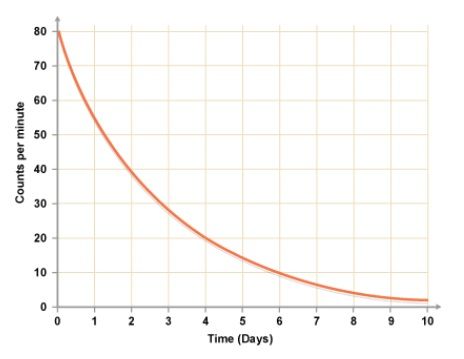
- decreasing, exponential decay, f(6)=10, estimate the y-intercept=80
- Linear vs. Exponential
- t=0,1,2,3,4,5
- j(t)=16,24,32,40,48,56
- j(t)=8t+16
- Linear
- t=0,1,2,3,4,5
- j(t)=16,24,36,54,81,121.5
- 16=Ca^t
- 24=16a^1
- a^1=1.5
- 24=16a^1
- j(t)=16(1.5)^t
- 16=Ca^t
- j(t)=16,24,36,54,81,121.5
- Rate of change
- 3.4 Graphs of Exponential Funtions
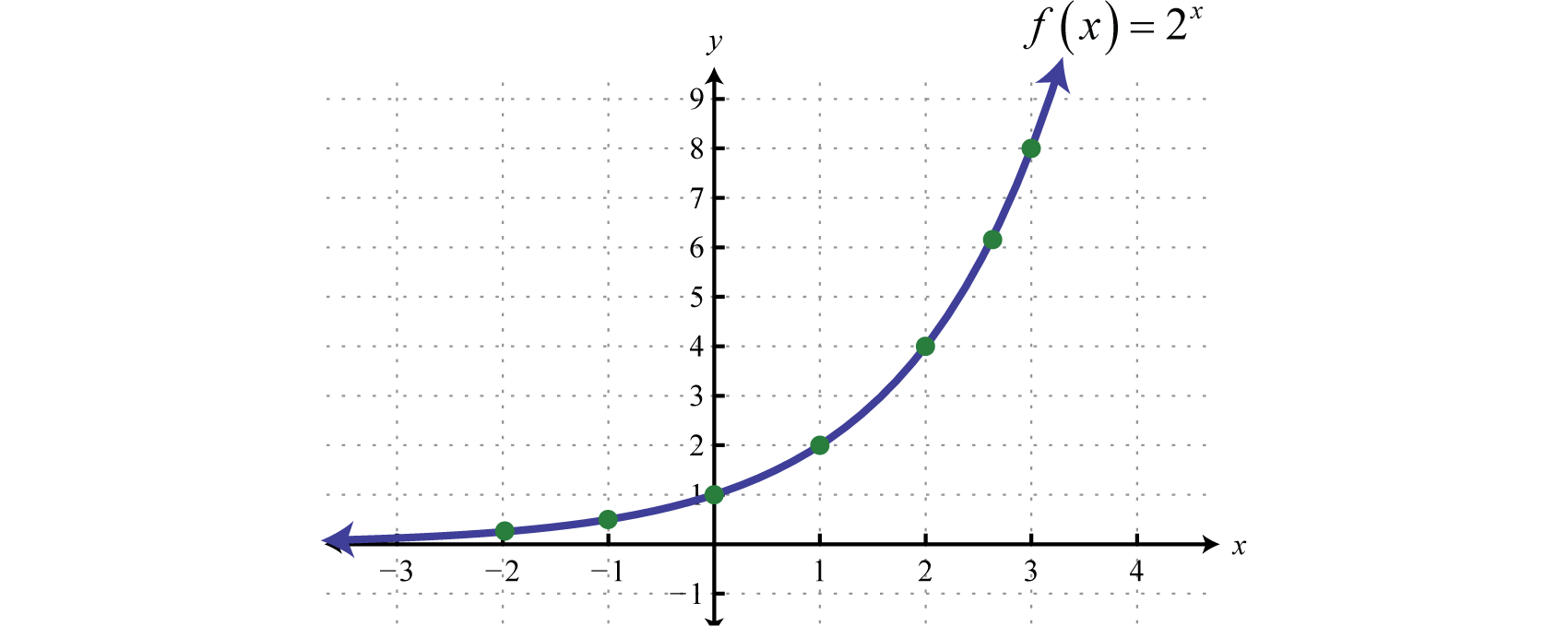
- C=(0,1)
- a>1
- Domain:(-Infinity,Infinity)
- Range:(0,Infinity)
- C=(0,1)
- Make sure to carefully read the graph and to think about the domain and the range
- Decay= a<1
- Growth= a>1
- 3.2 Exponential Models: Comparing Rates
chapter 4
- 4.5 Exponential Equations: Getting Information from a model
- 2^x=16, log216=x
- 11^x=54=log(11)54=x
- 2 x 6^x=25, = log6(25/2)=x
- 2logx=3, = x=10^3/2
- 7.5 billion population and increasing by 1.13% every year
- p(t)=7.5(1+.0113)^t
- What will it be in 2050?
- 7.5(1.0113)^34
- What will it be in 2050?
- p(t)=7.5(1+.0113)^t
- 4.4 Natural Exponential & Logarithm Functions
- Natural Exponential Function= f(x)=e^x
- Natural Logarithm function= f(x)= ln(x)=log(e)(x)
- ln(1), ln(1)=x, loge(1)=x, 1=e^x
- ln(e^10), ln(e^10)=x, loge(e^10)=10 e^10 = e^x
- ln1=0, because loge1=0
- ln e =1 because loge e=1
- ln e^x = x
- e^ln x =x
- ln e^x = x
- ln e =1 because loge e=1
- f(t)=Ce^rt
- 500 CFU/ml with a growth rate of 40% per hour
- f(t)=500e^.40t
- After 10 hours?
- f(t)=500e^.40(10)=27,299.1
- After 10 hours?
- f(t)=500e^.40t
- 500 CFU/ml with a growth rate of 40% per hour
- f(x)=Ca^x
- f(x)=Ce^rx
- r=ln(a)
- Instantaneous growth or decay rate
- Instantaneous growth or decay rate r per time period
- r=ln(a)
- Exponential growth or decay model
- f(x)=Ce^rx
- Natural Exponential Function= f(x)=e^x
- 4.3 Logarithmic Scales
- pH=-log[H+]
- When pH increases by one, [H+] decrease by factor of 10
- When a pH increases by one, [H+] decrease by factor of 10
- [H+] =3.16 x 10^-8M
- pH=-log10(3.16 x 10^-8) = 7.5, Basic
- B=10 x log(I/I-12)
- If the intensity was 100 W/m^2
- B= 10 x log (100/10^-12) = 140 db
- If the intensity was 100 W/m^2
- M=log(I/S)
- San Fran=8.3, Colombia-Ecuador was 4x as intense
- 8.3=log(I/S)
- m=(4I/S)
- m=log(4) + log(I/S) =8.3
- log (4)+8.3=8.9
- San Fran=8.3, Colombia-Ecuador was 4x as intense
- 4.2 Laws of logarithms
- logb(mn)=logb(m)+logb(n)
- logb(m/n)=logb(m)-logb(n)
- logb(m^n)= n x logb(m)
- log5(3^2)=2 x log5(3)
- log(12/n)= log10(12) - log10(h)
- logb(m^n)= n x logb(m)
- log3(9x)= log3(9) + log3(x)
- logb(m/n)=logb(m)-logb(n)
- log(h)+log(e)= log(he)
- log15(25)+log15(9)=log15(25x9)=log15(225)
- logb(mn)=logb(m)+logb(n)
- 4.5 Exponential Equations: Getting Information from a model
Images and files in the map
Information
- Description
- Mind Map on Math 141 chapter 3 and 4, created by Michael Zlotnick on 26/10/2017.
- Created by
- Michael Zlotnick
- Views
- 1
- Rating