
Mind map
Supply Chain and Customer Relationship Management Systems
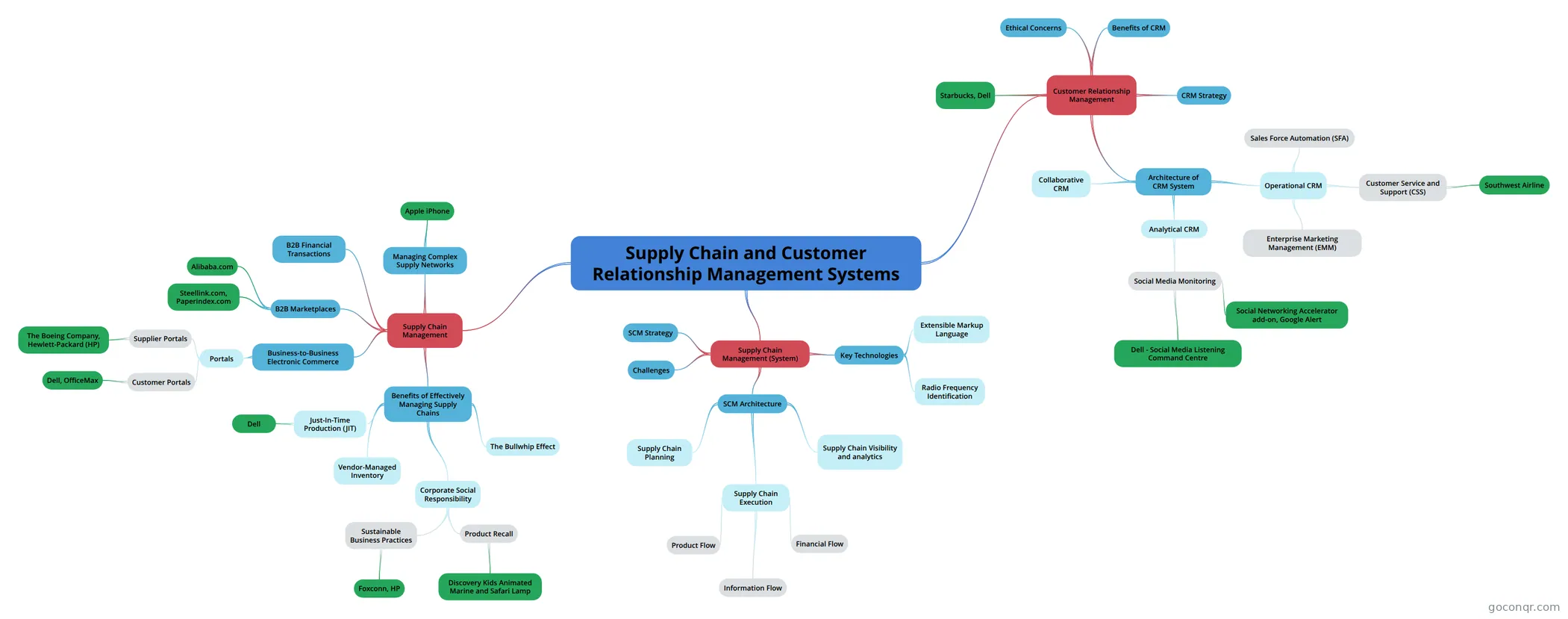
Mind map: Supply Chain and Customer Relationship Management Systems
Map content
Supply Chain and Customer Relationship Management Systems
Supply Chain Management
- Supply chain: refer to a collection of companies and processes involved in moving a product from the suppliers of raw materials to the suppliers of intermediate comments, then to final production and ultimately to consumers.
- Business-to-Business Electronic Commerce
- - Using Electronic Data Interchange (EDI): computer - computer communication following certain standards as set by the UN Economic Commission or the American National Standards Institute. - Secure communication. Transfer of data/order.
- Portals
- - access points through which a business partner accesses secured, proprietary information that may be dispersed throughout an organisation. - Productivity gain and cost savings - Expensive to set up, designing, developing and maintaining this type of system
- Supplier Portals
- - Large numbers of suppliers + Single buyer
- The Boeing Company, Hewlett-Packard (HP)
- - Companies can register interest to be a supplier, access terms and conditions or Guidelines.
- Customer Portals
- - Large number of buyers + 1 Suppliers - Manage all phase of purchasing cycle, review product information + order entry + customer service
- Dell, OfficeMax
- - Customer tailored offers or specific deals based on sales volume.
- B2B Marketplaces
- - Thrid party vendors - takes a small number of commission for each transaction - Serve market niche - smaller business - Can serve vertical markets (same industries) - Or just a marketplace
- Alibaba.com
- Steellink.com, Paperindex.com
- Managing Complex Supply Networks
- - Extensive supply network - Fear of shortage of supply/components - Natural disasters: 2011 - Japan Earthquake + Tsunami -> shut down plants around the world -> devastated the supply chains of electronics and automobile manufacturers
- Apple iPhone
- - Components of iPhone are sourced from different country - Flash memory and central Processing unit - Korean Sumsung - Display - Korean LG - Phone chips - German Infineon - Touch screen controller - Texas Instruments - Assembled in Shenzhen by Foxconn
- Benefits of Effectively Managing Supply Chains
- Just-In-Time Production (JIT)
- - Minimise storage cost and capital - Orders arrive when they are needed = smaller quantities but higher frequencies - Great cooperation between suppliers, all partners and logistics company
- Dell
- - Keeps only 2 hours of inventories in factories - Electronics go obsolete really fast - Sources most of its components from SE asia, depends heavily on suppliers for JIT manufacturing processes - Charted 18 Boeing 747 freighter aircraft to shuttles parts from Asian suppliers to the states.
- Vendor-Managed Inventory
- - A business model in which suppliers manage the manufacturer/retailers' inventory, allows suppliers to monitor real time sales and stock levels data. - Maintain inventory level based on reestablished agreements. - Save costs and minimise stock out situations. - Suppliers - reduces ordering error, more accurate forecasts and helps prioritise the shipment of goods
- The Bullwhip Effect
- - Forecast error or fluctuation in demand for an end product can leads to tremendous fluctuation or error farther up the supply chain. - Due to safety buffers/safety stocks to minimise stockout.
- Corporate Social Responsibility
- Product Recall
- - Keep track or their data and supply chain to be able to identify problem sources if some thing happens. - Save cost in recalling - Differences in quality and product safety regulation can leads to problems
- Discovery Kids Animated Marine and Safari Lamp
- - Originated in China, sold through online and offline retailers. - Recalled 300,000 lamps due to design flaw that could lead to potential fire hazard
- Sustainable Business Practices
- Foxconn, HP
- - Suicide case in Foxconn, effects apple's reputation - HP pursuing green image, needs to learn about the whole supply chain and provide evidence.
- Foxconn, HP
- Product Recall
- Just-In-Time Production (JIT)
- B2B Financial Transactions
- - Time need to process a check - Cards has spending limits - Letters of credit issued by bank is used for payments (large amount) - reduce credit risk - Western union
Customer Relationship Management
- - Customers have more power - Available of substitutes, information flow due to internet - Social media to voice out opinions, word of mouth. Wide reach - Twitter, blogs, Facebook - Internet allows customers to buy goods elsewhere, more competition, lower barriers to entry - Easy access to understand competitors product and predict company's next move
- - First-call resolution: addressing the customers' issues during the first call, save cost + increase customer satisfaction
- - CRM: corporate level strategy to create and maintain, through the introduction of reliable systems, processes, and procedures, lasting relationships with customers by concentrating on downstream information flows. 3 main objectives: 1. Attract potential customers 2. Create customer loyalty 3. Potray a positive corporate image
- Starbucks, Dell
- Starbucks - Loyalty card - Actively solicit feedback and new product ideas from consumers in store and open innovative platform mystarbucksidea.com - Most successful fan page on Facebook
- Dell - Provide all customers with a positive experience both during resale and the ongoing support phases
- Benefits of CRM
- 1. Enable 24/7/365 operation 2. Individualised service 3. Improved information 4. Speeds problem identification/resolution speeds processes 5. Improved integration 6. Improved integration 7. Improved product development 8. Improved planning
- - Experience greater customer satisfaction, increase productivity of sales and service personnel -> enhancement to company's profitability - Driving revenue + reduce costs
- CRM Strategy
- - Determine if CRM is needed - depending on how close the company and end customer is.
- Successful CRM needs enterprise-wide changes: 1. Policies and business processes: customer focused culture 2. Customer service: focus on customer satisfaction, enhancing customer's experiences 3. Employee Training: Consistent focus that values customer service and satisfaction 4. Data collection, Analysis and sharing: All aspect of customers experience (sales, support) must be tracked, analysed and shared
- Architecture of CRM System
- Collaborative CRM
- Providing effective and efficient communication with the customer from the entire organisation - Sharing of information across various departments: improve information quality - Streamline customer services
- 1. Greater customer focus: understanding customers history and current needs 2. Lower communication barriers: complete information is at hand 3. Increased information integration: customers can get status updates from any organisational touch point
- Analytical CRM
- Analysing consumer behaviour and perceptions in order to provide business intelligence. - Data mining, decision support, attempt to create predictive models of various customer attributes. - Continuous data collection and data analyse for decision making
- Social Media Monitoring
- - Join conversation, answers questions, maintain positive brand image - Identify influencers
- Social Networking Accelerator add-on, Google Alert
- - monitor and analyse ongoing conversations on social media sites: spot potential perception issues or discover trends
- - Gain deep and timely understanding of evolving customer sentiment
- Dell - Social Media Listening Command Centre
- - Full time staff monitor over 22,000 daily posts about the company on various social media - React to customer complaints - Real-time communication through social media
- Operational CRM
- Automating the fundamental business process - marketing, sales and support - Complete customer's information is stored - history, pending sales, service requests etc. Regardless of touch point.
- Sales Force Automation (SFA)
- System that supports day to day sakes activities of an organisation. - Goal: identify potential customers, streamline selling processes and improve managerial information - Supports ordering processing, tracking, managing accounts, contacts, opportunities and sales, tracking and managing customer's history and preferences- Create forecast and analyse sales performance
- Advantage: - sales personnel: reduce error-prone paperwork, focus on selling, more efficient - Manager: up-to date information about all customers, markets and sales personnel -> better planning, scheduling and coordination - Better understanding of markets. segments, customers and competitors
- Customer Service and Support (CSS)
- System that automate service requests, complaints, product returns and information requests. - Goal: Provide customer service anytime, anywhere and through any channel while keeping service and support costs low. - Customer interaction centre (CIC), using multiple channel of communication to support the communication preferences - web, phone, Facebook page.
- Advantages: - Faster response times, increased first-contact resolution rates, improve productivity of service and support personnel - Managers can utilised digital dashboard to monitor key metrics such as first contact resolution, service personnel utilisation
- Southwest Airline
- "virtual hold technology" - customer can choose to stay on the line or get called back. - Reduce toll minutes - Reduce number of abandoned calls - Increase overall satisfaction
- Enterprise Marketing Management (EMM)
- Help company to execute CRM strategy by improving the management of promotional campaigns. - Integrate campaigns such that the right messages are sent to the right people through the right channel - Tools provide extensive analytical capabilities to analyse the effectiveness of marketing campaigns, help efficiently route sales leads to the right salesperson -> higher conversion rates
- Collaborative CRM
- Ethical Concerns
- 1. Privacy concerns 2. Personalised communication gets too personal 3. Coercive sales practices
Supply Chain Management (System)
- 1. To accelerate product development and innovation 2. Reduce cost 3. Improve coordinations of suppliers, product or service production, and distribution - Comes in the form of modules that companies select and implement according to different business requirements
- Challenges
- 1. Data must be entered - employees must know how to use the system 2. Willingness of using SCM system, distrust among partners in the supply chain with data (sales and supply chain) 3. Increase intellectual property theft 4. All suppliers to use the same SCM system
- SCM Architecture
- Supply Chain Planning
- 1. Demand planning and Forecasting: examine historical data to develop accurate forecasts - Take inconsideration data from point of sales system, promotions and other factors influencing demand
- 2. Distribution planning: moving products to distributors. - Delivery, warehousing, invoicing and payment collection - Overall transportation schedule
- 3. Production scheduling: coordination of all activities needed to create the product or service - analytical tools are used to optimally utilised materials, equipment and labour. - Product testing, packing and delivery preparation - Production plan
- 4. Inventory and Safety stock planning: development of inventory estimate - balance inventory costs and desired customer service levels to determine optimal inventory level - Sourcing plan
- Supply Chain Execution
- Put SCM planning into motion and reflects the processes involved in improving the collaboration of all members of the supply chain
- Product Flow
- Movement of goods from the supplier -> Production -> Distribution -> Consumption - Effective SCM also deals with product returns
- Information Flow
- Movement of information: Delivery status updates, order processing - Flows up or down the supply chain - All time access to the most current information necessary for scheduling production, shipping orders etc.
- Financial Flow
- Movement of financial assets - Payment schedules, consignment And ownership of products and materials - Linkages to electronic banking and financial institutions allow payments to automatically flow into the accounts of all members of the supply chain
- Supply Chain Visibility and analytics
- Supply Chain Visibility: - Track movement of products - Foresee external events - Need tremendous trust between suppliers to share information
- Supply Chain Analytics: - use of key performance indicators to monitor performance of the entire supply chain: sourcing, planning, production and distribution - Identify to remove bottlenecks - switching suppliers, spreading orders, expediting shippings for critical goods
- Supply Chain Planning
- SCM Strategy
- Supply chain efficiency: Focus on minimising procurement, production and transportation cost. Supply chain effectiveness: focus on maximising customer service. - Trade offs
- Key Technologies
- Extensible Markup Language
- Data representation standard first specified by the WWW consortium.
- Radio Frequency Identification
- Use of electromagnetic energy to transmit information between a reader and a processing device or RFID tag. - Advantage: eliminates the need for line-of-sight reading, does not require time-consuming hand scanning, readable regardless of visibility of tag, contains more information than bar codes, can be scanned at at greater distance.
- Extensible Markup Language
Information
- Description
- INFS1602 Mind Map on Supply Chain and Customer Relationship Management Systems, created by Jessica Naing on 01/11/2017.
- Created by
- Jessica Naing
- Views
- 2
- Rating