
Mind map
Motor Control
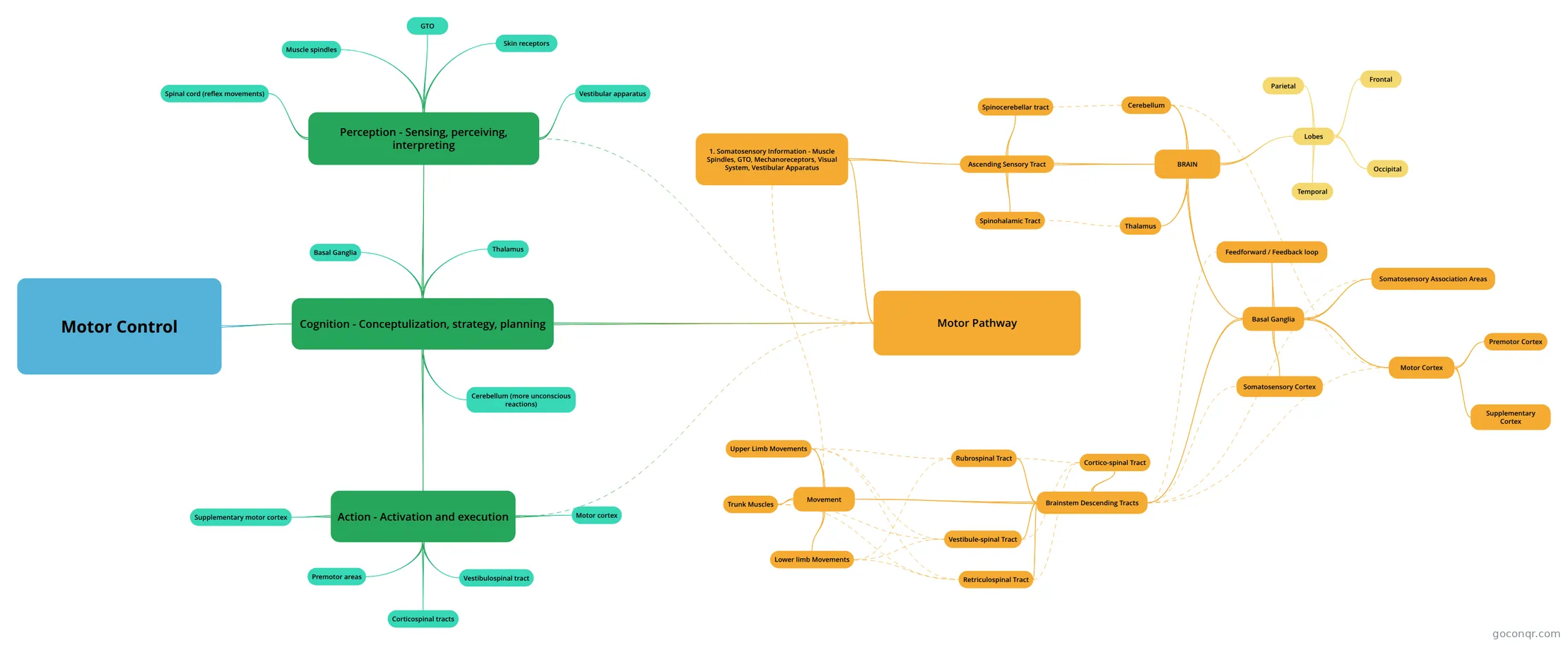
Mind map: Motor control
Map content
Motor Control
Cognition - Conceptulization, strategy, planning
- Action - Activation and execution
- Motor cortex
- Supplementary motor cortex
- Premotor areas
- Corticospinal tracts
- Vestibulospinal tract
- Perception - Sensing, perceiving, interpreting
- Muscle spindles
- GTO
- Skin receptors
- Vestibular apparatus
- Spinal cord (reflex movements)
- Thalamus
- Basal Ganglia
- Cerebellum (more unconscious reactions)
- Motor Pathway
- 1. Somatosensory Information - Muscle Spindles, GTO, Mechanoreceptors, Visual System, Vestibular Apparatus
- Ascending Sensory Tract
- BRAIN
- Cerebellum
- Responsible for voluntary balance and coordination of muscles and the body 1. Balance 2. Proximal Control 3. Coordination 4. Correction of Movement 5. Comparator 6. Autopilot function
- Thalamus
- Responsible for relaying information from the sensory receptors to proper areas of the brain where it can be processed
- Basal Ganglia
- Responsible to motor control Planning and control of complex motor behaviour Help to initiate movement Prevent unwanted movement Different routes through the BG can enhance or suppress movement
- Feedforward / Feedback loop
- raw information from the motor cortex is refined. it passes through 2 loops: 1. The BG 2. The Cerebellum Once the movement is planned by the cortex, based on previous experiences and knowledge of dynamics Once the movement is planned the FEEDFORWARD loop supplies the information to execute. Once the movement has started, receptors provide FEEDBACK about the movement and allow signals to be altered and movement refined.
- Brainstem Descending Tracts
- Movement
- Upper Limb Movements
- Trunk Muscles
- Lower limb Movements
- Rubrospinal Tract
- Lateral Pathway - Controls distal extremities
- Retriculospinal Tract
- Medial Pathway - Controlling posture and axial muscles and proximal sections of arms and legs
- Cortico-spinal Tract
- The main tract that stimulates motor neurone in the spinal cord responsible for the boys axial muscles and arm leg muscles 2 pathways:- Lateral (movement of distal extremities)- Medial (postural control)
- Vestibule-spinal Tract
- Medial Pathway - Controlling posture and axial muscles and proximal sections of arms and legs
- Movement
- Somatosensory Association Areas
- Somatosensory Cortex
- Motor Cortex
- interacts with sensory processing areas (BG & Cerebellum) to ID where we want to move, to plan the movement and execute the action. Initiates movement on the contralateral side
- Premotor Cortex
- Assists the proximal preparation and control of distal movements
- Supplementary Cortex
- Coordinates bilateral movements (e.g. clapping hands)
- Lobes
- Parietal
- Processes sensory information that had to do with taste, temperature, and touch. The parietal lobe carries out some very specific functions. As a part of the cortex, it has a lot of responsibilities and has to be able to process sensory information within seconds. The parietal lobe is where information such as taste, temperature and touch are integrated, or processed. Humans would not be able to to feel sensations of touch, if the parietal lobe was damaged.
- Frontal
- Carries out higher mental processes such as thinking, decision making, and planning
- Temporal
- Responsible for processing auditory information from the ears (hearing). It is also key to being able to comprehend, or understand meaningful speech. In fact, we would not be able to understand someone talking to us, if it wasn't for the temporal lobe. This lobe is special because it makes sense of the all the different sounds and pitches (different types of sound) being transmitted from the sensory receptors of the ears.
- Occipital
- Responsible for processing visual information from the eyes The occiptial lobe is important to being able to correctly understand what your eyes are seeing. These lobes have to be very fast to process the rapid information that our eyes are sending. Similar to how the temporal lobe makes sense of auditory information, the occipital lobe makes sense of visual information so that we are able to understand it. If our occipital lobe was impaired, or injured we would not be able to correctly process visual signals, thus visual confusion would result.
- Parietal
- Cerebellum
- Spinocerebellar tract
- Conveys proprioceptive information from the body to the cerebellum
- Spinohalamic Tract
- Sensory pathways from the skin to the thalamus
- BRAIN
- Ascending Sensory Tract
- 1. Somatosensory Information - Muscle Spindles, GTO, Mechanoreceptors, Visual System, Vestibular Apparatus
- Action - Activation and execution