
Mind map
The Adrenal Gland
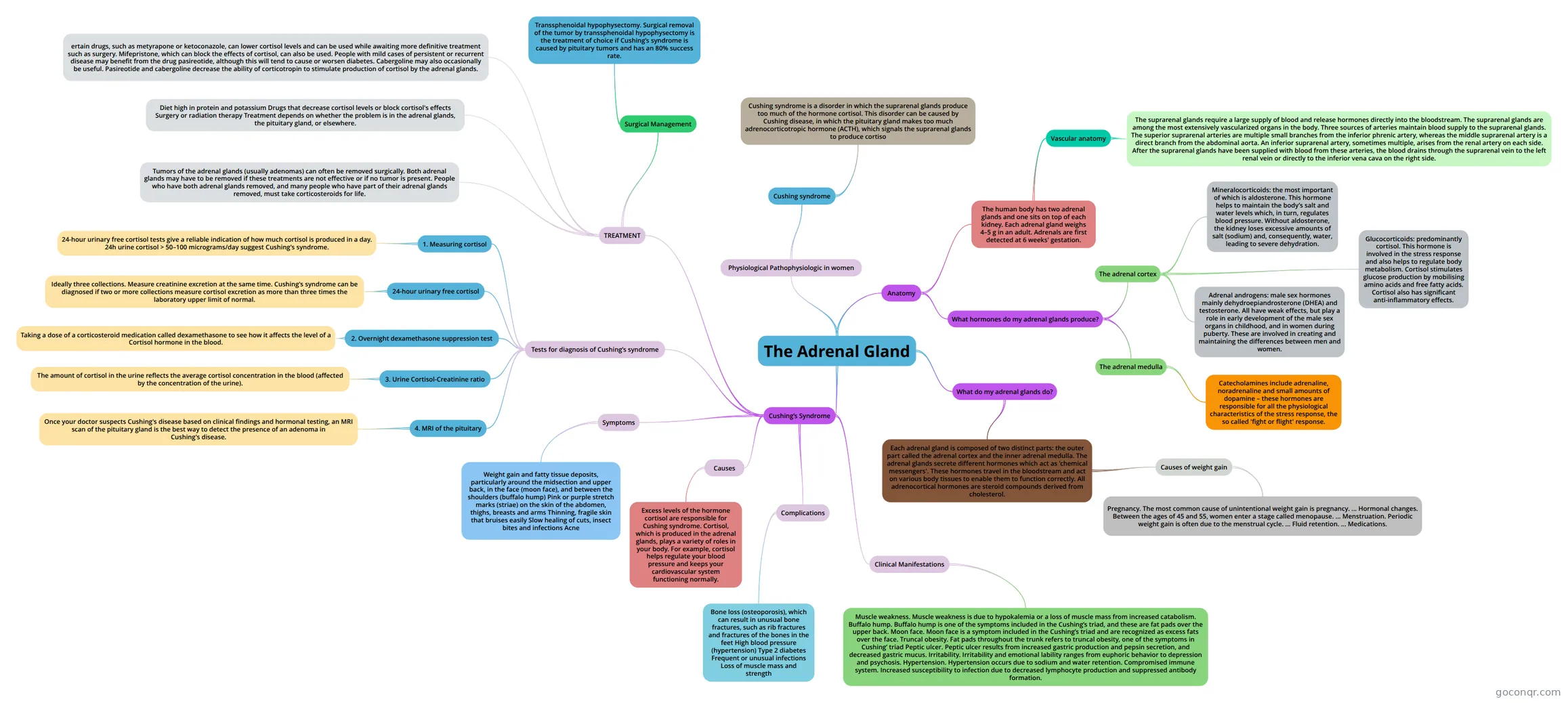
Mind map: The Adrenal Gland
Map content
The Adrenal Gland
Anatomy
- The human body has two adrenal glands and one sits on top of each kidney. Each adrenal gland weighs 4–5 g in an adult. Adrenals are first detected at 6 weeks' gestation.
- Vascular anatomy
- The suprarenal glands require a large supply of blood and release hormones directly into the bloodstream. The suprarenal glands are among the most extensively vascularized organs in the body. Three sources of arteries maintain blood supply to the suprarenal glands. The superior suprarenal arteries are multiple small branches from the inferior phrenic artery, whereas the middle suprarenal artery is a direct branch from the abdominal aorta. An inferior suprarenal artery, sometimes multiple, arises from the renal artery on each side. After the suprarenal glands have been supplied with blood from these arteries, the blood drains through the suprarenal vein to the left renal vein or directly to the inferior vena cava on the right side.
- Vascular anatomy
- What hormones do my adrenal glands produce?
- The adrenal cortex
- Mineralocorticoids: the most important of which is aldosterone. This hormone helps to maintain the body’s salt and water levels which, in turn, regulates blood pressure. Without aldosterone, the kidney loses excessive amounts of salt (sodium) and, consequently, water, leading to severe dehydration.
- Glucocorticoids: predominantly cortisol. This hormone is involved in the stress response and also helps to regulate body metabolism. Cortisol stimulates glucose production by mobilising amino acids and free fatty acids. Cortisol also has significant anti-inflammatory effects.
- Adrenal androgens: male sex hormones mainly dehydroepiandrosterone (DHEA) and testosterone. All have weak effects, but play a role in early development of the male sex organs in childhood, and in women during puberty. These are involved in creating and maintaining the differences between men and women.
- The adrenal medulla
- Catecholamines include adrenaline, noradrenaline and small amounts of dopamine – these hormones are responsible for all the physiological characteristics of the stress response, the so called 'fight or flight' response.
- The adrenal cortex
- The human body has two adrenal glands and one sits on top of each kidney. Each adrenal gland weighs 4–5 g in an adult. Adrenals are first detected at 6 weeks' gestation.
What do my adrenal glands do?
- Each adrenal gland is composed of two distinct parts: the outer part called the adrenal cortex and the inner adrenal medulla. The adrenal glands secrete different hormones which act as 'chemical messengers'. These hormones travel in the bloodstream and act on various body tissues to enable them to function correctly. All adrenocortical hormones are steroid compounds derived from cholesterol.
- Causes of weight gain
- Pregnancy. The most common cause of unintentional weight gain is pregnancy. ... Hormonal changes. Between the ages of 45 and 55, women enter a stage called menopause. ... Menstruation. Periodic weight gain is often due to the menstrual cycle. ... Fluid retention. ... Medications.
- Causes of weight gain
- Each adrenal gland is composed of two distinct parts: the outer part called the adrenal cortex and the inner adrenal medulla. The adrenal glands secrete different hormones which act as 'chemical messengers'. These hormones travel in the bloodstream and act on various body tissues to enable them to function correctly. All adrenocortical hormones are steroid compounds derived from cholesterol.
Cushing’s Syndrome
- Symptoms
- Weight gain and fatty tissue deposits, particularly around the midsection and upper back, in the face (moon face), and between the shoulders (buffalo hump) Pink or purple stretch marks (striae) on the skin of the abdomen, thighs, breasts and arms Thinning, fragile skin that bruises easily Slow healing of cuts, insect bites and infections Acne
- Causes
- Excess levels of the hormone cortisol are responsible for Cushing syndrome. Cortisol, which is produced in the adrenal glands, plays a variety of roles in your body. For example, cortisol helps regulate your blood pressure and keeps your cardiovascular system functioning normally.
- Complications
- Bone loss (osteoporosis), which can result in unusual bone fractures, such as rib fractures and fractures of the bones in the feet High blood pressure (hypertension) Type 2 diabetes Frequent or unusual infections Loss of muscle mass and strength
- Tests for diagnosis of Cushing’s syndrome
- 1. Measuring cortisol
- 24-hour urinary free cortisol tests give a reliable indication of how much cortisol is produced in a day. 24h urine cortisol > 50–100 micrograms/day suggest Cushing's syndrome.
- 24-hour urinary free cortisol
- Ideally three collections. Measure creatinine excretion at the same time. Cushing's syndrome can be diagnosed if two or more collections measure cortisol excretion as more than three times the laboratory upper limit of normal.
- 2. Overnight dexamethasone suppression test
- Taking a dose of a corticosteroid medication called dexamethasone to see how it affects the level of a Cortisol hormone in the blood.
- 3. Urine Cortisol-Creatinine ratio
- The amount of cortisol in the urine reflects the average cortisol concentration in the blood (affected by the concentration of the urine).
- 4. MRI of the pituitary
- Once your doctor suspects Cushing's disease based on clinical findings and hormonal testing, an MRI scan of the pituitary gland is the best way to detect the presence of an adenoma in Cushing's disease.
- 1. Measuring cortisol
- TREATMENT
- Diet high in protein and potassium Drugs that decrease cortisol levels or block cortisol's effects Surgery or radiation therapy Treatment depends on whether the problem is in the adrenal glands, the pituitary gland, or elsewhere.
- Tumors of the adrenal glands (usually adenomas) can often be removed surgically. Both adrenal glands may have to be removed if these treatments are not effective or if no tumor is present. People who have both adrenal glands removed, and many people who have part of their adrenal glands removed, must take corticosteroids for life.
- ertain drugs, such as metyrapone or ketoconazole, can lower cortisol levels and can be used while awaiting more definitive treatment such as surgery. Mifepristone, which can block the effects of cortisol, can also be used. People with mild cases of persistent or recurrent disease may benefit from the drug pasireotide, although this will tend to cause or worsen diabetes. Cabergoline may also occasionally be useful. Pasireotide and cabergoline decrease the ability of corticotropin to stimulate production of cortisol by the adrenal glands.
- Surgical Management
- Transsphenoidal hypophysectomy. Surgical removal of the tumor by transsphenoidal hypophysectomy is the treatment of choice if Cushing’s syndrome is caused by pituitary tumors and has an 80% success rate.
- Clinical Manifestations
- Muscle weakness. Muscle weakness is due to hypokalemia or a loss of muscle mass from increased catabolism. Buffalo hump. Buffalo hump is one of the symptoms included in the Cushing’s triad, and these are fat pads over the upper back. Moon face. Moon face is a symptom included in the Cushing’s triad and are recognized as excess fats over the face. Truncal obesity. Fat pads throughout the trunk refers to truncal obesity, one of the symptoms in Cushing’ triad Peptic ulcer. Peptic ulcer results from increased gastric production and pepsin secretion, and decreased gastric mucus. Irritability. Irritability and emotional lability ranges from euphoric behavior to depression and psychosis. Hypertension. Hypertension occurs due to sodium and water retention. Compromised immune system. Increased susceptibility to infection due to decreased lymphocyte production and suppressed antibody formation.
- Symptoms
Physiological Pathophysiologic in women
- Cushing syndrome
- Cushing syndrome is a disorder in which the suprarenal glands produce too much of the hormone cortisol. This disorder can be caused by Cushing disease, in which the pituitary gland makes too much adrenocorticotropic hormone (ACTH), which signals the suprarenal glands to produce cortiso
- Cushing syndrome
Information
- Description
- Mind Map on The Adrenal Gland, created by shaikha alzaabi on 23/11/2017.
- Created by
- shaikha alzaabi
- Views
- 2
- Rating
More on Adrenal Glands and Stress Response