
Mind map
Fluvial Processes
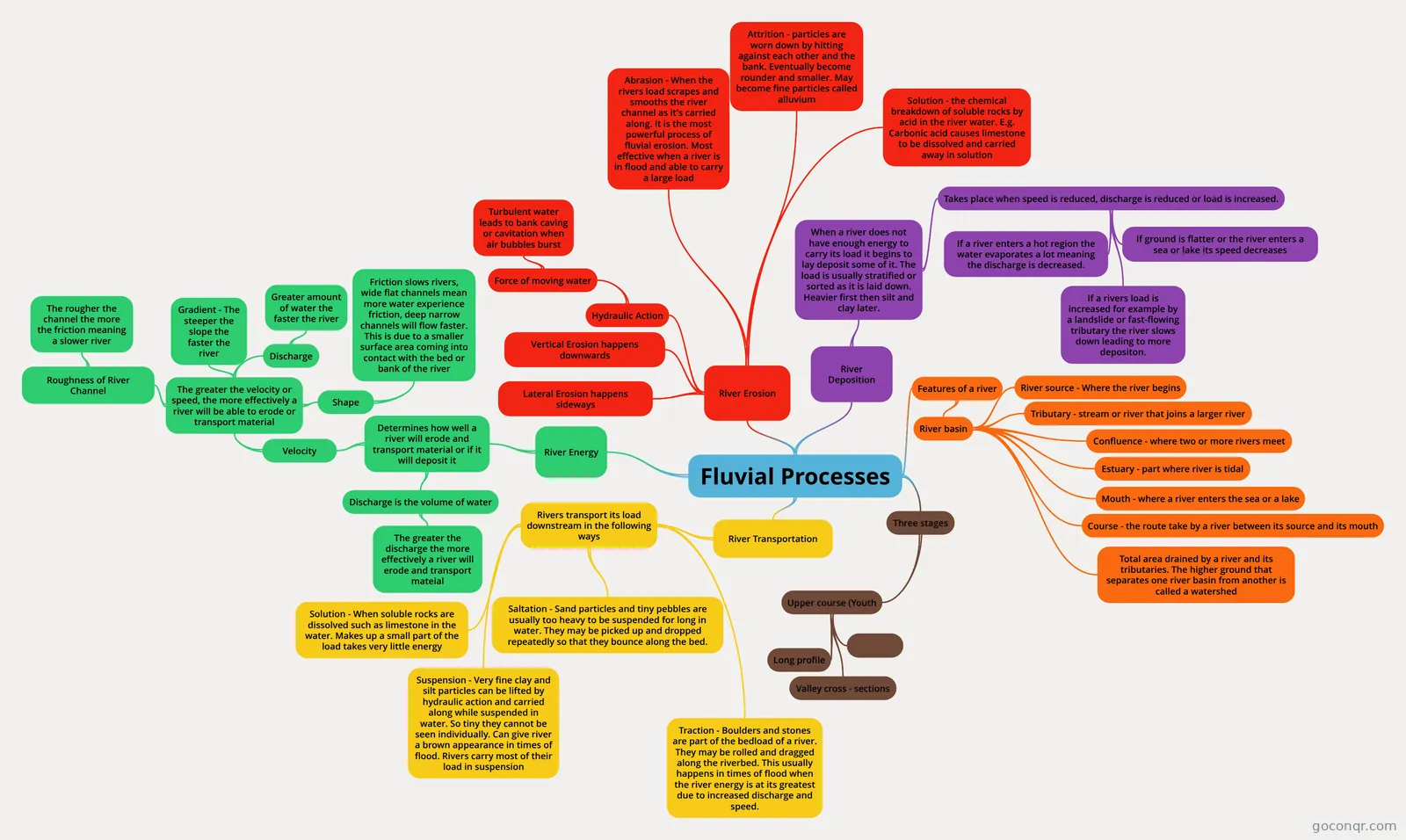
Mind map: Fluvial processes
Map content
Fluvial Processes
River Energy
- Determines how well a river will erode and transport material or if it will deposit it
- Discharge is the volume of water
- The greater the discharge the more effectively a river will erode and transport mateial
- Velocity
- The greater the velocity or speed, the more effectively a river will be able to erode or transport material
- Gradient - The steeper the slope the faster the river
- Discharge
- Greater amount of water the faster the river
- Shape
- Friction slows rivers, wide flat channels mean more water experience friction, deep narrow channels will flow faster. This is due to a smaller surface area coming into contact with the bed or bank of the river
- Roughness of River Channel
- The rougher the channel the more the friction meaning a slower river
- The greater the velocity or speed, the more effectively a river will be able to erode or transport material
- Discharge is the volume of water
- Determines how well a river will erode and transport material or if it will deposit it
River Erosion
- Vertical Erosion happens downwards
- Lateral Erosion happens sideways
- Hydraulic Action
- Force of moving water
- Turbulent water leads to bank caving or cavitation when air bubbles burst
- Force of moving water
- Abrasion - When the rivers load scrapes and smooths the river channel as it's carried along. It is the most powerful process of fluvial erosion. Most effective when a river is in flood and able to carry a large load
- Attrition - particles are worn down by hitting against each other and the bank. Eventually become rounder and smaller. May become fine particles called alluvium
- Solution - the chemical breakdown of soluble rocks by acid in the river water. E.g. Carbonic acid causes limestone to be dissolved and carried away in solution
River Transportation
- Rivers transport its load downstream in the following ways
- Solution - When soluble rocks are dissolved such as limestone in the water. Makes up a small part of the load takes very little energy
- Suspension - Very fine clay and silt particles can be lifted by hydraulic action and carried along while suspended in water. So tiny they cannot be seen individually. Can give river a brown appearance in times of flood. Rivers carry most of their load in suspension
- Saltation - Sand particles and tiny pebbles are usually too heavy to be suspended for long in water. They may be picked up and dropped repeatedly so that they bounce along the bed.
- Traction - Boulders and stones are part of the bedload of a river. They may be rolled and dragged along the riverbed. This usually happens in times of flood when the river energy is at its greatest due to increased discharge and speed.
- Rivers transport its load downstream in the following ways
River Deposition
- When a river does not have enough energy to carry its load it begins to lay deposit some of it. The load is usually stratified or sorted as it is laid down. Heavier first then silt and clay later.
- Takes place when speed is reduced, discharge is reduced or load is increased.
- If a river enters a hot region the water evaporates a lot meaning the discharge is decreased.
- If ground is flatter or the river enters a sea or lake its speed decreases
- If a rivers load is increased for example by a landslide or fast-flowing tributary the river slows down leading to more depositon.
- Takes place when speed is reduced, discharge is reduced or load is increased.
- When a river does not have enough energy to carry its load it begins to lay deposit some of it. The load is usually stratified or sorted as it is laid down. Heavier first then silt and clay later.
Features of a river
- River basin
- Total area drained by a river and its tributaries. The higher ground that separates one river basin from another is called a watershed
- River source - Where the river begins
- Tributary - stream or river that joins a larger river
- Confluence - where two or more rivers meet
- Estuary - part where river is tidal
- Mouth - where a river enters the sea or a lake
- Course - the route take by a river between its source and its mouth
- River basin
Three stages
- Upper course (Youth
- Long profile
- Valley cross - sections
- Upper course (Youth
Information
- Description
- Mind Map on Fluvial Processes, created by richard fox on 12/21/2017.
- Created by
- richard fox
- Views
- 20
- Rating