
Mind map
External Influences on Business Activity
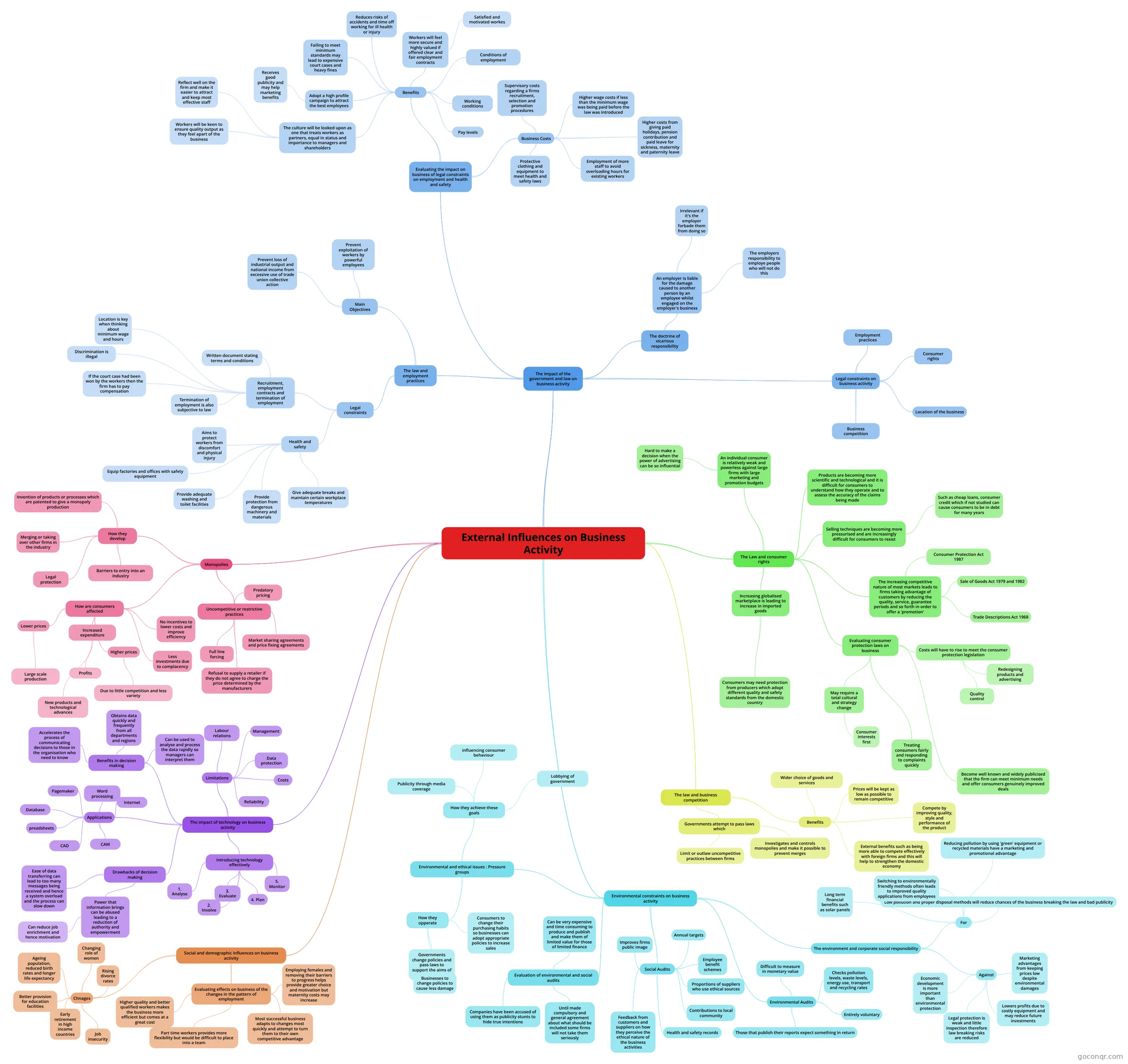
Mind map: External influences on business activity
Map content
External Influences on Business Activity
The impact of the government and law on business activity
- The doctrine of vicarious responsibility
- An employer is liable for the damage caused to another person by an employee whilst engaged on the employer's business
- Irrelevant if it's the employer forbade them from doing so
- The employers responsibility to employe people who will not do this
- An employer is liable for the damage caused to another person by an employee whilst engaged on the employer's business
- Legal constraints on business activity
- Employment practices
- Consumer rights
- Business competition
- Location of the business
- The law and employment practices
- Main Objectives
- Prevent exploitation of workers by powerful employees
- Prevent loss of industrial output and national income from excessive use of trade union collective action
- Legal constraints
- Recruitment, employment contracts and termination of employment
- Written document stating terms and conditions
- Discrimination is illegal
- Termination of employment is also subjective to law
- If the court case had been won by the workers then the firm has to pay compensation
- Location is key when thinking about minimum wage and hours
- Health and safety
- Aims to protect workers from discomfort and physical injury
- Equip factories and offices with safety equipment
- Provide adequate washing and toilet facilities
- Provide protection from dangerous machinery and materials
- Give adequate breaks and maintain certain workplace temperatures
- Recruitment, employment contracts and termination of employment
- Main Objectives
- Evaluating the impact on business of legal constraints on employment and health and safety
- Business Costs
- Supervisory costs regarding a firms recruitment, selection and promotion procedures
- Higher wage costs if less than the minimum wage was being paid before the law was introduced
- Higher costs from giving paid holidays, pension contribution and paid leave for sickness, maternity and paternity leave
- Employment of more staff to avoid overloading hours for existing workers
- Protective clothing and equipment to meet health and safety laws
- Benefits
- Conditions of employment
- Pay levels
- Working conditions
- Workers will feel more secure and highly valued if offered clear and fair employment contracts
- Satisfied and motivated workes
- Reduces risks of accidents and time off working for ill health or injury
- Failing to meet minimum standards may lead to expensive court cases and heavy fines
- Adopt a high profile campaign to attract the best employees
- Receives good publicity and may help marketing benefits
- The culture will be looked upon as one that treats workers as partners, equal in status and importance to managers and shareholders
- Reflect well on the firm and make it easier to attract and keep most effective staff
- Workers will be keen to ensure quality output as they feel apart of the business
- Business Costs
- The doctrine of vicarious responsibility
The Law and consumer rights
- An individual consumer is relatively weak and powerless against large firms with large marketing and promotion budgets
- Hard to make a decision when the power of advertising can be so influential
- Products are becoming more scientific and technological and it is difficult for consumers to understand how they operate and to assess the accuracy of the claims being made
- Selling techniques are becoming more pressurised and are increasingly difficult for consumers to resist
- Such as cheap loans, consumer credit which if not studied can cause consumers to be in debt for many years
- Increasing globalised marketplace is leading to increase in imported goods
- Consumers may need protection from producers which adopt different quality and safety standards from the domestic country
- The increasing competitive nature of most markets leads to firms taking advantage of customers by reducing the quality, service, guarantee periods and so forth in order to offer a 'promotion'
- Sale of Goods Act 1979 and 1982
- Trade Descriptions Act 1968
- Consumer Protection Act 1987
- Evaluating consumer protection laws on business
- Costs will have to rise to meet the consumer protection legislation
- Redesigning products and advertising
- Quality control
- Treating consumers fairly and responding to complaints quickly
- May require a total cultural and strategy change
- Consumer interests first
- Become well known and widely publicised that the firm can meet minimum needs and offer consumers genuinely improved deals
- Costs will have to rise to meet the consumer protection legislation
- An individual consumer is relatively weak and powerless against large firms with large marketing and promotion budgets
The law and business competition
- Benefits
- Wider choice of goods and services
- Prices will be kept as low as possible to remain competitive
- Compete by improving quality, style and performance of the product
- External benefits such as being more able to compete effectively with foreign firms and this will help to strengthen the domestic economy
- Governments attempt to pass laws which
- Investigates and controls monopolies and make it possible to prevent merges
- Limit or outlaw uncompetitive practices between firms
- Benefits
Monopolies
- How they develop
- Invention of products or processes which are patented to give a monopoly production
- Merging or taking over other firms in the industry
- Legal protection
- Barriers to entry into an industry
- How are consumers affected
- Lower prices
- Large scale production
- Increased expenditure
- New products and technological advances
- Profits
- Higher prices
- Due to little competition and less variety
- Less investments due to complacency
- No incentives to lower costs and improve efficiency
- Lower prices
- Uncompetitive or restrictive practices
- Refusal to supply a retailer if they do not agree to charge the price determined by the manufacturers
- Full line forcing
- Market sharing agreements and price fixing agreements
- Predatory pricing
- How they develop
The impact of technology on business activity
- Limitations
- Costs
- Labour relations
- Reliability
- Data protection
- Management
- Benefits in decision making
- Obtains data quickly and frequently from all departments and regions
- Can be used to analyse and process the data rapidly so managers can interpret them
- Accelerates the process of communicating decisions to those in the organisation who need to know
- Applications
- Word processing
- Pagemaker
- Database
- preadsheets
- CAD
- CAM
- Internet
- Drawbacks of decision making
- Ease of data transferring can lead to too many messages being received and hence a system overload and the process can slow down
- Power that information brings can be abused leading to a reduction of authority and empowerment
- Can reduce job enrichment and hence motivation
- Introducing technology effectively
- 1. Analyse
- 2. Involve
- 3. Evaluate
- 4. Plan
- 5. Monitor
- Limitations
Social and demographic influences on business activity
- Chnages
- Ageing population, reduced birth rates and longer life expectancy
- Changing role of women
- Better provision for education facilities
- Early retirement in high income countries
- Rising divorce rates
- Job insecurity
- Evaluating effects on business of the changes in the pattern of employment
- Higher quality and better qualified workers makes the business more efficient but comes at a great cost
- Part time workers provides more flexibility but would be difficult to place into a team
- Employing females and removing their barriers to progress helps provide greater choice and motivation but maternity costs may increase
- Most successful business adapts to changes most quickly and attempt to turn them to their own competitive advantage
- Chnages
Environmental constraints on business activity
- The environment and corporate social responsibility
- For
- Reducing pollution by using 'green' equipment or recycled materials have a marketing and promotional advantage
- Low pollution and proper disposal methods will reduce chances of the business breaking the law and bad publicity
- Switching to environmentally friendly methods often leads to improved quality applications from employees
- Long term financial benefits such as solar panels
- Against
- Marketing advantages from keeping prices low despite environmental damages
- Lowers profits due to costly equipment and may reduce future investments
- Legal protection is weak and little inspection therefore law breaking risks are reduced
- Economic development is more important than environmental protection
- For
- Environmental Audits
- Difficult to measure in monetary value
- Checks pollution levels, waste levels, energy use, transport and recycling rates
- Entirely voluntary
- Those that publish their reports expect something in return
- Social Audits
- Health and safety records
- Contributions to local community
- Proportions of suppliers who use ethical sources
- Employee benefit schemes
- Feedback from customers and suppliers on how they perceive the ethical nature of the business activities
- Annual targets
- Improves firms public image
- Evaluation of environmental and social audits
- Until made compulsory and general agreement about what should be included some firms will not take them seriously
- Companies have been accused of using them as publicity stunts to hide true intentions
- Can be very expensive and time consuming to produce and publish and make them of limited value for those of limited finance
- Environmental and ethical issues : Pressure groups
- How they opperate
- Governments change policies and pass laws to support the aims of the group
- Businesses to change policies to cause less damage
- Consumers to change their purchasing habits so businesses can adopt appropriate policies to increase sales
- How they achieve these goals
- Publicity through media coverage
- influencing consumer behaviour
- Lobbying of government
- How they opperate
- The environment and corporate social responsibility
Information
- Description
- Mind Map on External Influences on Business Activity, created by jolenedewitt on 17/09/2014.
- Created by
- jolenedewitt
- Views
- 26
- Rating
More on Government and Political Influences on Business