
Mind map
GM Week 10
Map content
GM Week 10
Line Integrals
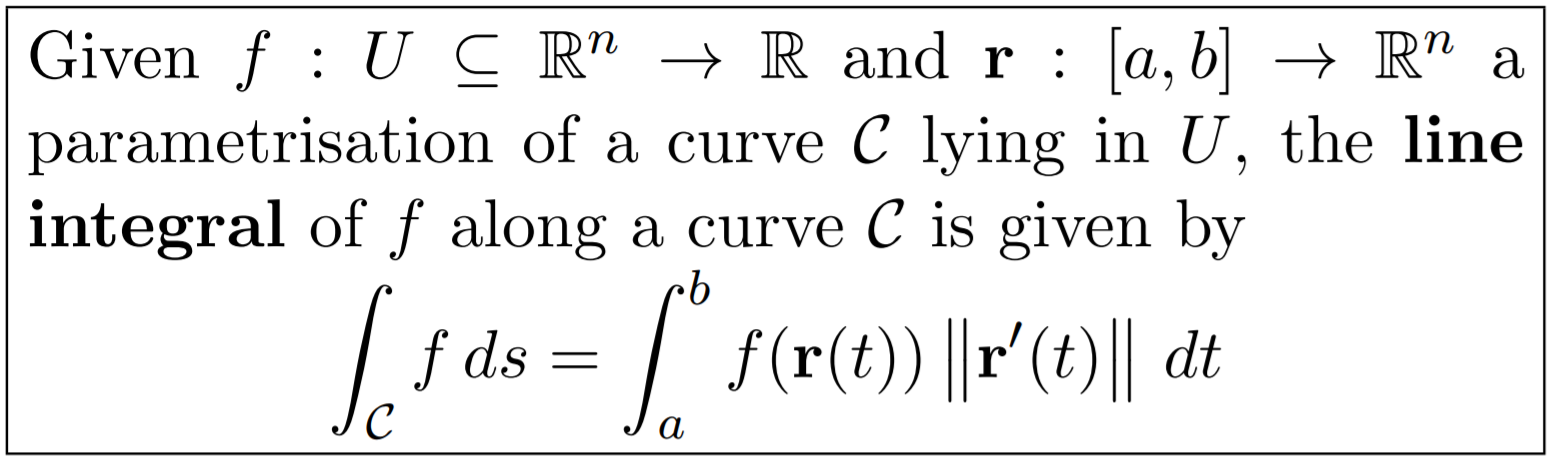
- Why restrict ourselves to just integrating along straight lines? We known how to work with curves so let us generalise and consider a curve in the plane and a function f(x, y) that is positive in some region containing the curve. A surface is formed by f over the curve. Think of a curtain hanging down from f to the curve. We want to compute the area of this curtain by integration
- In practice, such an integral is evaluated by parametrising the curve. Given a parametrisation of the curve r(t), t ∈ [a, b], the infinitesimal arc length
- It is not necessary to restrict to positive functions, nor does the method depend on dimension. The relationship ds = ||r'(t)||dt holds in any dimension. Thus we can go directly to the general formula.
- Note that in our definition of the line integral f is a function defined on a region of R n . It also happens that one may have f defined only on the curve. For example, f might represent the linear density (mass per unit length) of a wire (the curve). Therefore f only has meaning on the curve
- It is not necessary to restrict to positive functions, nor does the method depend on dimension. The relationship ds = ||r'(t)||dt holds in any dimension. Thus we can go directly to the general formula.
- In practice, such an integral is evaluated by parametrising the curve. Given a parametrisation of the curve r(t), t ∈ [a, b], the infinitesimal arc length
- Why restrict ourselves to just integrating along straight lines? We known how to work with curves so let us generalise and consider a curve in the plane and a function f(x, y) that is positive in some region containing the curve. A surface is formed by f over the curve. Think of a curtain hanging down from f to the curve. We want to compute the area of this curtain by integration
Line Integrals and Vector Fields
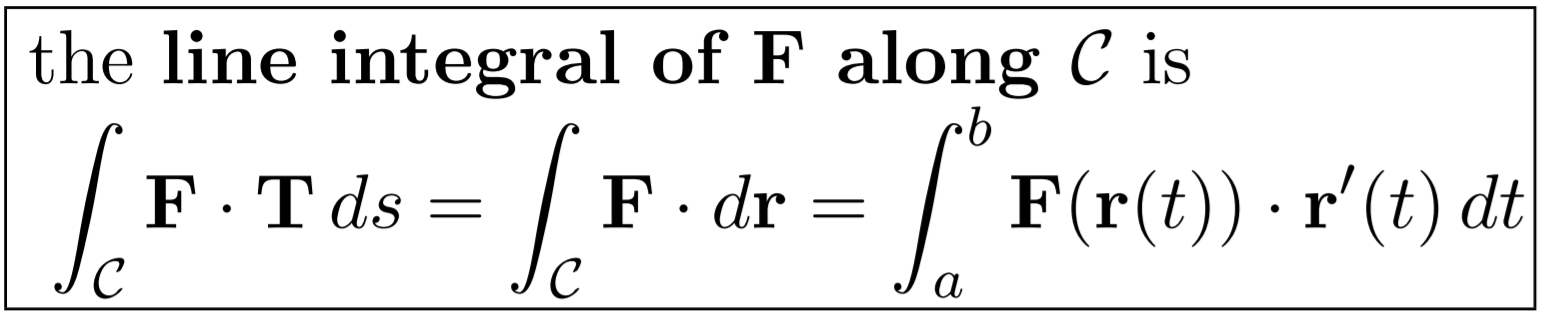
- Given a vector field F, it frequently occurs that one wants to compute a line integral where the function f is f = F · T where T is the unit tangent vector to the curve C.
- Note in particular that if F = ∇f then:
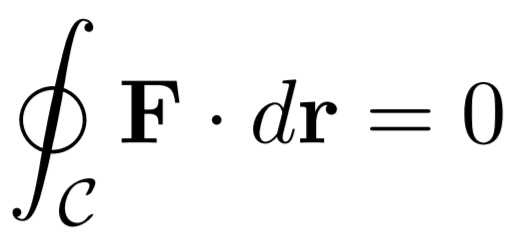
- for any closed curve C because ra = rb for a closed curve.
- With some mild conditions, it can be shown that if all line integrals of a vector field F are path independent, or equivalently if the line integral around all closed curves is zero, then F is a conservative vector field and there is a function f such that a F = ∇f. The converse is generally easier, although perhaps less important. If the line integral of F around a close path is not zero, then F is definitely not a conservative vector field and it cannot be expressed as the gradient of a function
- for any closed curve C because ra = rb for a closed curve.
- Note in particular that if F = ∇f then:
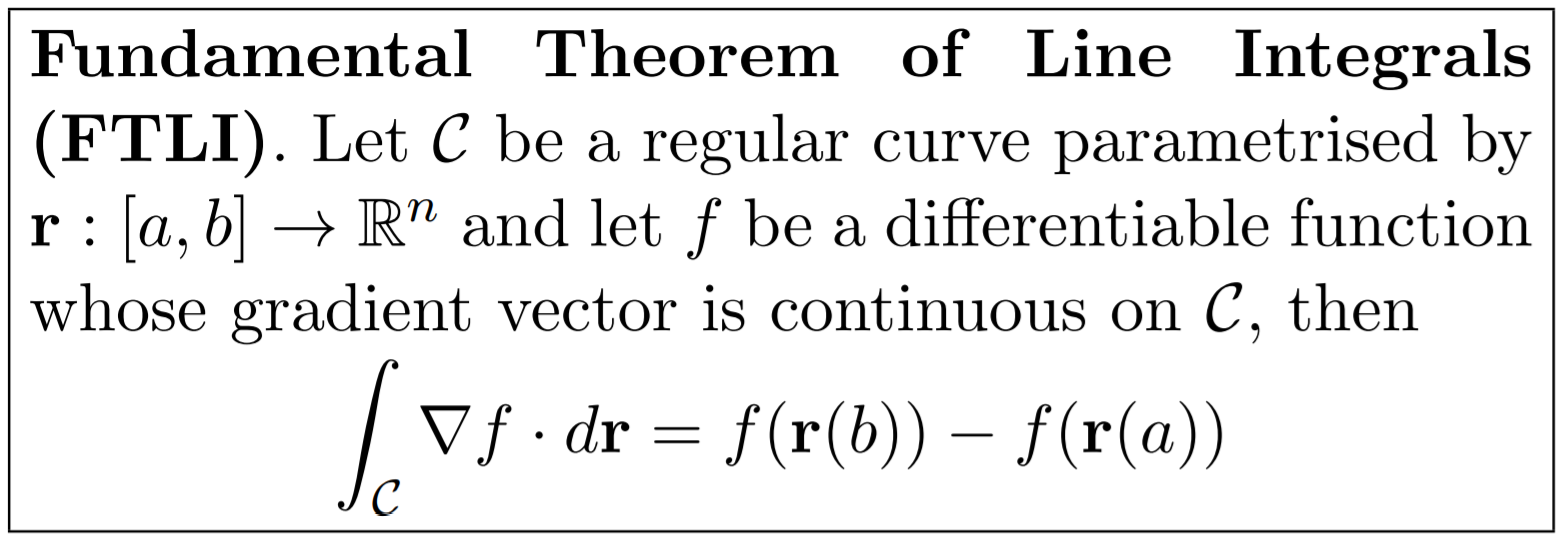
- When we introduced vector fields it was noted that an important class of vector fields was that obtained as the gradient of a function of several variables: F = ∇f. Such vector fields are called conservative vector fields. They are important because they arise in practice and because the following holds
- Line integrals of vector fields are not independent of the orientation of the curve. The reason is that is that if one reverses the orientation of a curve, then the tangent vector changes sign. Denoting −C as the curve C with the opposite orientation, then
- The FTLI tells use that if we know our vector field F is a conservative vector field, and hence given by gradient of some function f, then we can evaluate any line integral of F over C simply by evaluating f at the end points of C. Call these points ra and rb. The importance is not just that it simplifies our calculations, but the fact that since the integral depends only on the end points, it in fact must be the same for any curve that starts ra and ends at rb. The line integral is said to by path independent.
- Line integrals of vector fields are not independent of the orientation of the curve. The reason is that is that if one reverses the orientation of a curve, then the tangent vector changes sign. Denoting −C as the curve C with the opposite orientation, then
Relationship between Various Line & Surface Integrals
- First consider integration of scalar functions. Line integration of scalar functions and surface integration of scalar function are similar concepts. Surface integration can be thought of as the extension of line integration, just as double integration (Week 6) is an extension of single variable integration.
- On the other hand, line integrals of vector functions and flux integrals through a surface correspond to very different concepts. For line integrals of vector functions, the integrand is the dot product between the vector field F(r) an the tangent T to the curve. The integral measures total component of F(r) in direction of the curve.
- For flux integrals, the integrand is the dot product between the vector field an the unit normal n to the surface. The integral measures total component of F crossing the surface. The relevant physical idea is sometime traversing or passing through the surface (whether anything actually crosses the surface of not). The surface must be of dimension one less than the dimension of the space, i.e. we consider a two-dimensional surface in R 3 . In fact, it is perfectly sensible to define flux integrals for two dimensional vectors field F : R 2 → R 2 .
Applications
- Work
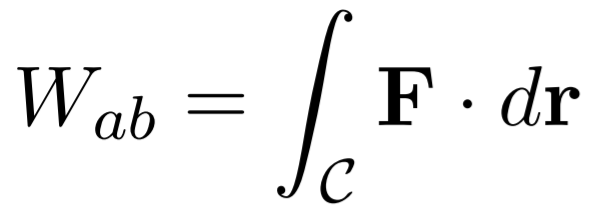
- Work is an important physical concept that you can learn all about in a mechanics module. It is a classic example of a case where one needs to do line integrals of a vector field. If a force F(r) acts on a point particle and the particle moves from position ra to rb along a curve C, then the work Wab done by the force on the particle is
- This definition is independent of whether or not the force F(r) is a conservative vector field
- Work is an important physical concept that you can learn all about in a mechanics module. It is a classic example of a case where one needs to do line integrals of a vector field. If a force F(r) acts on a point particle and the particle moves from position ra to rb along a curve C, then the work Wab done by the force on the particle is
- Circulation
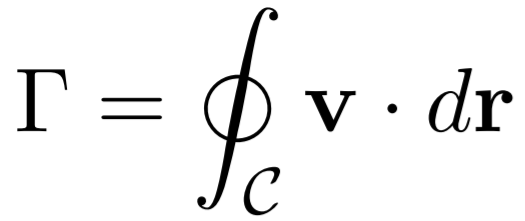
- For many vector fields, line integrals around closed curves have physical significance. In fluid dynamics, for example, such integrals give what is known as the circulation of the fluid around the curve.
- For many vector fields, line integrals around closed curves have physical significance. In fluid dynamics, for example, such integrals give what is known as the circulation of the fluid around the curve.
- Intuitively this integral corresponds to the net amount the fluid is circulating around the curve.
- For many vector fields, line integrals around closed curves have physical significance. In fluid dynamics, for example, such integrals give what is known as the circulation of the fluid around the curve.
- For many vector fields, line integrals around closed curves have physical significance. In fluid dynamics, for example, such integrals give what is known as the circulation of the fluid around the curve.
- Work
Images and files in the map

Information
- Description
- Mind Map on GM Week 10, created by Anthony Rajecki-Doyle on 31/03/2018.
- Created by
- Anthony Rajecki-Doyle
- Views
- 0
- Rating