
Mind map
Alternative Dispute Resolution: Arbitration vs. Mediation
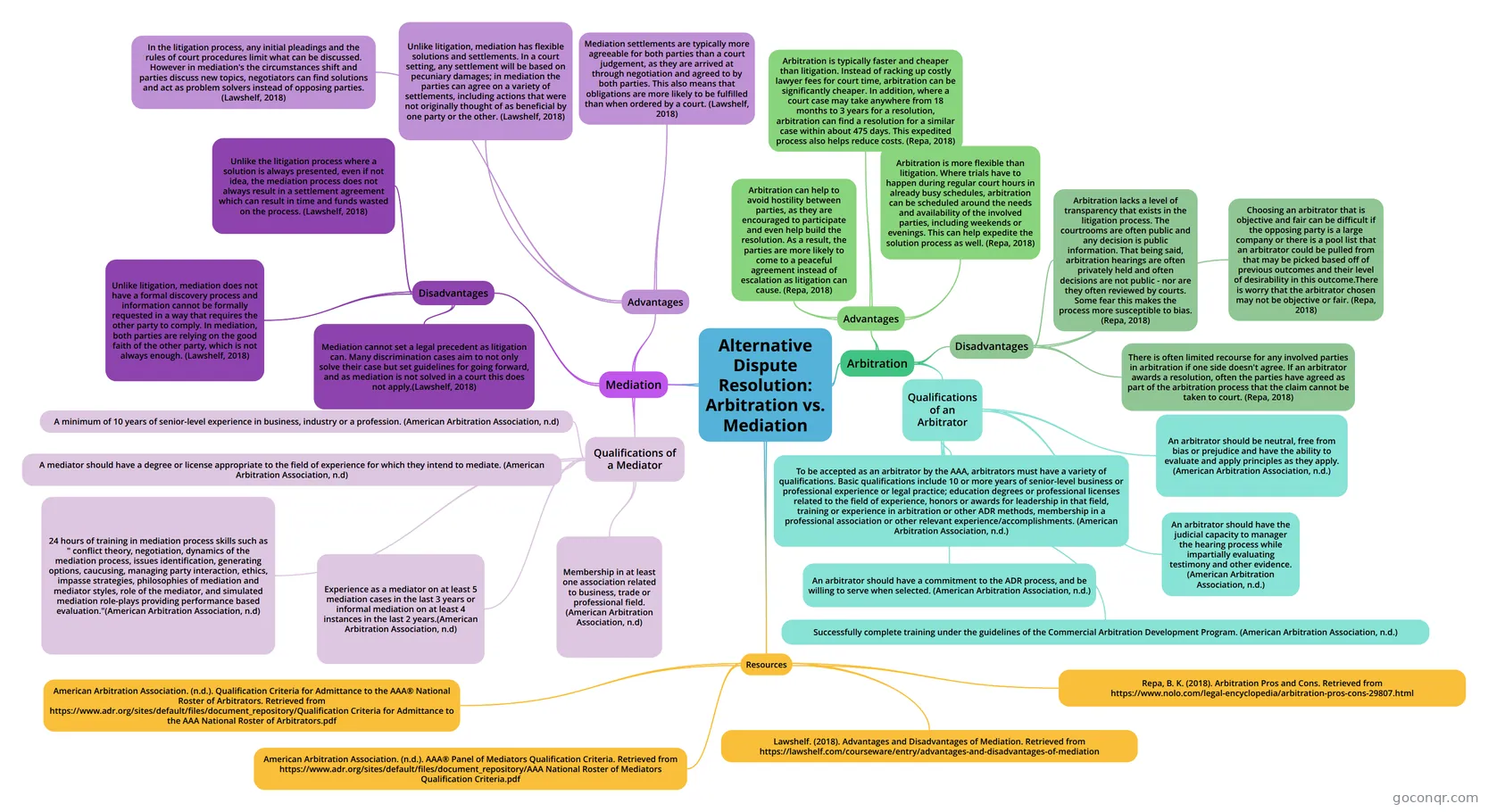
Mind map: Alternative dispute resolution: arbitration vs. mediation
Map content
Alternative Dispute Resolution: Arbitration vs. Mediation
Arbitration
- Advantages
- Arbitration can help to avoid hostility between parties, as they are encouraged to participate and even help build the resolution. As a result, the parties are more likely to come to a peaceful agreement instead of escalation as litigation can cause. (Repa, 2018)
- Arbitration is typically faster and cheaper than litigation. Instead of racking up costly lawyer fees for court time, arbitration can be significantly cheaper. In addition, where a court case may take anywhere from 18 months to 3 years for a resolution, arbitration can find a resolution for a similar case within about 475 days. This expedited process also helps reduce costs. (Repa, 2018)
- Arbitration is more flexible than litigation. Where trials have to happen during regular court hours in already busy schedules, arbitration can be scheduled around the needs and availability of the involved parties, including weekends or evenings. This can help expedite the solution process as well. (Repa, 2018)
- Disadvantages
- There is often limited recourse for any involved parties in arbitration if one side doesn't agree. If an arbitrator awards a resolution, often the parties have agreed as part of the arbitration process that the claim cannot be taken to court. (Repa, 2018)
- Arbitration lacks a level of transparency that exists in the litigation process. The courtrooms are often public and any decision is public information. That being said, arbitration hearings are often privately held and often decisions are not public - nor are they often reviewed by courts. Some fear this makes the process more susceptible to bias. (Repa, 2018)
- Choosing an arbitrator that is objective and fair can be difficult if the opposing party is a large company or there is a pool list that an arbitrator could be pulled from that may be picked based off of previous outcomes and their level of desirability in this outcome.There is worry that the arbitrator chosen may not be objective or fair. (Repa, 2018)
- Qualifications of an Arbitrator
- To be accepted as an arbitrator by the AAA, arbitrators must have a variety of qualifications. Basic qualifications include 10 or more years of senior-level business or professional experience or legal practice; education degrees or professional licenses related to the field of experience, honors or awards for leadership in that field, training or experience in arbitration or other ADR methods, membership in a professional association or other relevant experience/accomplishments. (American Arbitration Association, n.d.)
- An arbitrator should be neutral, free from bias or prejudice and have the ability to evaluate and apply principles as they apply. (American Arbitration Association, n.d.)
- An arbitrator should have the judicial capacity to manager the hearing process while impartially evaluating testimony and other evidence. (American Arbitration Association, n.d.)
- An arbitrator should have a commitment to the ADR process, and be willing to serve when selected. (American Arbitration Association, n.d.)
- Successfully complete training under the guidelines of the Commercial Arbitration Development Program. (American Arbitration Association, n.d.)
- Advantages
Resources
- Repa, B. K. (2018). Arbitration Pros and Cons. Retrieved from https://www.nolo.com/legal-encyclopedia/arbitration-pros-cons-29807.html
- American Arbitration Association. (n.d.). Qualification Criteria for Admittance to the AAA® National Roster of Arbitrators. Retrieved from https://www.adr.org/sites/default/files/document_repository/Qualification Criteria for Admittance to the AAA National Roster of Arbitrators.pdf
- Lawshelf. (2018). Advantages and Disadvantages of Mediation. Retrieved from https://lawshelf.com/courseware/entry/advantages-and-disadvantages-of-mediation
- American Arbitration Association. (n.d.). AAA® Panel of Mediators Qualification Criteria. Retrieved from https://www.adr.org/sites/default/files/document_repository/AAA National Roster of Mediators Qualification Criteria.pdf
Mediation
- Advantages
- Mediation settlements are typically more agreeable for both parties than a court judgement, as they are arrived at through negotiation and agreed to by both parties. This also means that obligations are more likely to be fulfilled than when ordered by a court. (Lawshelf, 2018)
- Unlike litigation, mediation has flexible solutions and settlements. In a court setting, any settlement will be based on pecuniary damages; in mediation the parties can agree on a variety of settlements, including actions that were not originally thought of as beneficial by one party or the other. (Lawshelf, 2018)
- In the litigation process, any initial pleadings and the rules of court procedures limit what can be discussed. However in mediation's the circumstances shift and parties discuss new topics, negotiators can find solutions and act as problem solvers instead of opposing parties. (Lawshelf, 2018)
- Disadvantages
- Unlike the litigation process where a solution is always presented, even if not idea, the mediation process does not always result in a settlement agreement which can result in time and funds wasted on the process. (Lawshelf, 2018)
- Unlike litigation, mediation does not have a formal discovery process and information cannot be formally requested in a way that requires the other party to comply. In mediation, both parties are relying on the good faith of the other party, which is not always enough. (Lawshelf, 2018)
- Mediation cannot set a legal precedent as litigation can. Many discrimination cases aim to not only solve their case but set guidelines for going forward, and as mediation is not solved in a court this does not apply.(Lawshelf, 2018)
- Qualifications of a Mediator
- A minimum of 10 years of senior-level experience in business, industry or a profession. (American Arbitration Association, n.d)
- A mediator should have a degree or license appropriate to the field of experience for which they intend to mediate. (American Arbitration Association, n.d)
- 24 hours of training in mediation process skills such as " conflict theory, negotiation, dynamics of the mediation process, issues identification, generating options, caucusing, managing party interaction, ethics, impasse strategies, philosophies of mediation and mediator styles, role of the mediator, and simulated mediation role-plays providing performance based evaluation."(American Arbitration Association, n.d)
- Experience as a mediator on at least 5 mediation cases in the last 3 years or informal mediation on at least 4 instances in the last 2 years.(American Arbitration Association, n.d)
- Membership in at least one association related to business, trade or professional field. (American Arbitration Association, n.d)
- Advantages
Information
- Description
- Mind Map on Alternative Dispute Resolution: Arbitration vs. Mediation, created by Kimberly Helwig on 03/04/2018.
- Created by
- Kimberly Helwig
- Views
- 0
- History
-
- Created by Kimberly Helwig · Apr 3, 2018
- Copied by Kimberly Helwig · Apr 3, 2018
- Rating
More on Comparing Mediation, Arbitration and Litigation