Mind map
Genetics Exam 3
Map content
Genetics Exam 3
chapter 10
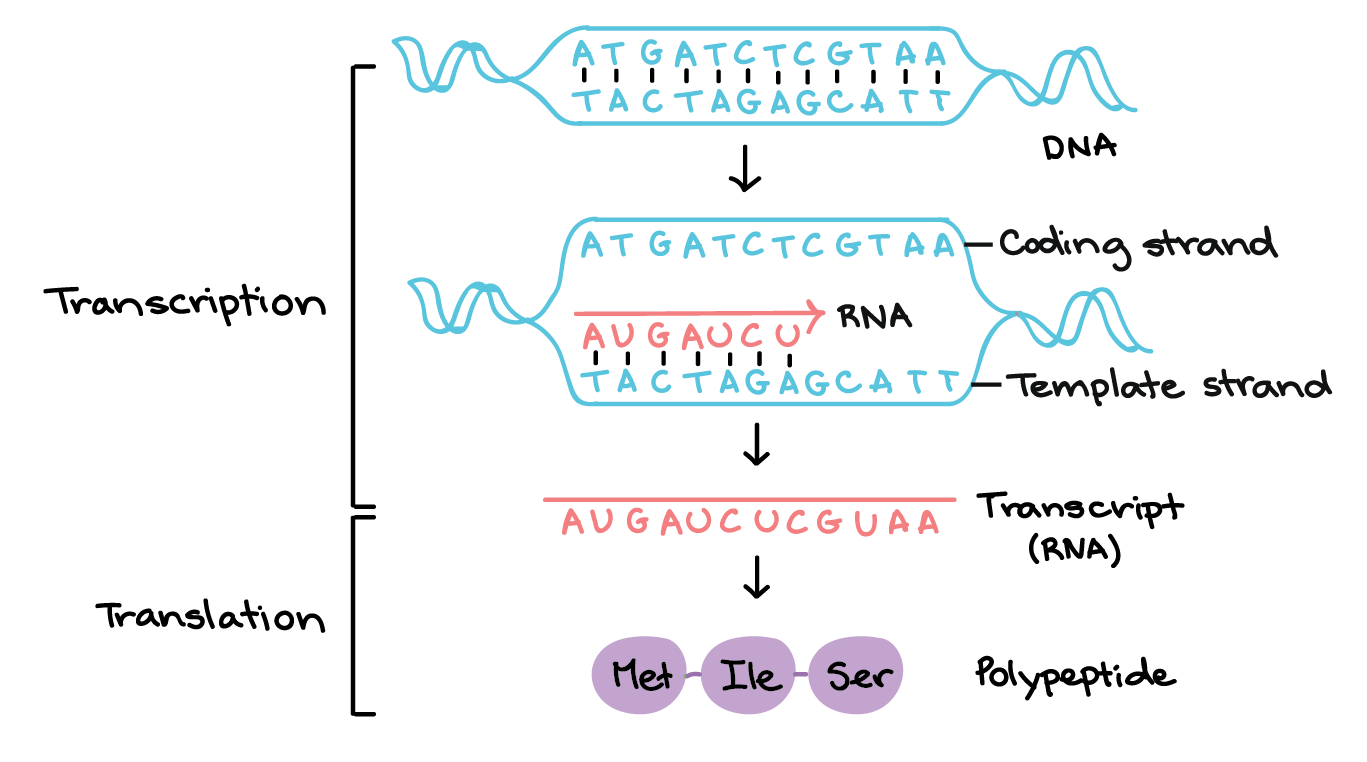
- central dogma
- DNA -> RNA -> proteins transcription is major control point!
- replication
- DNA -> DNA
- transcription
- DNA -> RNA
- translation
- RNA -> proteins
- DNA vs. RNA
- both
- -made of nucleotides joined by phosphodiester bonds
- DNA
- -deoxyribose sugar -T -usually double -more stable :)
- RNA
- -ribose sugar -has 2'-OH group -usually single, but can form intramolecular dbl strands -U
- mRNA
- messenger RNA in cytoplasm/nucleus carries genetic code for proteins
- rRNA
- ribosomal RNA in cytoplasm structural/functional component of ribosomes
- tRNA
- transfer RNA cytoplasm moves amino acids into polypep chains
- both
- beadle & tatum
- made mutants -> crossed them w wt -> found missing proteins -> found arganine was needed *ONE ENZYME ENCODED BY ONE GENE
- khorana and nirenburg
- found which codons encode for which amino acid 1 start 3 stop
- jacob & monod
- discovered mRNA
- syndey brenner
- said code was triplet was supported bcus only three base insertion/deletion could restore polypeptide order
- CODON
- set of 3 nucleotides responsible for coding an amino acid
- transcription
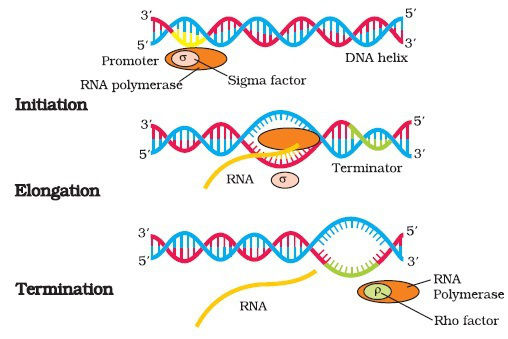
- 1. dsDNA template 2. DNA dependent RNAP 3. NTP + buffer
- dsDNA
- transcription unit
- made of promoter (RNAP binds), structural gene (RNA coding), + terminator (stops).
- 1. initiation
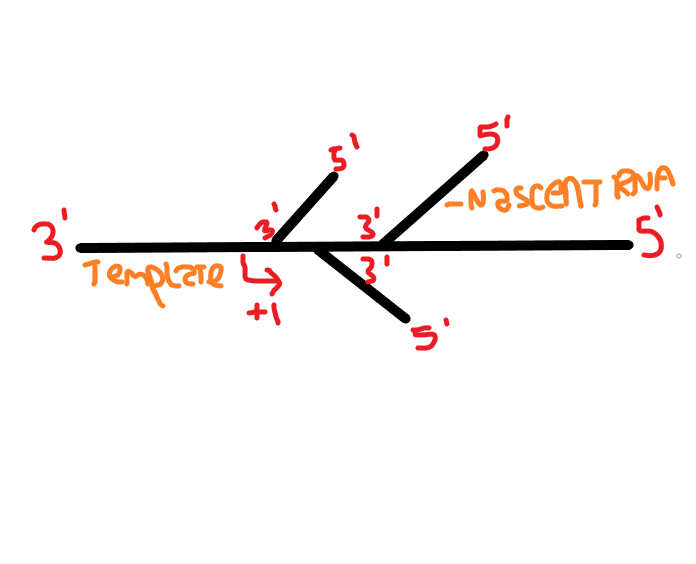
- main control point RNAP + signma bind promoter (holoenzyme) -> DNA melted -> first NT added -> RNAP leaves starts @ +1 downstream
- RNAP
- I & II knows how to bind bcus of 12 base sequence at target site
- 2. elongation
- NTs add 5'-3' -> as RNAP moves down the pieces behind reanneal
- 3. termination
- stop signal signal = DNA sequence OR DNA sequence + termination protein
- oscar miller
- christmas tree thing
- colinearity
- # nucleotides amino acids in DNA = # of amino acids in proteins -tested by DNA:RNA hybridization
- DNA:RNA hybridization
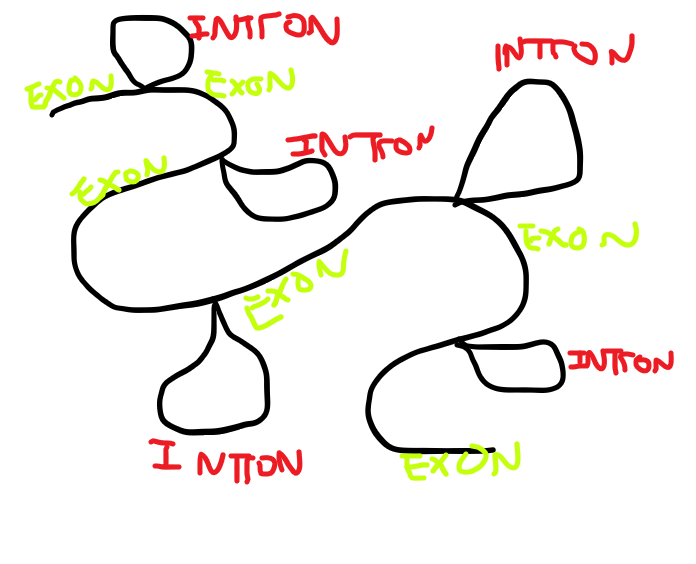
- 1. RNA is compatible with more than one spot on DNA 2. ssDNA reanneals to other OR RNA FOUND INTRONS AND EXONS
- introns
- noncoding DNA
- exons
- coding DNA
- post-transcription modification
- 1. base addition (5' cap/3' polyA tail) 2. base modification (tRNA, hairpin) 3. RNA splicing (intron removal)
- hairpin loop
- when ssRNA folds in on itself during transcription
- transcription vs replication
- both
- -use DNA template -5'->3' -products r antiparallel and complementary to template -substrates are nucleotide triphosphates
- transcription
- -unidirectional -initiation doesnt need primer -each gene transcribed separately
- replication
- -bidirectional synthesis -initiates from a replication origin
- both
- central dogma
chapter 12
chapter 13
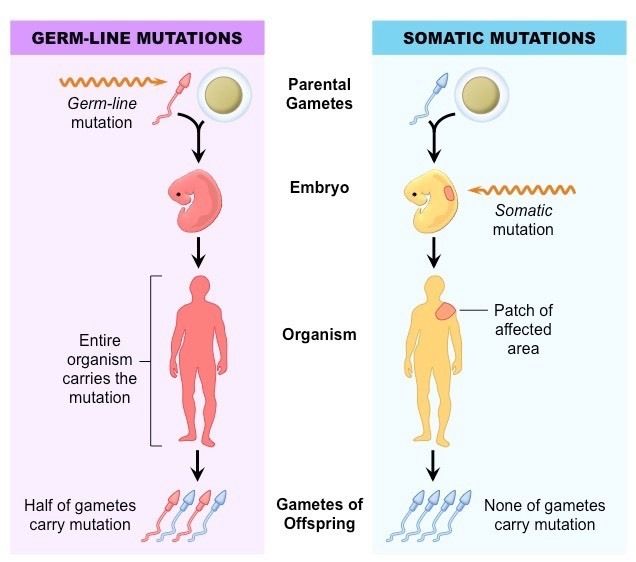
- somatic vs germline mutation
- somatic: only carrier has it, offspring don't germline: whole carrier has it, and half of offspring do
- phenotypic level
- lethal vs nonlethal
- lethal conditional- death w certain environmental conditions nonlethal conditional - no death w certain environmental conditions
- no phenotype change
- 1. doesn't occur in gene 2. occurs in gene: silent/missense
- silent mutation
- no change in amino acid sequence
- missense mutation
- changes amino acid sequence if protein function doesn't change then it is NEUTRAL
- change in phenotype
- 1. morphological 2. nutritional 3. behavioral 4. regulatory (can be pleiotrophic)
- lethal vs nonlethal
- genotypic level
- point
- change in one base
- substitution
- can have no change (silent/neutral) or cause nonsense mutation
- nonsense mutation
- changes sense codon into stop codon
- insertion
- addition of nucleotide
- frameshift mutation
- can change the reading frame, usually causes loss of function
- trinucleotide repeat
- ex: FXS/huntington's...both can undergo genetic anticipation -fxs: x linked dominant, FMR1 not expressed -huntington's: autosomal dominant
- deletion
- removal of nucleotide
- more than 1 base involved
- reverse
- wt is returned entirely
- intergenic
- 2 genes involved
- intragenic
- mutations are in the same gene
- reverse
- point
- causes of mutations
- 1. spontaneous 2. chemicals 3. radiation 4. transposable elements
- spontaneous
- 1. tautomerization 2. wobble/slippage (issues w incorporating enzymes n stuff) 3. recombination
- wobble
- nonstandard base pairing between third codon and first anticodon
- chemicals
- changing base chemical composition
- intercalating agents
- intercalate between dna bp -> dna contorts -> deletions/insertions happen
- radiation
- 1. UV - (5-300) cross links pyrimidines 2. X-ray - (.005-5) dna binds w free radicals and causes dna backbone to break
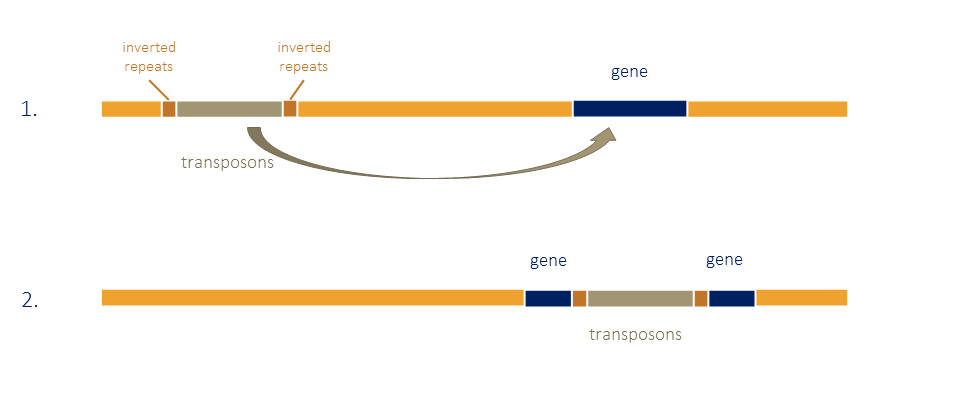
- transposable elements
- cause: insertions rearragement/duplicate of target site mobilizing surrounding DNA
- transposon
- mobile DNA due to nonrecombination 1.delineated by inverted repeats (>...<) 2. has gene encoding transposase 3. flanked by direct repeats in target
- retrotransposon
- transposes thru RNA intermediate
- ames test
- how to tell if smth is a mutagen not always valid for humans
- DNA repair
- xeroderma pigmentosum
- autosomal recessive skin sensitivity to sunlight caused by defects in DNA repair
- xeroderma pigmentosum
- somatic vs germline mutation
CRISPR
- Cas9 based targeted genome sequencing
- type of DNA damage
- 1. single strand break 2. dbl strand break 3. base adducts 4. base mismatch/insertion/deletion