
Mind map
(9) Presidential debate's
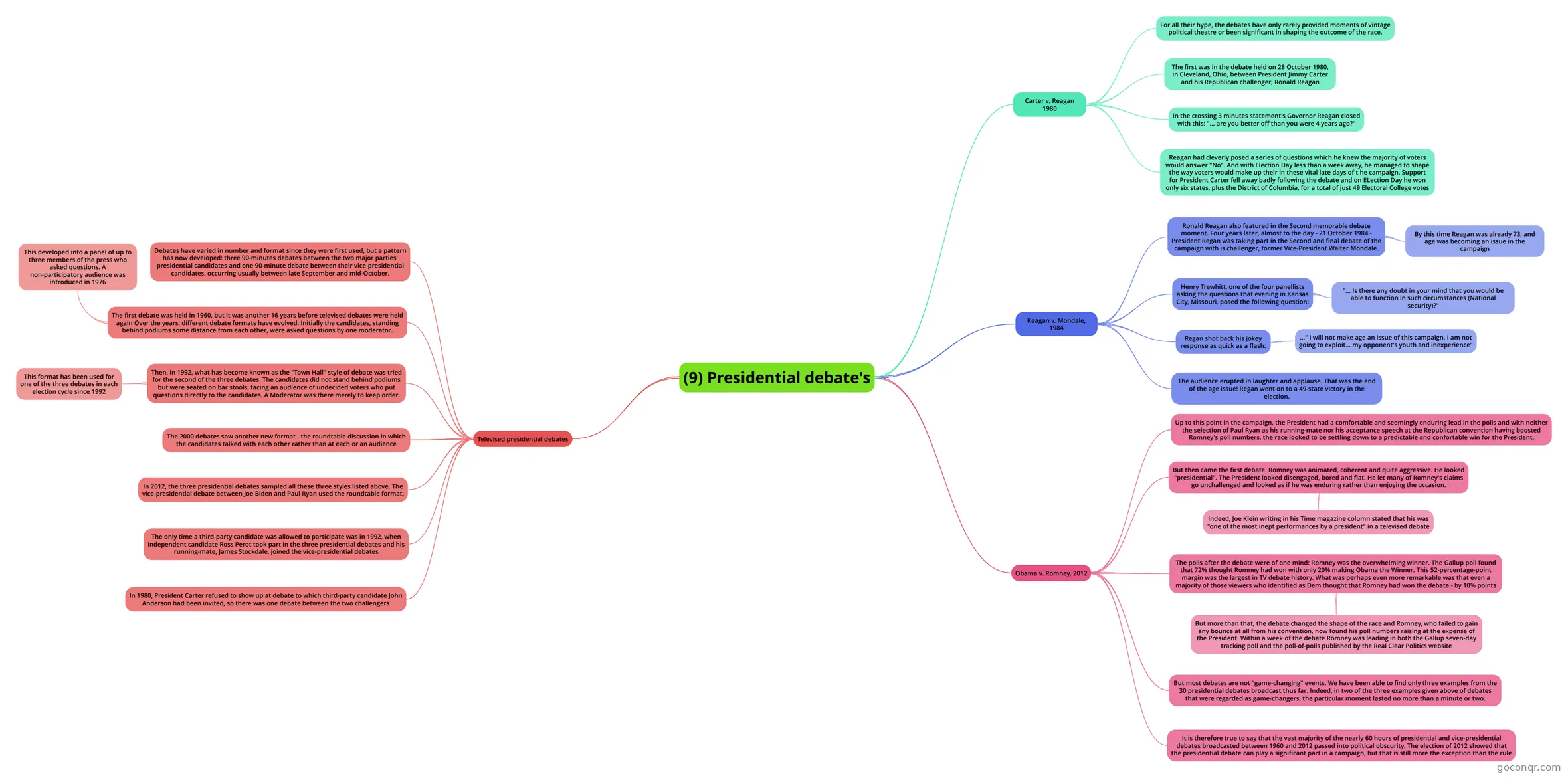
Mind map: Presidential debates
Map content
(9) Presidential debate's
Televised presidential debates
- Debates have varied in number and format since they were first used, but a pattern has now developed: three 90-minutes debates between the two major parties' presidential candidates and one 90-minute debate between their vice-presidential candidates, occurring usually between late September and mid-October.
- The first debate was held in 1960, but it was another 16 years before televised debates were held again Over the years, different debate formats have evolved. Initially the candidates, standing behind podiums some distance from each other, were asked questions by one moderator.
- This developed into a panel of up to three members of the press who asked questions. A non-participatory audience was introduced in 1976
- Then, in 1992, what has become known as the "Town Hall" style of debate was tried for the second of the three debates. The candidates did not stand behind podiums but were seated on bar stools, facing an audience of undecided voters who put questions directly to the candidates. A Moderator was there merely to keep order.
- This format has been used for one of the three debates in each election cycle since 1992
- The 2000 debates saw another new format - the roundtable discussion in which the candidates talked with each other rather than at each or an audience
- In 2012, the three presidential debates sampled all these three styles listed above. The vice-presidential debate between Joe Biden and Paul Ryan used the roundtable format.
- The only time a third-party candidate was allowed to participate was in 1992, when independent candidate Ross Perot took part in the three presidential debates and his running-mate, James Stockdale, joined the vice-presidential debates
- In 1980, President Carter refused to show up at debate to which third-party candidate John Anderson had been invited, so there was one debate between the two challengers
Carter v. Reagan 1980
- For all their hype, the debates have only rarely provided moments of vintage political theatre or been significant in shaping the outcome of the race.
- The first was in the debate held on 28 October 1980, in Cleveland, Ohio, between President Jimmy Carter and his Republican challenger, Ronald Reagan
- In the crossing 3 minutes statement's Governor Reagan closed with this: "... are you better off than you were 4 years ago?"
- Reagan had cleverly posed a series of questions which he knew the majority of voters would answer "No". And with Election Day less than a week away, he managed to shape the way voters would make up their in these vital late days of t he campaign. Support for President Carter fell away badly following the debate and on ELection Day he won only six states, plus the District of Columbia, for a total of just 49 Electoral College votes
Reagan v. Mondale, 1984
- Ronald Reagan also featured in the Second memorable debate moment. Four years later, almost to the day - 21 October 1984 - President Regan was taking part in the Second and final debate of the campaign with is challenger, former Vice-President Walter Mondale.
- By this time Reagan was already 73, and age was becoming an issue in the campaign
- Henry Trewhitt, one of the four panellists asking the questions that evening in Kansas City, Missouri, posed the following question:
- "... Is there any doubt in your mind that you would be able to function in such circumstances (National security)?"
- Regan shot back his jokey response as quick as a flash:
- ..." I will not make age an issue of this campaign. I am not going to exploit... my opponent's youth and inexperience"
- The audience erupted in laughter and applause. That was the end of the age issue! Regan went on to a 49-state victory in the election.
- Ronald Reagan also featured in the Second memorable debate moment. Four years later, almost to the day - 21 October 1984 - President Regan was taking part in the Second and final debate of the campaign with is challenger, former Vice-President Walter Mondale.
Obama v. Romney, 2012
- Up to this point in the campaign, the President had a comfortable and seemingly enduring lead in the polls and with neither the selection of Paul Ryan as his running-mate nor his acceptance speech at the Republican convention having boosted Romney's poll numbers, the race looked to be settling down to a predictable and confortable win for the President.
- But then came the first debate. Romney was animated, coherent and quite aggressive. He looked "presidential". The President looked disengaged, bored and flat. He let many of Romney's claims go unchallenged and looked as if he was enduring rather than enjoying the occasion.
- Indeed, Joe Klein writing in his Time magazine column stated that his was "one of the most inept performances by a president" in a televised debate
- The polls after the debate were of one mind: Romney was the overwhelming winner. The Gallup poll found that 72% thought Romney had won with only 20% making Obama the Winner. This 52-percentage-point margin was the largest in TV debate history. What was perhaps even more remarkable was that even a majority of those viewers who identified as Dem thought that Romney had won the debate - by 10% points
- But more than that, the debate changed the shape of the race and Romney, who failed to gain any bounce at all from his convention, now found his poll numbers raising at the expense of the President. Within a week of the debate Romney was leading in both the Gallup seven-day tracking poll and the poll-of-polls published by the Real Clear Politics website
- But most debates are not "game-changing" events. We have been able to find only three examples from the 30 presidential debates broadcast thus far. Indeed, in two of the three examples given above of debates that were regarded as game-changers, the particular moment lasted no more than a minute or two.
- It is therefore true to say that the vast majority of the nearly 60 hours of presidential and vice-presidential debates broadcasted between 1960 and 2012 passed into political obscurity. The election of 2012 showed that the presidential debate can play a significant part in a campaign, but that is still more the exception than the rule
Information
- Description
- A level US Politics - 3C ((1) Election and Voting - Presidential elections) Mind Map on (9) Presidential debate's, created by Marcus Danvers on 25/09/2014.
- Created by
- Marcus Danvers
- Views
- 6
- Rating
More on Campaign Strategy and Media