
Mind map
Mammals
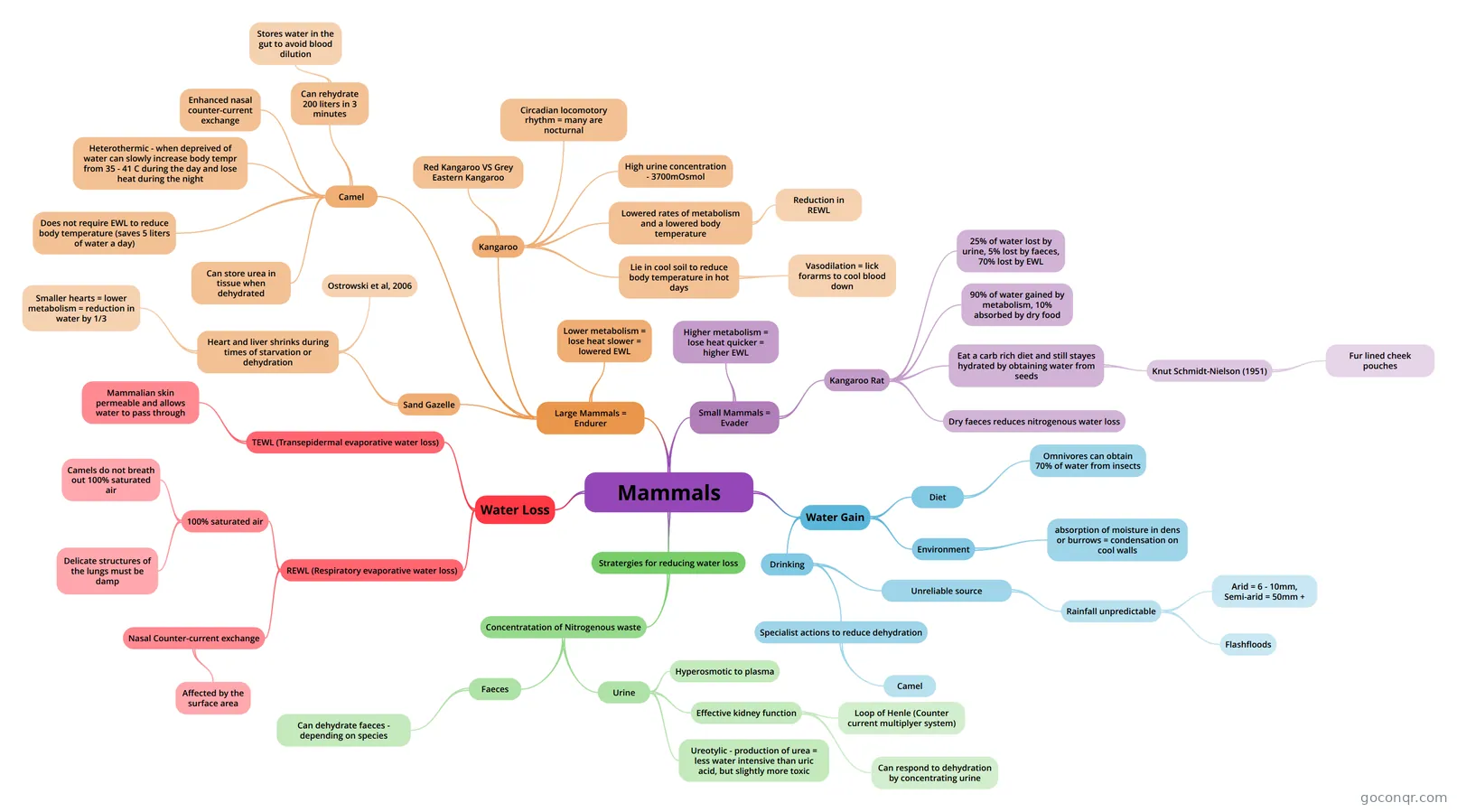
Mind map: Mammals water balance strategies
Map content
Mammals
Water Gain
- Drinking
- Unreliable source
- Rainfall unpredictable
- Arid = 6 - 10mm, Semi-arid = 50mm +
- Flashfloods
- Rainfall unpredictable
- Specialist actions to reduce dehydration
- Camel
- Unreliable source
- Environment
- absorption of moisture in dens or burrows = condensation on cool walls
- Diet
- Omnivores can obtain 70% of water from insects
- Drinking
Water Loss
- REWL (Respiratory evaporative water loss)
- Nasal Counter-current exchange
- Affected by the surface area
- 100% saturated air
- Delicate structures of the lungs must be damp
- Camels do not breath out 100% saturated air
- Nasal Counter-current exchange
- TEWL (Transepidermal evaporative water loss)
- Mammalian skin permeable and allows water to pass through
- REWL (Respiratory evaporative water loss)
Stratergies for reducing water loss
- Concentratation of Nitrogenous waste
- Faeces
- Can dehydrate faeces - depending on species
- Urine
- Effective kidney function
- Loop of Henle (Counter current multiplyer system)
- Can respond to dehydration by concentrating urine
- Hyperosmotic to plasma
- Ureotylic - production of urea = less water intensive than uric acid, but slightly more toxic
- Effective kidney function
- Faeces
- Concentratation of Nitrogenous waste
Large Mammals = Endurer
- Camel
- Can rehydrate 200 liters in 3 minutes
- Stores water in the gut to avoid blood dilution
- Enhanced nasal counter-current exchange
- Heterothermic - when depreived of water can slowly increase body tempr from 35 - 41 C during the day and lose heat during the night
- Does not require EWL to reduce body temperature (saves 5 liters of water a day)
- Can store urea in tissue when dehydrated
- Can rehydrate 200 liters in 3 minutes
- Sand Gazelle
- Heart and liver shrinks during times of starvation or dehydration
- Smaller hearts = lower metabolism = reduction in water by 1/3
- Ostrowski et al, 2006
- Heart and liver shrinks during times of starvation or dehydration
- Lower metabolism = lose heat slower = lowered EWL
- Kangaroo
- High urine concentration - 3700mOsmol
- Lowered rates of metabolism and a lowered body temperature
- Reduction in REWL
- Circadian locomotory rhythm = many are nocturnal
- Lie in cool soil to reduce body temperature in hot days
- Vasodilation = lick forarms to cool blood down
- Red Kangaroo VS Grey Eastern Kangaroo
- Camel
Small Mammals = Evader
- Kangaroo Rat
- Eat a carb rich diet and still stayes hydrated by obtaining water from seeds
- Knut Schmidt-Nielson (1951)
- Fur lined cheek pouches
- Knut Schmidt-Nielson (1951)
- Dry faeces reduces nitrogenous water loss
- 90% of water gained by metabolism, 10% absorbed by dry food
- 25% of water lost by urine, 5% lost by faeces, 70% lost by EWL
- Eat a carb rich diet and still stayes hydrated by obtaining water from seeds
- Higher metabolism = lose heat quicker = higher EWL
- Kangaroo Rat
Information
- Description
- Survival Strategies - Desert living mammals
- Created by
- Adam Heywood
- Views
- 76
- Tags
- Rating