
Mind map
Magnetism
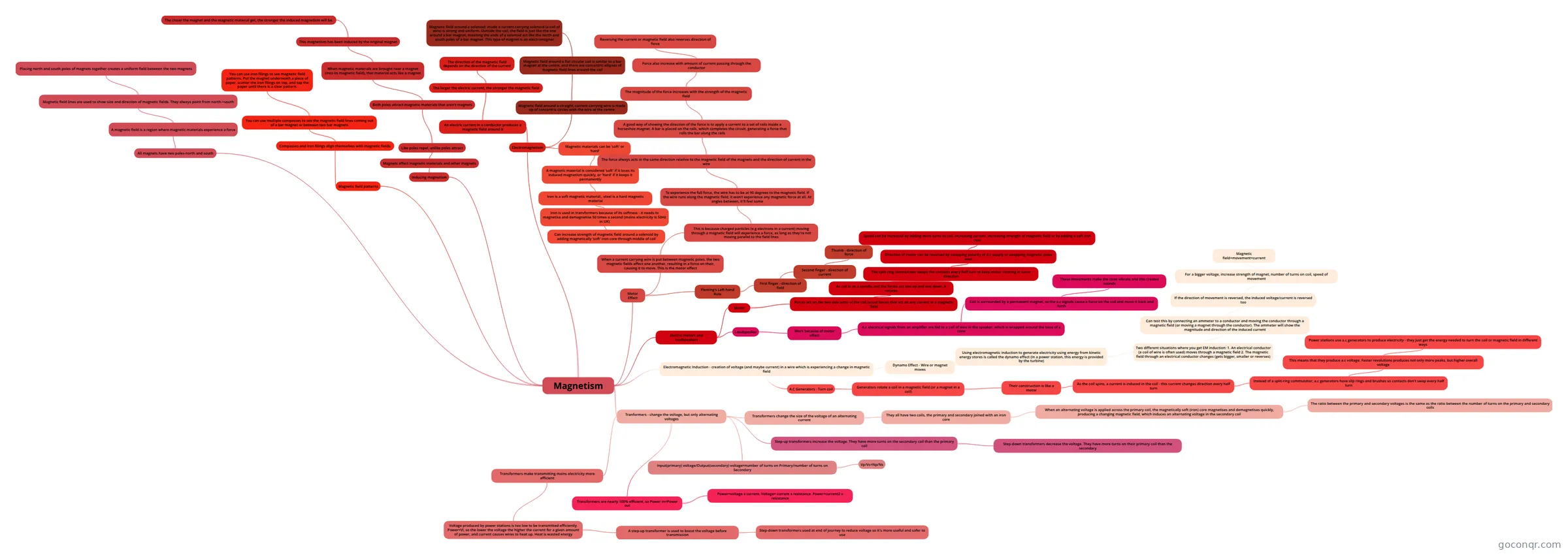
Mind map: Magnetism
Map content
Magnetism
All magnets have two poles-north and south
- A magnetic field is a region where magnetic materials experience a force
- Magnetic field lines are used to show size and direction of magnetic fields. They always point from north->south
- Placing north and south poles of magnets together creates a uniform field between the two magnets
- Magnetic field lines are used to show size and direction of magnetic fields. They always point from north->south
- A magnetic field is a region where magnetic materials experience a force
Magnetic field patterns
- Compasses and iron filings align themselves with magnetic fields.
- You can use multiple compasses to see the magnetic field lines coming out of a bar magnet or between two bar magnets
- You can use iron filings to see magnetic field patterns. Put the magnet underneath a piece of paper, scatter the iron filings on top, and tap the paper until there is a clear pattern.
- You can use multiple compasses to see the magnetic field lines coming out of a bar magnet or between two bar magnets
- Compasses and iron filings align themselves with magnetic fields.
Inducing magnetism
- Magnets affect magnetic materials and other magnets
- Like poles repel, unlike poles attract
- Both poles attract magnetic materials that aren't magnets
- When magnetic materials are brought near a magnet (into its magnetic field), that material acts like a magnet
- This magnetism has been induced by the original magnet
- The closer the magnet and the magnetic material get, the stronger the induced magnetism will be.
- This magnetism has been induced by the original magnet
- When magnetic materials are brought near a magnet (into its magnetic field), that material acts like a magnet
- Both poles attract magnetic materials that aren't magnets
- Like poles repel, unlike poles attract
- Magnets affect magnetic materials and other magnets
Electromagnetism
- An electric current in a conductor produces a magnetic field around it
- The larger the electric current, the stronger the magnetic field
- The direction of the magnetic field depends on the direction of the current
- The larger the electric current, the stronger the magnetic field
- Magnetic field around a straight, current carrying wire is made up of concentric circles with the wire at the centre
- Magnetic field around a flat circular coil is similar to a bar magnet at the centre, and there are concentric ellipses of magnetic field lines around the coil
- Magnetic field around a solenoid: inside a current carrying solenoid (a coil of wire) is strong and uniform. Outside the coil, the field is just like the one around a bar magnet, meaning the ends of a solenoid act like the north and south poles of a bar magnet. This type of magnet is an electromagnet
- Magnetic field around a flat circular coil is similar to a bar magnet at the centre, and there are concentric ellipses of magnetic field lines around the coil
- Magnetic materials can be 'soft' or 'hard'
- A magnetic material is considered 'soft' if it loses its induced magnetism quickly, or 'hard' if it keeps it permanently
- Iron is a soft magnetic material,, steel is a hard magnetic material
- Iron is used in transformers because of its softness - it needs to magnetise and demagnetise 50 times a second (mains electricity is 50Hz in UK)
- Can increase strength of magnetic field around a solenoid by adding magnetically 'soft' iron core through middle of coil
- Iron is used in transformers because of its softness - it needs to magnetise and demagnetise 50 times a second (mains electricity is 50Hz in UK)
- Iron is a soft magnetic material,, steel is a hard magnetic material
- A magnetic material is considered 'soft' if it loses its induced magnetism quickly, or 'hard' if it keeps it permanently
- An electric current in a conductor produces a magnetic field around it
Motor Effect
- When a current carrying wire is put between magnetic poles, the two magnetic fields affect one another, resulting in a force on their, causing it to move. This is the motor effect
- This is because charged particles (e.g electrons in a current) moving through a magnetic field will experience a force, as long as they're not moving parallel to the field lines
- To experience the full force, the wire has to be at 90 degrees to the magnetic field. If the wire runs along the magnetic field, it won't experience any magnetic force at all. At angles between, it'll feel some
- The force always acts in the same direction relative to the magnetic field of the magnets and the direction of current in the wire
- A good way of showing the direction of the force is to apply a current to a set of rails inside a horseshoe magnet. A bar is placed on the rails, which completes the circuit, generating a force that rolls the bar along the rails
- The magnitude of the force increases with the strength of the magnetic field
- Force also increase with amount of current passing through the conductor
- Reversing the current or magnetic field also reverses direction of force
- Force also increase with amount of current passing through the conductor
- The magnitude of the force increases with the strength of the magnetic field
- A good way of showing the direction of the force is to apply a current to a set of rails inside a horseshoe magnet. A bar is placed on the rails, which completes the circuit, generating a force that rolls the bar along the rails
- The force always acts in the same direction relative to the magnetic field of the magnets and the direction of current in the wire
- To experience the full force, the wire has to be at 90 degrees to the magnetic field. If the wire runs along the magnetic field, it won't experience any magnetic force at all. At angles between, it'll feel some
- This is because charged particles (e.g electrons in a current) moving through a magnetic field will experience a force, as long as they're not moving parallel to the field lines
- Fleming's Left-hand Rule
- First finger - direction of field
- Second finger - direction of current
- Thumb - direction of force
- Second finger - direction of current
- First finger - direction of field
- When a current carrying wire is put between magnetic poles, the two magnetic fields affect one another, resulting in a force on their, causing it to move. This is the motor effect
Electric motors and loudspeakers
- Motor
- Forces act on the two side arms of the coil (usual forces that act on any current in a magnetic field
- As coil is on a spindle and the forces act one up and one down, it rotates
- The split-ring commutator swaps the contacts every half turn to keep motor rotating in same direction
- Direction of motor can be reversed by swapping polarity of d.c supply or swapping magnetic poles over
- Speed can be increased by adding more turns to coil, increasing current, increasing strength of magnetic field or by adding a soft iron core
- Direction of motor can be reversed by swapping polarity of d.c supply or swapping magnetic poles over
- The split-ring commutator swaps the contacts every half turn to keep motor rotating in same direction
- As coil is on a spindle and the forces act one up and one down, it rotates
- Forces act on the two side arms of the coil (usual forces that act on any current in a magnetic field
- Loudspeaker
- Work because of motor effect
- A.c electrical signals from an amplifier are fed to a coil of wire in the speaker, which is wrapped around the base of a cone
- Coil is surrounded by a permanent magnet, so the a.c signals cause a force on the coil and move it back and forth
- These movements make the cone vibrate and this creates sounds
- Coil is surrounded by a permanent magnet, so the a.c signals cause a force on the coil and move it back and forth
- A.c electrical signals from an amplifier are fed to a coil of wire in the speaker, which is wrapped around the base of a cone
- Work because of motor effect
- Motor
Electromagnetic Induction - creation of voltage (and maybe current) in a wire which is experiencing a change in magnetic field
- Dynamo Effect - Wire or magnet moves
- Using electromagnetic induction to generate electricity using energy from kinetic energy stores is called the dynamo effect (In a power station, this energy is provided by the turbine)
- Two different situations where you get EM induction: 1. An electrical conductor (a coil of wire is often used) moves through a magnetic field 2. The magnetic field through an electrical conductor changes (gets bigger, smaller or reverses)
- Can test this by connecting an ammeter to a conductor and moving the conductor through a magnetic field (or moving a magnet through the conductor). The ammeter will show the magnitude and direction of the induced current
- If the direction of movement is reversed, the induced voltage/current is reversed too
- For a bigger voltage, increase strength of magnet, number of turns on coil, speed of movement
- Magnetic field+movement=current
- For a bigger voltage, increase strength of magnet, number of turns on coil, speed of movement
- If the direction of movement is reversed, the induced voltage/current is reversed too
- Can test this by connecting an ammeter to a conductor and moving the conductor through a magnetic field (or moving a magnet through the conductor). The ammeter will show the magnitude and direction of the induced current
- Two different situations where you get EM induction: 1. An electrical conductor (a coil of wire is often used) moves through a magnetic field 2. The magnetic field through an electrical conductor changes (gets bigger, smaller or reverses)
- Using electromagnetic induction to generate electricity using energy from kinetic energy stores is called the dynamo effect (In a power station, this energy is provided by the turbine)
- A.C Generators - Turn coil
- Generators rotate a coil in a magnetic field (or a magnet in a coil)
- Their construction is like a motor
- As the coil spins, a current is induced in the coil - this current changes direction every half turn
- Instead of a split-ring commutator, a.c generators have slip rings and brushes so contacts don't swap every half turn
- This means that they produce a.c voltage. Faster revolutions produces not only more peaks, but higher overall voltage
- Power stations use a.c generators to produce electricity - they just get the energy needed to turn the coil or magnetic field in different ways
- This means that they produce a.c voltage. Faster revolutions produces not only more peaks, but higher overall voltage
- Instead of a split-ring commutator, a.c generators have slip rings and brushes so contacts don't swap every half turn
- As the coil spins, a current is induced in the coil - this current changes direction every half turn
- Their construction is like a motor
- Generators rotate a coil in a magnetic field (or a magnet in a coil)
- Dynamo Effect - Wire or magnet moves
Tranformers - change the voltage, but only alternating voltages
- Transformers change the size of the voltage of an alternating current
- They all have two coils, the primary and secondary joined with an iron core
- When an alternating voltage is applied across the primary coil, the magnetically soft (iron) core magnetises and demagnetises quickly, producing a changing magnetic field, which induces an alternating voltage in the secondary coil
- The ratio between the primary and secondary voltages is the same as the ratio between the number of turns on the primary and secondary coils
- When an alternating voltage is applied across the primary coil, the magnetically soft (iron) core magnetises and demagnetises quickly, producing a changing magnetic field, which induces an alternating voltage in the secondary coil
- They all have two coils, the primary and secondary joined with an iron core
- Step-up transformers increase the voltage. They have more turns on the secondary coil than the primary coil
- Step-down transformers decrease the voltage. They have more turns on their primary coil than the secondary
- Input(primary) voltage/Output(secondary) voltage=number of turns on Primary/number of turns on Secondary
- Vp/Vs=Np/Ns
- Transformers are nearly 100% efficient, so Power in=Power out
- Power=voltage x current. Voltage= current x resistance. Power=current2 x resistance
- Transformers make transmitting mains electricity more efficient
- Voltage produced by power stations is too low to be transmitted efficiently. Power=VI, so the lower the voltage the higher the current for a given amount of power, and current causes wires to heat up. Heat is wasted energy
- A step-up transformer is used to boost the voltage before transmission
- Step-down transformers used at end of journey to reduce voltage so it's more useful and safer to use
- A step-up transformer is used to boost the voltage before transmission
- Voltage produced by power stations is too low to be transmitted efficiently. Power=VI, so the lower the voltage the higher the current for a given amount of power, and current causes wires to heat up. Heat is wasted energy
- Transformers change the size of the voltage of an alternating current
Information
- Description
- Physics Mind Map on Magnetism, created by Sophie J Evans on 19/05/2018.
- Created by
- Sophie J Evans
- Views
- 2
- Rating