
Mind map
Development Economics IIB: Lcture 4 - Foreign Aid.
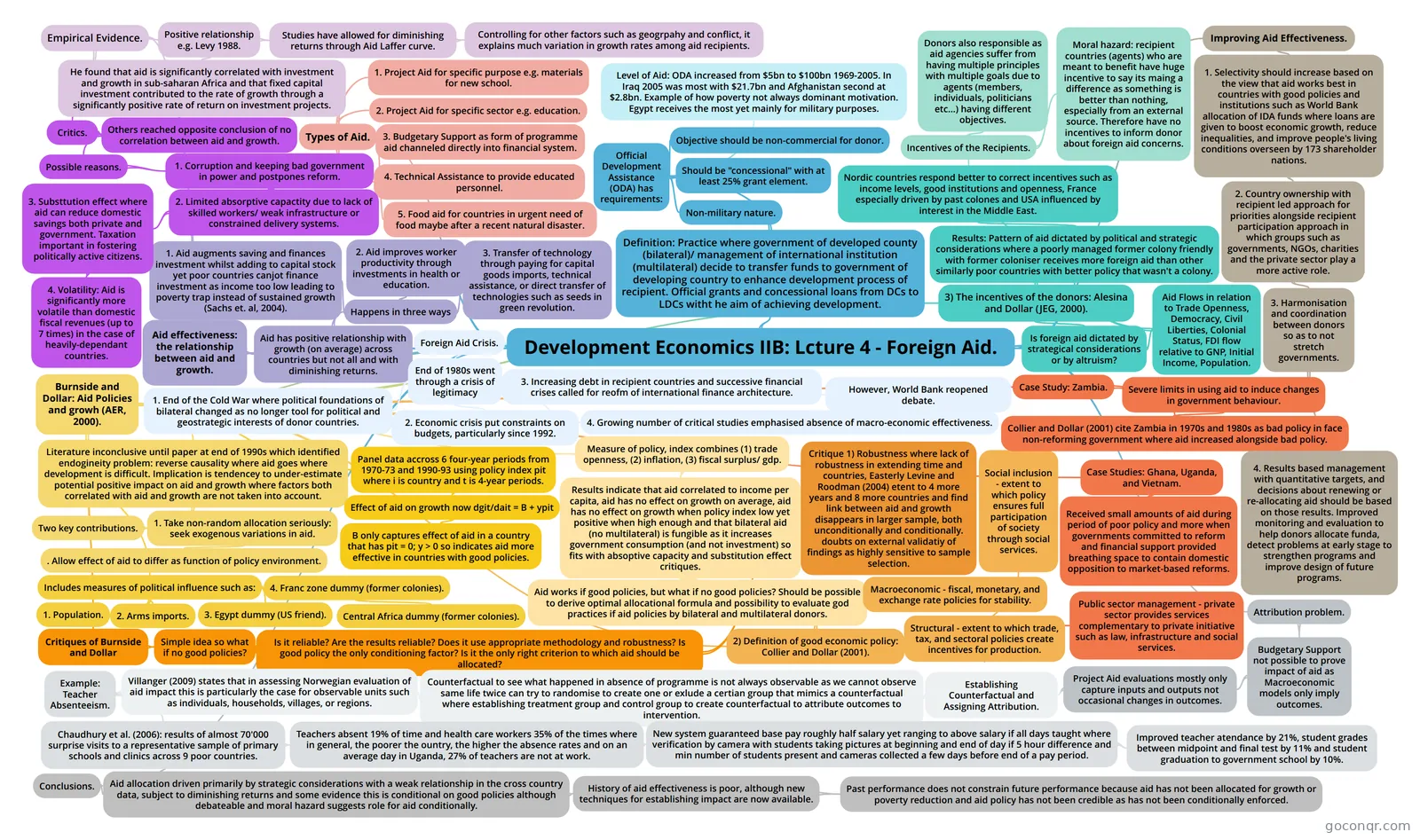
Mind map: Foreign aid
Map content
Development Economics IIB: Lcture 4 - Foreign Aid.
Definition: Practice where government of developed county (bilateral)/ management of international institution (multilateral) decide to transfer funds to government of developing country to enhance development process of recipient. Official grants and concessional loans from DCs to LDCs witht he aim of achieving development.
- Official Development Assistance (ODA) has requirements:
- Objective should be non-commercial for donor.
- Should be "concessional" with at least 25% grant element.
- Non-military nature.
- Level of Aid: ODA increased from $5bn to $100bn 1969-2005. In Iraq 2005 was most with $21.7bn and Afghanistan second at $2.8bn. Example of how poverty not always dominant motivation. Egypt receives the most yet mainly for military purposes.
- Official Development Assistance (ODA) has requirements:
Types of Aid.
- 1. Project Aid for specific purpose e.g. materials for new school.
- 2. Project Aid for specific sector e.g. education.
- 3. Budgetary Support as form of programme aid channeled directly into financial system.
- 4. Technical Assistance to provide educated personnel.
- 5. Food aid for countries in urgent need of food maybe after a recent natural disaster.
Aid effectiveness: the relationship between aid and growth.
- Aid has positive relationship with growth (on average) across countries but not all and with diminishing returns.
- Happens in three ways
- 1. Aid augments saving and finances investment whilst adding to capital stock yet poor countries canjot finance investment as income too low leading to poverty trap instead of sustained growth (Sachs et. al, 2004).
- 2. Aid improves worker productivity through investments in health or education.
- 3. Transfer of technology through paying for capital goods imports, technical assistance, or direct transfer of technologies such as seeds in green revolution.
- Happens in three ways
- Empirical Evidence.
- Positive relationship e.g. Levy 1988.
- Studies have allowed for diminishing returns through Aid Laffer curve.
- Controlling for other factors such as geogrpahy and conflict, it explains much variation in growth rates among aid recipients.
- He found that aid is significantly correlated with investment and growth in sub-saharan Africa and that fixed capital investment contributed to the rate of growth through a significantly positive rate of return on investment projects.
- Studies have allowed for diminishing returns through Aid Laffer curve.
- Critics.
- Others reached opposite conclusion of no correlation between aid and growth.
- Possible reasons.
- 1. Corruption and keeping bad government in power and postpones reform.
- 2. Limited absorptive capactity due to lack of skilled workers/ weak infrastructure or constrained delivery systems.
- 3. Substtution effect where aid can reduce domestic savings both private and government. Taxation important in fostering politically active citizens.
- 4. Volatility: Aid is significantly more volatile than domestic fiscal revenues (up to 7 times) in the case of heavily-dependant countries.
- 3. Substtution effect where aid can reduce domestic savings both private and government. Taxation important in fostering politically active citizens.
- 2. Limited absorptive capactity due to lack of skilled workers/ weak infrastructure or constrained delivery systems.
- 1. Corruption and keeping bad government in power and postpones reform.
- Possible reasons.
- Others reached opposite conclusion of no correlation between aid and growth.
- Positive relationship e.g. Levy 1988.
- Aid has positive relationship with growth (on average) across countries but not all and with diminishing returns.
Foreign Aid Crisis.
- End of 1980s went through a crisis of legitimacy
- 1. End of the Cold War where political foundations of bilateral changed as no longer tool for political and geostrategic interests of donor countries.
- 2. Economic crisis put constraints on budgets, particularly since 1992.
- 3. Increasing debt in recipient countries and successive financial crises called for reofm of international finance architecture.
- 4. Growing number of critical studies emphasised absence of macro-economic effectiveness.
- However, World Bank reopened debate.
- End of 1980s went through a crisis of legitimacy
Burnside and Dollar: Aid Policies and growh (AER, 2000).
- Literature inconclusive until paper at end of 1990s which identified endogineity problem: reverse causality where aid goes where development is difficult. Implication is tendencey to under-estimate potential positive impact on aid and growth where factors both correlated with aid and growth are not taken into account.
- Two key contributions.
- 1. Take non-random allocation seriously: seek exogenous variations in aid.
- . Allow effect of aid to differ as function of policy environment.
- 1. Take non-random allocation seriously: seek exogenous variations in aid.
- Two key contributions.
- Panel data accross 6 four-year periods from 1970-73 and 1990-93 using policy index pit where i is country and t is 4-year periods.
- Effect of aid on growth now dgit/dait = B + ypit
- B only captures effect of aid in a country that has pit = 0; y > 0 so indicates aid more effective in countries with good policies.
- Effect of aid on growth now dgit/dait = B + ypit
- Includes measures of political influence such as:
- 1. Population.
- 2. Arms imports.
- 3. Egypt dummy (US friend).
- 4. Franc zone dummy (former colonies).
- Central Africa dummy (former colonies).
- Measure of policy, index combines (1) trade openness, (2) inflation, (3) fiscal surplus/ gdp.
- Results indicate that aid correlated to income per capita, aid has no effect on growth on average, aid has no effect on growth when policy index low yet positive when high enough and that bilateral aid (no multilateral) is fungible as it increases government consumption (and not investment) so fits with absoptive capacity and substitution effect critiques.
- Aid works if good policies, but what if no good policies? Should be possible to derive optimal allocational formula and possibility to evaluate god practices if aid policies by bilateral and multilateral donors.
- Results indicate that aid correlated to income per capita, aid has no effect on growth on average, aid has no effect on growth when policy index low yet positive when high enough and that bilateral aid (no multilateral) is fungible as it increases government consumption (and not investment) so fits with absoptive capacity and substitution effect critiques.
- Critiques of Burnside and Dollar
- Simple idea so what if no good policies?
- Is it reliable? Are the results reliable? Does it use appropriate methodology and robustness? Is good policy the only conditioning factor? Is it the only right criterion to which aid should be allocated?
- Critique 1) Robustness where lack of robustness in extending time and countries, Easterly Levine and Roodman (2004) etent to 4 more years and 8 more countries and find link between aid and growth disappears in larger sample, both unconditionally and conditionally. doubts on external validatiy of findings as highly sensitive to sample selection.
- Is it reliable? Are the results reliable? Does it use appropriate methodology and robustness? Is good policy the only conditioning factor? Is it the only right criterion to which aid should be allocated?
- Simple idea so what if no good policies?
- 2) Definition of good economic policy: Collier and Dollar (2001).
- Macroeconomic - fiscal, monetary, and exchange rate policies for stability.
- Structural - extent to which trade, tax, and sectoral policies create incentives for production.
- Public sector management - private sector provides services complementary to private initiative such as law, infrastructure and social services.
- Social inclusion - extent to which policy ensures full participation of society through social services.
- Case Study: Zambia.
- Collier and Dollar (2001) cite Zambia in 1970s and 1980s as bad policy in face non-reforming government where aid increased alongside bad policy.
- Severe limits in using aid to induce changes in government behaviour.
- Collier and Dollar (2001) cite Zambia in 1970s and 1980s as bad policy in face non-reforming government where aid increased alongside bad policy.
- Case Studies: Ghana, Uganda, and Vietnam.
- Received small amounts of aid during period of poor policy and more when governments committed to reform and financial support provided breathing space to contain domestic opposition to market-based reforms.
- 3) The incentives of the donors: Alesina and Dollar (JEG, 2000).
- Is foreign aid dictated by strategical considerations or by altruism?
- Aid Flows in relation to Trade Openness, Democracy, Civil Liberties, Colonial Status, FDI flow relative to GNP, Initial Income, Population.
- Results: Pattern of aid dictated by political and strategic considerations where a poorly managed former colony friendly with former coloniser receives more foreign aid than other similarly poor countries with better policy that wasn't a colony.
- Nordic countries respond better to correct incentives such as income levels, good institutions and openness, France especially driven by past colones and USA influenced by interest in the Middle East.
- Results: Pattern of aid dictated by political and strategic considerations where a poorly managed former colony friendly with former coloniser receives more foreign aid than other similarly poor countries with better policy that wasn't a colony.
- Aid Flows in relation to Trade Openness, Democracy, Civil Liberties, Colonial Status, FDI flow relative to GNP, Initial Income, Population.
- Incentives of the Recipients.
- Moral hazard: recipient countries (agents) who are meant to benefit have huge incentive to say its maing a difference as something is better than nothing, especially from an external source. Therefore have no incentives to inform donor about foreign aid concerns.
- Donors also responsible as aid agencies suffer from having multiple principles with multiple goals due to agents (members, individuals, politicians etc...) having different objectives.
- Is foreign aid dictated by strategical considerations or by altruism?
- Literature inconclusive until paper at end of 1990s which identified endogineity problem: reverse causality where aid goes where development is difficult. Implication is tendencey to under-estimate potential positive impact on aid and growth where factors both correlated with aid and growth are not taken into account.
Improving Aid Effectiveness.
- 1. Selectivity should increase based on the view that aid works best in countries with good policies and institutions such as World Bank allocation of IDA funds where loans are given to boost economic growth, reduce inequalities, and improve people's living conditions overseen by 173 shareholder nations.
- 2. Country ownership with recipient led approach for priorities alongside recipient participation approach in which groups such as governments, NGOs, charities and the private sector play a more active role.
- 3. Harmonisation and coordination between donors so as to not stretch governments.
- 4. Results based management with quantitative targets, and decisions about renewing or re-allocating aid should be based on those results. Improved monitoring and evaluation to help donors allocate funda, detect problems at early stage to strengthen programs and improve design of future programs.
- 3. Harmonisation and coordination between donors so as to not stretch governments.
- 2. Country ownership with recipient led approach for priorities alongside recipient participation approach in which groups such as governments, NGOs, charities and the private sector play a more active role.
- 1. Selectivity should increase based on the view that aid works best in countries with good policies and institutions such as World Bank allocation of IDA funds where loans are given to boost economic growth, reduce inequalities, and improve people's living conditions overseen by 173 shareholder nations.
Attribution problem.
- Budgetary Support not possible to prove impact of aid as Macroeconomic models only imply outcomes.
- Project Aid evaluations mostly only capture inputs and outputs not occasional changes in outcomes.
- Establishing Counterfactual and Assigning Attribution.
- Counterfactual to see what happened in absence of programme is not always observable as we cannot observe same life twice can try to randomise to create one or exlude a certian group that mimics a counterfactual where establishing treatment group and control group to create counterfactual to attribute outcomes to intervention.
- Villanger (2009) states that in assessing Norwegian evaluation of aid impact this is particularly the case for observable units such as individuals, households, villages, or regions.
- Example: Teacher Absenteeism.
- Chaudhury et al. (2006): results of almost 70'000 surprise visits to a representative sample of primary schools and clinics across 9 poor countries.
- Teachers absent 19% of time and health care workers 35% of the times where in general, the poorer the ountry, the higher the absence rates and on an average day in Uganda, 27% of teachers are not at work.
- New system guaranteed base pay roughly half salary yet ranging to above salary if all days taught where verification by camera with students taking pictures at beginning and end of day if 5 hour difference and min number of students present and cameras collected a few days before end of a pay period.
- Improved teacher atendance by 21%, student grades between midpoint and final test by 11% and student graduation to government school by 10%.
- New system guaranteed base pay roughly half salary yet ranging to above salary if all days taught where verification by camera with students taking pictures at beginning and end of day if 5 hour difference and min number of students present and cameras collected a few days before end of a pay period.
- Teachers absent 19% of time and health care workers 35% of the times where in general, the poorer the ountry, the higher the absence rates and on an average day in Uganda, 27% of teachers are not at work.
- Chaudhury et al. (2006): results of almost 70'000 surprise visits to a representative sample of primary schools and clinics across 9 poor countries.
- Example: Teacher Absenteeism.
- Villanger (2009) states that in assessing Norwegian evaluation of aid impact this is particularly the case for observable units such as individuals, households, villages, or regions.
- Counterfactual to see what happened in absence of programme is not always observable as we cannot observe same life twice can try to randomise to create one or exlude a certian group that mimics a counterfactual where establishing treatment group and control group to create counterfactual to attribute outcomes to intervention.
- Establishing Counterfactual and Assigning Attribution.
- Project Aid evaluations mostly only capture inputs and outputs not occasional changes in outcomes.
- Budgetary Support not possible to prove impact of aid as Macroeconomic models only imply outcomes.
Conclusions.
- Aid allocation driven primarily by strategic considerations with a weak relationship in the cross country data, subject to diminishing returns and some evidence this is conditional on good policies although debateable and moral hazard suggests role for aid conditionally.
- History of aid effectiveness is poor, although new techniques for establishing impact are now available.
- Past performance does not constrain future performance because aid has not been allocated for growth or poverty reduction and aid policy has not been credible as has not been conditionally enforced.
- History of aid effectiveness is poor, although new techniques for establishing impact are now available.
- Aid allocation driven primarily by strategic considerations with a weak relationship in the cross country data, subject to diminishing returns and some evidence this is conditional on good policies although debateable and moral hazard suggests role for aid conditionally.
Information
- Description
- Mind Map on Development Economics IIB: Lcture 4 - Foreign Aid., created by Hugh Summers on 02/06/2018.
- Created by
- Hugh Summers
- Views
- 2
- Rating
More on Foreign Aid and Development