
Mind map
Mass Culture and McDonaldization
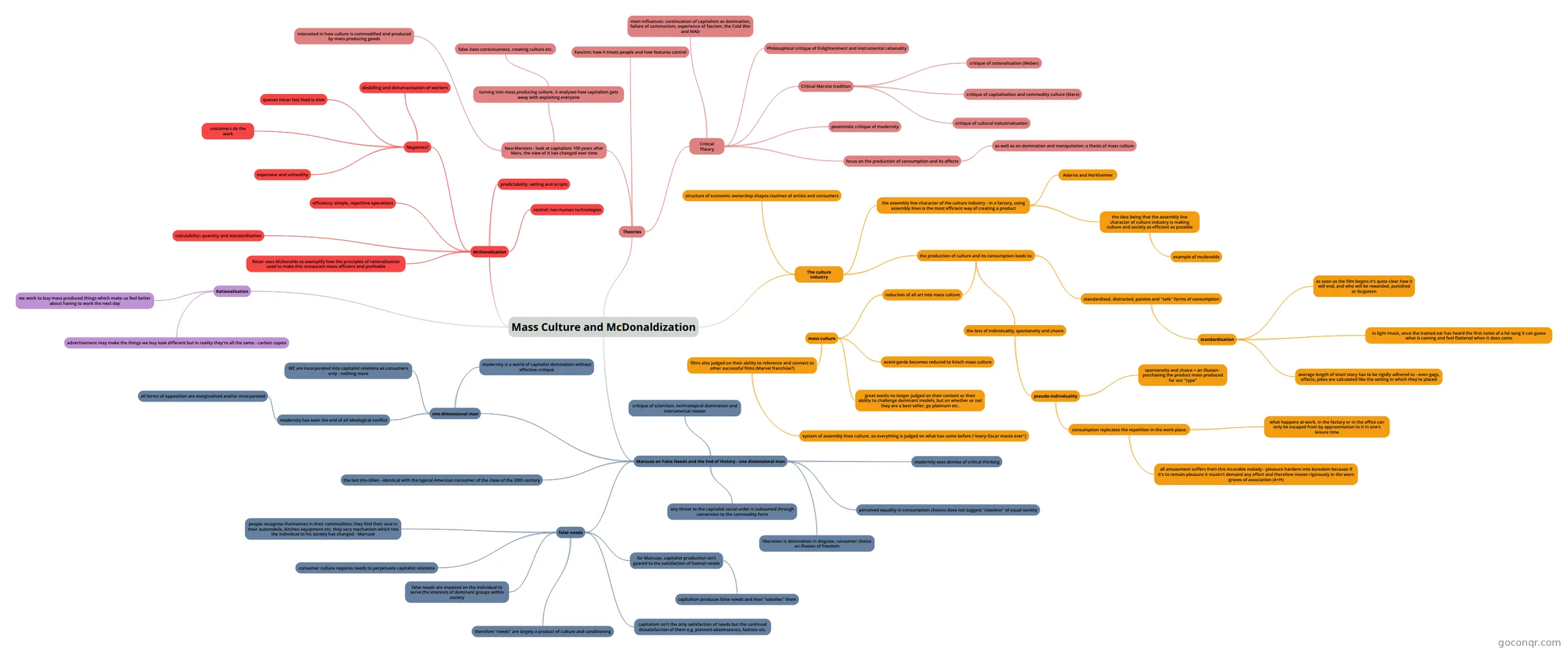
Mind map: mass culture and McDonaldization
Map content
Mass Culture and McDonaldization
Theories
- Neo-Marxists - look at capitalism 100 years after Marx, the view of it has changed over time
- interested in how culture is commodified and produced by mass producing goods
- turning into mass producing culture, it analyses how capitalism gets away with exploiting everyone
- false class consciousness, creating culture etc.
- Fascism: how it treats people and how features control
- Critical Theory
- main influences: continuation of capitalism as domination, failure of communism, experience of fascism, the Cold War and MAD
- Philosophical critique of Enlightenment and instrumental rationality
- Critical Marxist tradition
- critique of rationalisation (Weber)
- critique of capitalisation and commodity culture (Marx)
- critique of cultural industrialisation
- pessimistic critique of modernity
- focus on the production of consumption and its affects
- as well as on domination and manipulation: a thesis of mass culture
- Neo-Marxists - look at capitalism 100 years after Marx, the view of it has changed over time
The culture industry
- structure of economic ownership shapes routines of artists and consumers
- the assembly line character of the culture industry - in a factory, using assembly lines is the most efficient way of creating a product
- the idea being that the assembly line character of culture industry is making culture and society as efficient as possible
- example of mcdonalds
- Adorno and Horkheimer
- the idea being that the assembly line character of culture industry is making culture and society as efficient as possible
- the production of culture and its consumption leads to:
- standardised, distracted, passive and "safe" forms of consumption
- standardisation
- as soon as the film begins it's quite clear how it will end, and who will be rewarded, punished or forgotten
- in light music, once the trained ear has heard the first notes of a hit song it can guess what is coming and feel flattered when it does come
- average length of short story has to be rigidly adhered to - even gags, effects, jokes are calculated like the setting in which they're placed
- standardisation
- the loss of individuality, spontaneity and choice
- pseudo-individuality
- spontaneity and choice = an illusion - purchasing the product mass produced for our "type"
- consumption replicates the repetition in the work place:
- what happens at work, in the factory or in the office can only be escaped from by approximation to it in one's leisure time
- all amusement suffers from this incurable malady - pleasure hardens into boredom because if it's to remain pleasure it mustn't demand any effort and therefore moves rigorously in the worn groves of association (A+H)
- pseudo-individuality
- reduction of all art into mass culture
- mass culture
- avant-garde becomes reduced to kitsch mass culture
- great works no longer judged on their content or their ability to challenge dominant models; but on whether or not they are a best-seller, go platinum etc.
- films also judged on their ability to reference and connect to other successful films (Marvel franchise?)
- system of assembly lines culture, so everything is judged on what has come before ("every Oscar movie ever")
- mass culture
- standardised, distracted, passive and "safe" forms of consumption
Marcuse on False Needs and the End of History - one dimensional man
- critique of scientism, technological domination and instrumental reason
- modernity sees demise of critical thinking
- liberation is domination in disguise, consumer choice an illusion of freedom
- perceived equality in consumption choices does not suggest "classless" of equal society
- any threat to the capitalist social order is subsumed through conversion to the commodity form
- false needs
- for Marcuse, capitalist production isn't geared to the satisfaction of human needs
- capitalism produces false needs and then "satisfies" them
- capitalism isn't the only satisfaction of needs but the continual dissatisfaction of them e.g. planned obsolescence, fashion etc.
- therefore "needs" are largely a product of culture and conditioning
- false needs are imposed on the individual to serve the interests of dominant groups within society
- consumer culture requires needs to perpetuate capitalist relations
- people recognise themselves in their commodities; they find their soul in their automobile, kitchen equipment etc. they very mechanism which ties the individual to his society has changed - Marcuse
- for Marcuse, capitalist production isn't geared to the satisfaction of human needs
- one-dimensional man
- modernity is a world of capitalist domination without effective critique
- WC are incorporated into capitalist relations as consumers only - nothing more
- modernity has seen the end of all ideological conflict
- all forms of opposition are marginalised and/or incorporated
- the last (Hu-)Man - identical with the typical American consumer of the close of the 20th century
Rationalisation
- advertisement may make the things we buy look different but in reality they're all the same - carbon copies
- we work to buy mass produced things which make us feel better about having to work the next day
McDonalization
- Ritzer uses McDonalds to exemplify how the principles of rationalisation used to make this restaurant more efficient and profitable
- efficiency: simple, repetitive operations
- calculability: quantity and standardisation
- predictability: setting and scripts
- control: non-human technologies
- Negatives?
- queues mean fast food is slow
- customers do the work
- expensive and unhealthy
- deskilling and dehumanisation of workers
Information
- Description
- Mind Map on Mass Culture and McDonaldization, created by Danielle Warburton on 13/06/2018.
- Created by
- Danielle Warburton
- Views
- 1
- Rating