
Mind map
Theories and Methodologies for Coaching
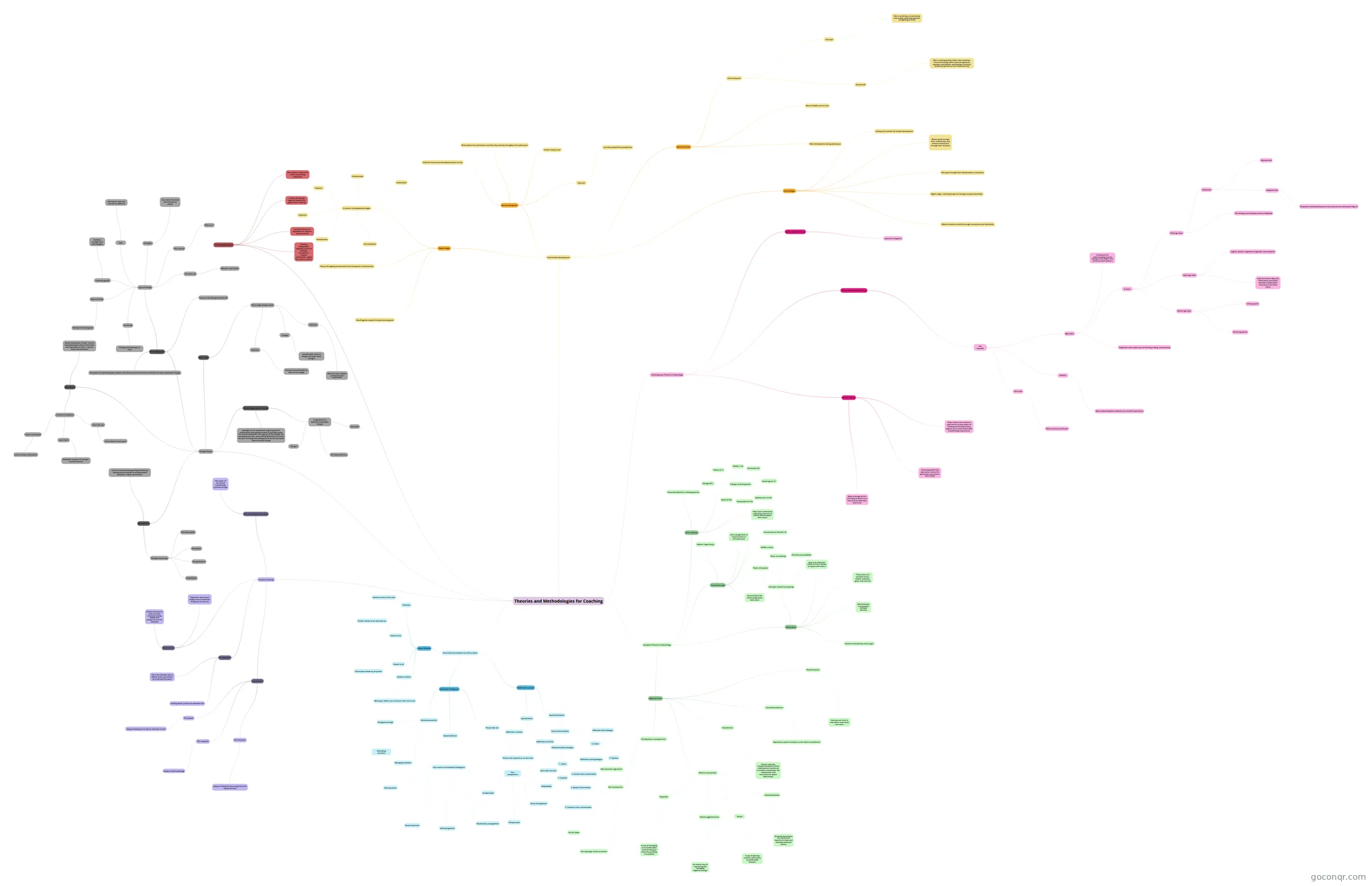
Mind map: Theories and methodologies for coaching
Map content
Theories and Methodologies for Coaching
Theoretical Foundations For Self as Coach
- Johari Window
- Known to all
- Information known by all parties
- Known to others
- Blind spot: Others see in me but I don't see in me
- Known to me
- Facade: Known to me and only me
- Unknown
- Known to none at this time
- Known to all
- Emotional Intelligence
- Emotional quotient
- Recognize feelings
- Motivating ourselves
- Managing emotions
- Daniel Goleman
- Four essence of emotional intelligence
- Self-awareness
- Social-awareness
- Self-management
- Relationship-management
- Four essence of emotional intelligence
- Reuven Bar-On
- Four components
- Intrapersonal
- Interpersoanl
- Stress management
- Adaptability
- Four components
- Emotional quotient
- Reflection-in-Action
- Donald Schon
- Reflection-in-Action
- Think in the moment or on ones feet
- Reflection-on-Action
- Done after the fact
- Reflection-in-Action
- David Clutterbuck
- Seven Conversations
- Reflection before dialogue
- 1. Coach
- 2. Coachee
- 1. Coach
- Reflection during dialogue
- 3. Coach's inner conversation
- 4. Spoken Conversation
- 5. Coachee's inner conversation
- 4. Spoken Conversation
- 3. Coach's inner conversation
- Reflection after dialogue
- 6. Coach
- 7. Coachee
- 6. Coach
- Reflection before dialogue
- Seven Conversations
- Donald Schon
- Johari Window
Analytical Theories In Psychology
- Sigmund Freud
- Driving forces in peoples lives
- Not conscious: ego driven
- But unconscious:
- The ID: libido
- The superego: social conscience
- Defense mechanisms
- Projection
- A way of managing an uncomfortable internal feeling or desire by ascribing it to another
- Passive-aggressiveness
- An indirect way of expressing and managing negative feelings
- Denial
- A way of ignoring realities, particularly uncomfortable domains
- Intellectualization
- Routinely focusing on the intellectual aspects of a topic and avoiding emotional content
- Projection
- Transference
- Process whereby relationship patterns from childhood are transferred to another relationship, like relationships with hierarchical or power differentials
- Countertransference
- Represents coaches reactions to the client's transference
- Parallel process
- How you see client is how others most likely sees them
- Driving forces in peoples lives
- Alfred Adler
- Humans motivated by social urges
- Adult behavior is purposeful and goal directed
- Theory focus on personal values, beliefs, attitudes, goals, and interests
- Goal is to reeducate adults to live in society as equals with others
- Concepts relevant to coaching
- Power of purpose
- Power of visioning
- Personal accountability
- Carl Gustav Jung
- Modern stage theory
- Life as progression in consciousness or self-awareness
- Concentrate on life after 40
- Midlife crisises
- Second half of life where progression takes place
- Erik H. Erikson
- Views development as lifelong process
- 8 Stages of development
- Infancy (0-1)
- Toddler (1-3)
- Preschool (3-6)
- School age (6-11)
- Adolescence (12-20)
- Young adult (20-24)
- Adult (25-65)
- Old age (65+)
- Help coach understand underlying concerns of clients and anticipate their issues
- Sigmund Freud
Contemporary Theories in Psychology
- Gestalt Theory
- Make a change by first attending to what's true now and not what they wish to do
- Underlying belief that awareness creates the ground for new choices and change
- Helps create in-the-moment experiences to have power of thinking and feeling coming together and create memorable breakthrough experiences
- Transactional Analysis Theory
- Key concepts
- Life script
- Most unconscious life plan
- Rackets
- Ways of behaving that replicate our early life experiences
- Ego states
- Organized, observable ways of thinking, feeling, and bahaving
- 3 states
- Parent ego state
- Nurturing parent
- Critical parent
- Adult ego state
- Logical, rational, organized, pragmatic, and analytical
- State that stores data and information and makes decisions independent from parent and child states
- Child ego state
- The feelings and emotions of early childhood
- 2 Elements
- Natural child
- Adapted child
- Responds emotionally based on early interactions with parent figures
- Parent ego state
- Framework for understanding internal dialogue and insights into communication patterns
- Life script
- Key concepts
- Family Systems Theory
- Covered in chapter 8
- Gestalt Theory
Field of Adult Development
- Bernice Neugarten
- Adult life from social-development point of view
- Wrote about men and women and how they develop throughout the adult years
- Coined "empty nest"
- Time left
- Less time ahead than already lived
- Daniel Levinson
- Male development during adult years
- Role of midlife crisis in men
- Life in two parts
- First half
- Man is achieving, accumulating, procreating, obtaining approval, and gaining security
- Second half
- Man is seeking quality (rather than quantity), internal meaning (rather external approval), leaving a contribution, and finding a universal human perspective on the human journey
- First half
- Robert Kegan
- Neo-Piagetian model of human development
- Theory of ongoing interpersonal and intrapsychic reconstruction
- 6 Levels or developmental stages
- Incorporative
- Impulsive
- Imperial
- Interpersonal
- Institutional
- Interindividual
- Carol Gilligan
- Intimacy the context for female development
- Women grow through their relationships and measure themselves through their inclusion
- Men grow through their individuation or autonomy
- Higher stage = working things out through caring relationships
- Women construct identity through connections and spirituality
- Bernice Neugarten
The Working Alliance
- The coachee's experience of the coach being supportive
- A sense of working together towards the goals of the coaching
- Quality of alliance is dependent on coaches mastery of self
- Humility, compassion, empathy, access to feelings, humanness, respect, authenticity = goals for coach to realize
Change Theory
- Kurt Lewin
- Three-stage change model
- Unfreeze
- Examine the motivation to take on the change
- Change
- Identify what needs to change and make those changes
- Refreeze
- Make the new changes permanent and sustainable
- Unfreeze
- Three-stage change model
- Robert Kegan and Lisa Lahey
- 3 Ingredients to facilitate sustainable change
- The gut
- The head and heart
- The hand
- Spotlight on the importance of gaining client's commitment and taking the time to carefully assess the level of motivation, the urgency of this change, the competing priorities, and underlying beliefs that hinder the path to change and willingness to do the hard work required by the change
- 3 Ingredients to facilitate sustainable change
- Richard Boyatzis
- Focus on identifying the ideal self
- Cycle of change
- The ideal self
- Who do I want to be?
- The real self
- Who am I?
- Strengths
- Area where the ideal and real self are similar
- Gaps
- Area where ideal and real self are different
- Learning agenda
- Building strengths and reducing gaps
- Experimenting
- Testing the learning plan
- Practicing
- Putting new behaviors to work
- The ideal self
- The power of aspirational goal rooted in the heart and mind of client is essential to create sustainable change
- Rick Mauer
- 3 Levels of resistance
- I don't understand
- Lack necessary information
- I don't like it
- Emotional response to change = survival instincts
- I don't like you
- Client doesn't trust coach
- I don't understand
- Shows importance of clear, visceral aspirational goals that provide hope and inspiration to client = capture both head and heart
- 3 Levels of resistance
- Doug Silsbee
- Focus on client becoming self-generative by moving from automatic to self-generated behaviors, habits, and choices
- Self-generative loop
- Self-observation
- Realization
- Reorganization
- Stabilization
- Kurt Lewin
Systems Thinking
- Homeostasis
- Organisms and human beings strive to maintain things just as they are
- Remain attached to what we know instead of risking change that plunges us into the unknown
- Triangulation
- The most common way to diffuse stress and tension by involving third party
- Venting about a person to someone else
- Family Roles
- The blamer
- Always finding fault in others and never in self
- The computer
- Always intellectualizingg
- The distracter
- Adept at taking the focus away from the important issue
- The blamer
- The Interactional Force Field
- The power of the web of relationships (systems) at play
- Homeostasis
Information
- Description
- Mind Map on Theories and Methodologies for Coaching, created by Phuong Dinh on 18/06/2018.
- Created by
- Phuong Dinh
- Views
- 3
- Rating