
Mind map
B&B - TB9 - L3 Deciding to Act
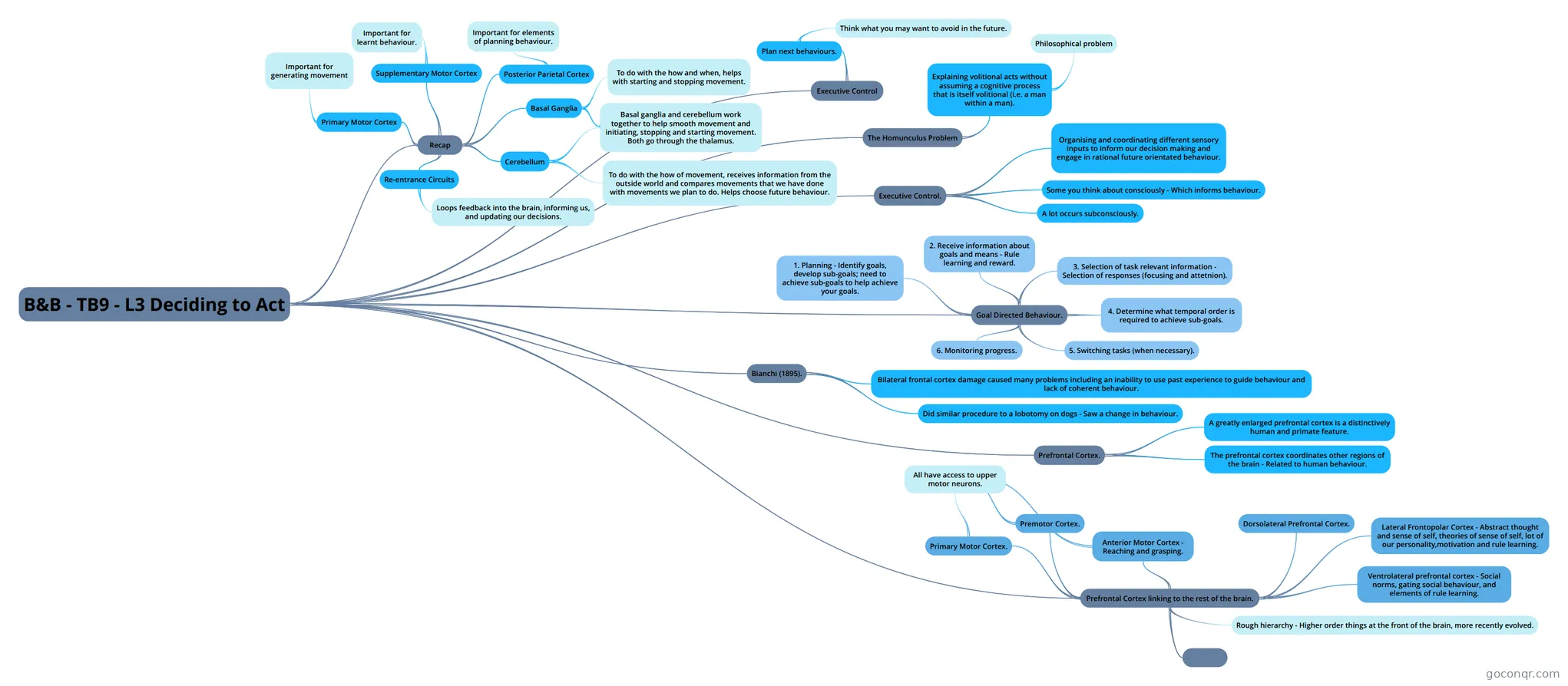
Mind map: Deciding to act executive control
Map content
B&B - TB9 - L3 Deciding to Act
Recap
- Primary Motor Cortex
- Important for generating movement
- Supplementary Motor Cortex
- Important for learnt behaviour.
- Posterior Parietal Cortex
- Important for elements of planning behaviour.
- Basal Ganglia
- To do with the how and when, helps with starting and stopping movement.
- Cerebellum
- Basal ganglia and cerebellum work together to help smooth movement and initiating, stopping and starting movement. Both go through the thalamus.
- To do with the how of movement, receives information from the outside world and compares movements that we have done with movements we plan to do. Helps choose future behaviour.
- Re-entrance Circuits
- Loops feedback into the brain, informing us, and updating our decisions.
- Primary Motor Cortex
Executive Control
- Plan next behaviours.
- Think what you may want to avoid in the future.
- Plan next behaviours.
The Homunculus Problem
- Explaining volitional acts without assuming a cognitive process that is itself volitional (i.e. a man within a man).
- Philosophical problem
- Explaining volitional acts without assuming a cognitive process that is itself volitional (i.e. a man within a man).
Executive Control.
- Organising and coordinating different sensory inputs to inform our decision making and engage in rational future orientated behaviour.
- Some you think about consciously - Which informs behaviour.
- A lot occurs subconsciously.
Goal Directed Behaviour.
- 1. Planning - Identify goals, develop sub-goals; need to achieve sub-goals to help achieve your goals.
- 2. Receive information about goals and means - Rule learning and reward.
- 3. Selection of task relevant information - Selection of responses (focusing and attetnion).
- 4. Determine what temporal order is required to achieve sub-goals.
- 5. Switching tasks (when necessary).
- 6. Monitoring progress.
Bianchi (1895).
- Bilateral frontal cortex damage caused many problems including an inability to use past experience to guide behaviour and lack of coherent behaviour.
- Did similar procedure to a lobotomy on dogs - Saw a change in behaviour.
Prefrontal Cortex.
- A greatly enlarged prefrontal cortex is a distinctively human and primate feature.
- The prefrontal cortex coordinates other regions of the brain - Related to human behaviour.
Prefrontal Cortex linking to the rest of the brain.
- Primary Motor Cortex.
- All have access to upper motor neurons.
- Premotor Cortex.
- Anterior Motor Cortex - Reaching and grasping.
- Dorsolateral Prefrontal Cortex.
- Lateral Frontopolar Cortex - Abstract thought and sense of self, theories of sense of self, lot of our personality,motivation and rule learning.
- Ventrolateral prefrontal cortex - Social norms, gating social behaviour, and elements of rule learning.
- Rough hierarchy - Higher order things at the front of the brain, more recently evolved.
- Primary Motor Cortex.
Information
- Description
- Brain and Behaviour TB9 Mind Map on B&B - TB9 - L3 Deciding to Act, created by Bethan Williams on 17/07/2018.
- Created by
- Bethan Williams
- Views
- 5
- Rating
More on Motor Cortex and Voluntary Movement