
Mind map
Accounting and Finance
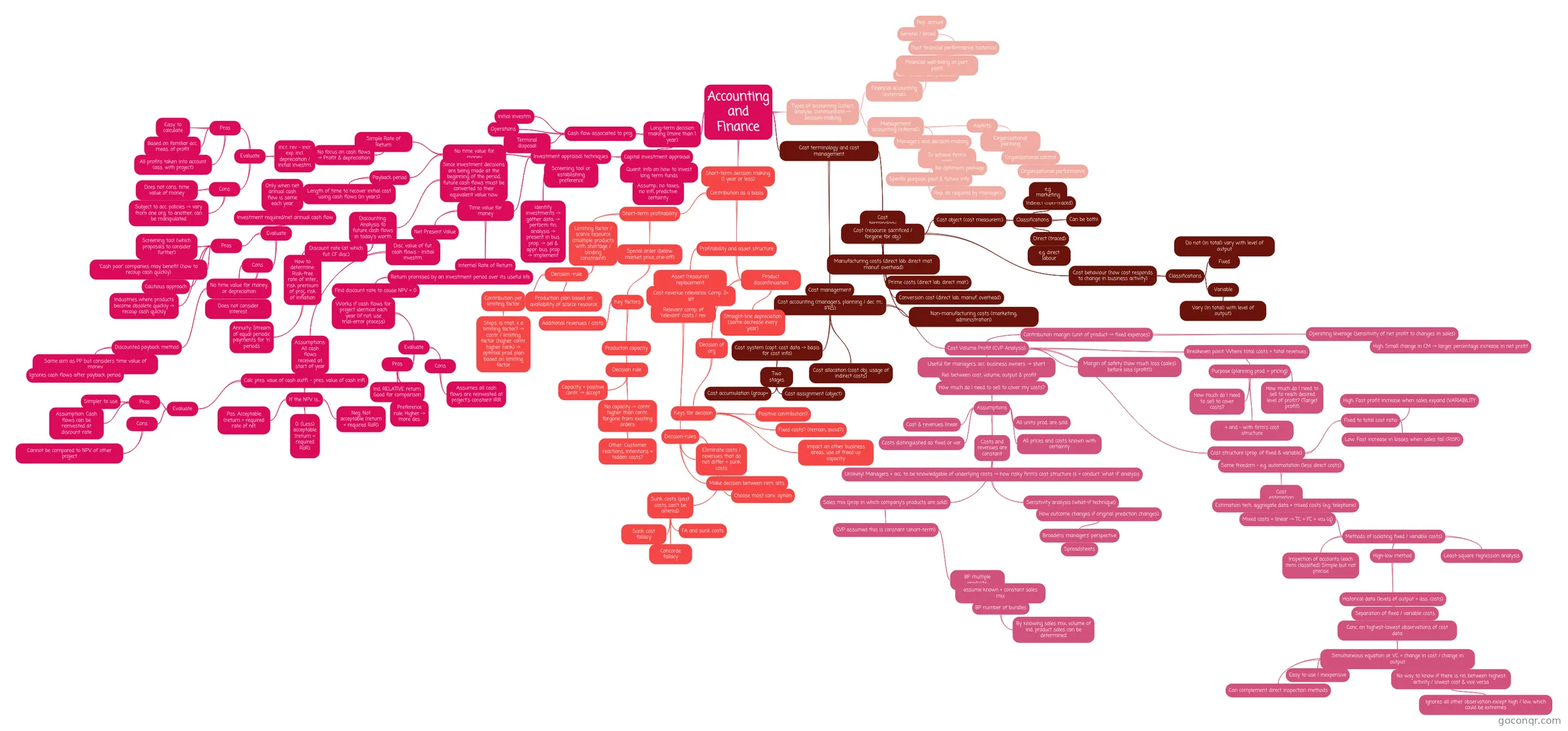
Mind map: Accounting and finance
Map content
Accounting and Finance
Types of accounting (collect, analyse, communicate -> decision-making
- Financial accounting (external,)
- Nat. / Intern. acc. stanards
- Financial well-being at part. point
- Past financial performance, historical
- General / broad
- Rep. annual
- General / broad
- Past financial performance, historical
- Financial well-being at part. point
- Nat. / Intern. acc. stanards
- Management accounting (internal)
- Managers and decision-making
- To achieve firm's goals
- No optimum package
- Specific purpose, past & future info
- Rep. as required by managers
- Specific purpose, past & future info
- No optimum package
- To achieve firm's goals
- Aspects
- Organizational planning
- Organizational control
- Organizational performance
- Organizational control
- Organizational planning
- Managers and decision-making
- Financial accounting (external,)
Cost terminology and cost management
- Cost terminology
- Cost (resource sacrificed / forgone for obj.)
- Cost object (cost measurem.)
- Classifications
- Indirect (non-traced)
- e.g. marketing
- Direct (traced)
- e.g. direct labour
- Can be both!
- Indirect (non-traced)
- Classifications
- Manufacturing costs (direct lab. direct mat. manuf. overhead)
- Prime costs (direct lab. direct mat.)
- Conversion cost (direct lab. manuf. overhead)
- Non-manufacturing costs (marketing, administration)
- Cost behaviour (how cost responds to change in business activity)
- Classifications
- Fixed
- Do not (in total) vary with level of output
- Variable
- Vary (in total) with level of output)
- Fixed
- Classifications
- Cost object (cost measurem.)
- Cost (resource sacrificed / forgone for obj.)
- Cost management
- Cost accounting (managers, planning / dec. m., IFRS)
- Cost system (capt. cost data -> basis for cost info)
- Two stages
- Cost accumulation (group=
- Cost assignment (object)
- Two stages
- Cost allocation (cost obj. usage of indirect costs)
- Cost Volume Profit (CVP Analysis)
- Contribution margin (unit of product -> fixed expenses)
- Operating leverage (sensitivity of net profit to changes in sales)
- High: Small change in CM -> larger percentage increase in net profit
- Operating leverage (sensitivity of net profit to changes in sales)
- Useful for managers, acc. business owners -> short term!
- Rel. between cost, volume, output & profit
- How much do I need to sell to cover my costs?
- Assumptions
- Cost & revenues linear
- Costs distinguished as fixed or var.
- Costs and revenues are constant
- Unlikely! Managers + acc. to be knowledgable of underlying costs -> how risky firm's cost structure is + conduct 'what if' analysis
- Sensitivity analysis (what-if technique)
- How outcome changes if original prediction changes)
- Broadens managers' perspective
- Spreadsheets
- Broadens managers' perspective
- How outcome changes if original prediction changes)
- Sensitivity analysis (what-if technique)
- Sales mix (prop in which company's products are sold)
- CVP assumed this is constant (short-term)
- BP multiple products:
- assume known + constant sales mix
- BP number of bundles
- By knowing sales mix, volume of ind. product sales can be determined
- BP number of bundles
- assume known + constant sales mix
- BP multiple products:
- CVP assumed this is constant (short-term)
- Unlikely! Managers + acc. to be knowledgable of underlying costs -> how risky firm's cost structure is + conduct 'what if' analysis
- All units prod. are sold
- All prices and costs known with certainty
- Assumptions
- How much do I need to sell to cover my costs?
- Rel. between cost, volume, output & profit
- Breakeven point: Where total costs = total revenues
- Purpose (planning prod. + pricing)
- How much do I need to sell to cover costs?
- How much do I need to sell to reach desired level of profit? (Target profit)
- + and - with firm's cost structure
- Purpose (planning prod. + pricing)
- Margin of safety (how much loss (sales) before loss (profit))
- Cost structure (prop. of fixed & variable)
- Some freedom - e.g. automatation (less direct costs)
- Cost estimation
- Estimation tech. aggregate data + mixed costs (e.g. telephone)
- Mixed costs = linear -> TC = FC + vcu (q)
- Methods of isolating fixed / variable costs)
- Inspection of accounts (each item classified) SImple but not precise
- High-low method
- Historical data (levels of output + ass. costs)
- Separation of fixed / variable costs
- Conc. on highest-lowest observations of cost data
- Simultaneous equation or VC = change in cost / change in output
- Easy to use / inexpensive
- Can complement direct inspection methods
- No way to know if there is rel. between highest activity / lowest cost & vice versa
- Ignores all other observation except high / low, which could be extremes
- Simultaneous equation or VC = change in cost / change in output
- Conc. on highest-lowest observations of cost data
- Separation of fixed / variable costs
- Historical data (levels of output + ass. costs)
- Least-square regression analysis
- Methods of isolating fixed / variable costs)
- Mixed costs = linear -> TC = FC + vcu (q)
- Estimation tech. aggregate data + mixed costs (e.g. telephone)
- Cost estimation
- FIxed to total cost ratio
- High: Fast profit increase when sales expand (VARIABILITY
- Low: Fast increase in losses when sales fall (RISK)
- Some freedom - e.g. automatation (less direct costs)
- Contribution margin (unit of product -> fixed expenses)
- Cost system (capt. cost data -> basis for cost info)
- Cost accounting (managers, planning / dec. m., IFRS)
- Cost terminology
Short-term decision making (1 year or less)
- Contribution as a basis
- Short-term profitability
- Special order (below market price, one-off)
- Key factors
- Additional revenues / costs
- Producton capacity
- Decision rule
- Capacity + positive contr. -> accept
- No capacity -> contr. higher than contr. forgone from existing orders
- Other: Customer reactions, intentions + hidden costs?
- Decision rule
- Key factors
- Limiting factor / scarce resource (multiple products with shortage / binding constraint)
- Decision -rule
- Production plan based on availability of scarce resource
- Contribution per limiting factor
- Steps: Is mat. x a limiting factor? -> contr / limiting factor (higher contr. higher rank) -> optimal prod. plan based on limiting factor
- Decision -rule
- Special order (below market price, one-off)
- Profitability and asset structure
- Product discontinuation
- Straight-line depreciation (same decrease every year)
- Decision of org
- Keys for decision
- Positive contribution?
- Fixed costs? (remain, avoid?)
- Impact on other business areas, use of freed up capacity
- Keys for decision
- Asset (resource) replacement
- Cost-revenue relevance: Comp. 2+ alt
- Relevant comp. of 'relevant' costs / rev.
- Decision-rules
- Eliminate costs / revenues that do not differ + sunk costs
- Sunk costs (past costs, can't be altered)
- Sunk cost fallacy
- Concorde fallacy
- FA and sunk costs
- Sunk costs (past costs, can't be altered)
- Make decision between rem. alts.
- Choose most conv. option
- Eliminate costs / revenues that do not differ + sunk costs
- Decision-rules
- Relevant comp. of 'relevant' costs / rev.
- Cost-revenue relevance: Comp. 2+ alt
- Product discontinuation
- Short-term profitability
- Contribution as a basis
Long-term decision making (more than 1 year)
- Capital investment appraisal
- Quant. info on how to invest long term funds
- Assump.: no taxes, no infl, predictive certainty
- Investment appraisal techniques
- No time value for money
- Payback period
- Length of time to recover initial cost using cash flows (in years)
- Only when net annual cash flow is same each year
- Investment required/net annual cash flow
- Evaluate
- Pros
- Screening tool (which proposals to consider further)
- 'Cash poor' companies may benefit (how to recoup cash quickly)
- Cautious approach
- Industries where products become obsolete quickly -> recoup cash quickly
- Cons
- No time value for money, or depreciation
- Discounted payback method
- Same aim as PP but considers time value of money
- Ignores cash flows after payback period
- Same aim as PP but considers time value of money
- Discounted payback method
- Does not consider interest
- No time value for money, or depreciation
- Pros
- Evaluate
- Investment required/net annual cash flow
- Only when net annual cash flow is same each year
- Length of time to recover initial cost using cash flows (in years)
- Simple Rate of Return
- No focus on cash flows -> Profit & depreciation
- inc.r. rev - incr. exp. incl. depreciation / initial investm.
- Evaluate
- Pros
- Easy to calculate
- Based on familiar acc. meas. of profit
- All profits taken into account (ass. with project)
- Cons
- Does not cons. time value of money
- Subject to acc. policies -> vary from one org. to another, can be manipulated
- Pros
- Evaluate
- inc.r. rev - incr. exp. incl. depreciation / initial investm.
- No focus on cash flows -> Profit & depreciation
- Since investment decisions are being made at the beginning of the period, future cash flows must be converted to their equivalent value now
- Discounting: Analysis fo future cash flows in today's worth
- Discount rate (at which fut. CF disc.)
- How to determine: Risk-free rate of inter., risk premium of proj., risk of inflation
- Annuity: Stream of equal periodic payments for 'n' periods
- How to determine: Risk-free rate of inter., risk premium of proj., risk of inflation
- Discount rate (at which fut. CF disc.)
- Discounting: Analysis fo future cash flows in today's worth
- Payback period
- Time value for money
- Net Present Value
- Disc. value of fut. cash flows - initial investm.
- Assumptions: All cash flows received at start of year
- Calc pres. vaue of cash outfl. - pres. value of cash infl.
- If the NPV is...
- Pos: Acceptable (return > required rate of ret.
- 0: (Less) acceptable (return = required RoR)
- Neg: Not acceptable (return < required RoR)
- Evaluate
- Pros
- Simpler to use
- Assumption: Cash flows can be reinvested at discount rate
- Cons
- Cannot be compared to NPV of other project
- Pros
- If the NPV is...
- Calc pres. vaue of cash outfl. - pres. value of cash infl.
- Assumptions: All cash flows received at start of year
- Disc. value of fut. cash flows - initial investm.
- Internal Rate of Return
- Return promised by an investment period over its useful life
- Find discount rate to cause NPV = 0
- Works if cash flows for project identical each year (if not, use trial-error process)
- Evaluate
- Pros
- Ind. RELATIVE return: Good for comparison
- Preference rule: Higher -> more des.
- Cons
- Assumes all cash flows are reinvested at project's constant IRR
- Pros
- Evaluate
- Works if cash flows for project identical each year (if not, use trial-error process)
- Find discount rate to cause NPV = 0
- Return promised by an investment period over its useful life
- Net Present Value
- Screening tool or establishing preference
- Identify investments -> gather data, -> perform fin. analysis -> present in bus. prop. -> sel & appr. bus. prop -> implement
- No time value for money
- Quant. info on how to invest long term funds
- Cash flow associated to proj.
- Initial investm.
- Operations
- Terminal disposal
- Capital investment appraisal
Information
- Description
- Business and Management 2A (Accounting and Finance) Mind Map on Accounting and Finance, created by Nina Olsson on 03/08/2018.
- Created by
- Nina Olsson
- Views
- 2
- Rating