
Mind map
Computer Legislation
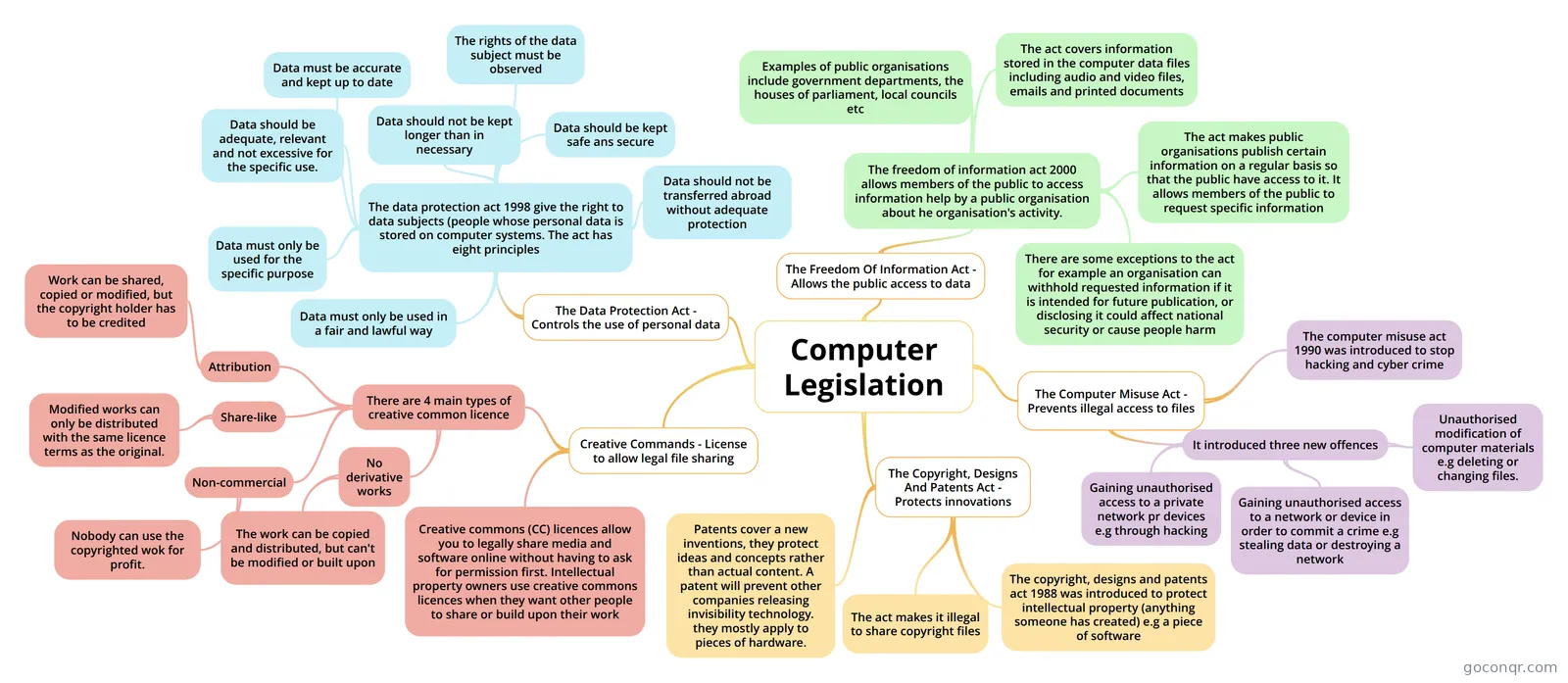
Mind map: Computer legislation
Map content
Computer Legislation
The Data Protection Act - Controls the use of personal data
- The data protection act 1998 give the right to data subjects (people whose personal data is stored on computer systems. The act has eight principles
- Data must only be used in a fair and lawful way
- Data must only be used for the specific purpose
- Data should be adequate, relevant and not excessive for the specific use.
- Data must be accurate and kept up to date
- Data should not be kept longer than in necessary
- The rights of the data subject must be observed
- Data should be kept safe ans secure
- Data should not be transferred abroad without adequate protection
- The data protection act 1998 give the right to data subjects (people whose personal data is stored on computer systems. The act has eight principles
The Freedom Of Information Act - Allows the public access to data
- The freedom of information act 2000 allows members of the public to access information help by a public organisation about he organisation's activity.
- Examples of public organisations include government departments, the houses of parliament, local councils etc
- The act covers information stored in the computer data files including audio and video files, emails and printed documents
- The act makes public organisations publish certain information on a regular basis so that the public have access to it. It allows members of the public to request specific information
- There are some exceptions to the act for example an organisation can withhold requested information if it is intended for future publication, or disclosing it could affect national security or cause people harm
- The freedom of information act 2000 allows members of the public to access information help by a public organisation about he organisation's activity.
The Computer Misuse Act - Prevents illegal access to files
- The computer misuse act 1990 was introduced to stop hacking and cyber crime
- It introduced three new offences
- Gaining unauthorised access to a private network pr devices e.g through hacking
- Gaining unauthorised access to a network or device in order to commit a crime e.g stealing data or destroying a network
- Unauthorised modification of computer materials e.g deleting or changing files.
The Copyright, Designs And Patents Act - Protects innovations
- The copyright, designs and patents act 1988 was introduced to protect intellectual property (anything someone has created) e.g a piece of software
- The act makes it illegal to share copyright files
- Patents cover a new inventions, they protect ideas and concepts rather than actual content. A patent will prevent other companies releasing invisibility technology. they mostly apply to pieces of hardware.
Creative Commands - License to allow legal file sharing
- Creative commons (CC) licences allow you to legally share media and software online without having to ask for permission first. Intellectual property owners use creative commons licences when they want other people to share or build upon their work
- There are 4 main types of creative common licence
- Attribution
- Work can be shared, copied or modified, but the copyright holder has to be credited
- Share-like
- Modified works can only be distributed with the same licence terms as the original.
- Non-commercial
- Nobody can use the copyrighted wok for profit.
- No derivative works
- The work can be copied and distributed, but can't be modified or built upon
- Attribution
Information
- Description
- Mind Map on Computer Legislation, created by Grace Pryce-Jones on 11/09/2018.
- Created by
- Grace Pryce-Jones
- Views
- 3
- Rating