
Mind map
The group as a pedagogical mediation
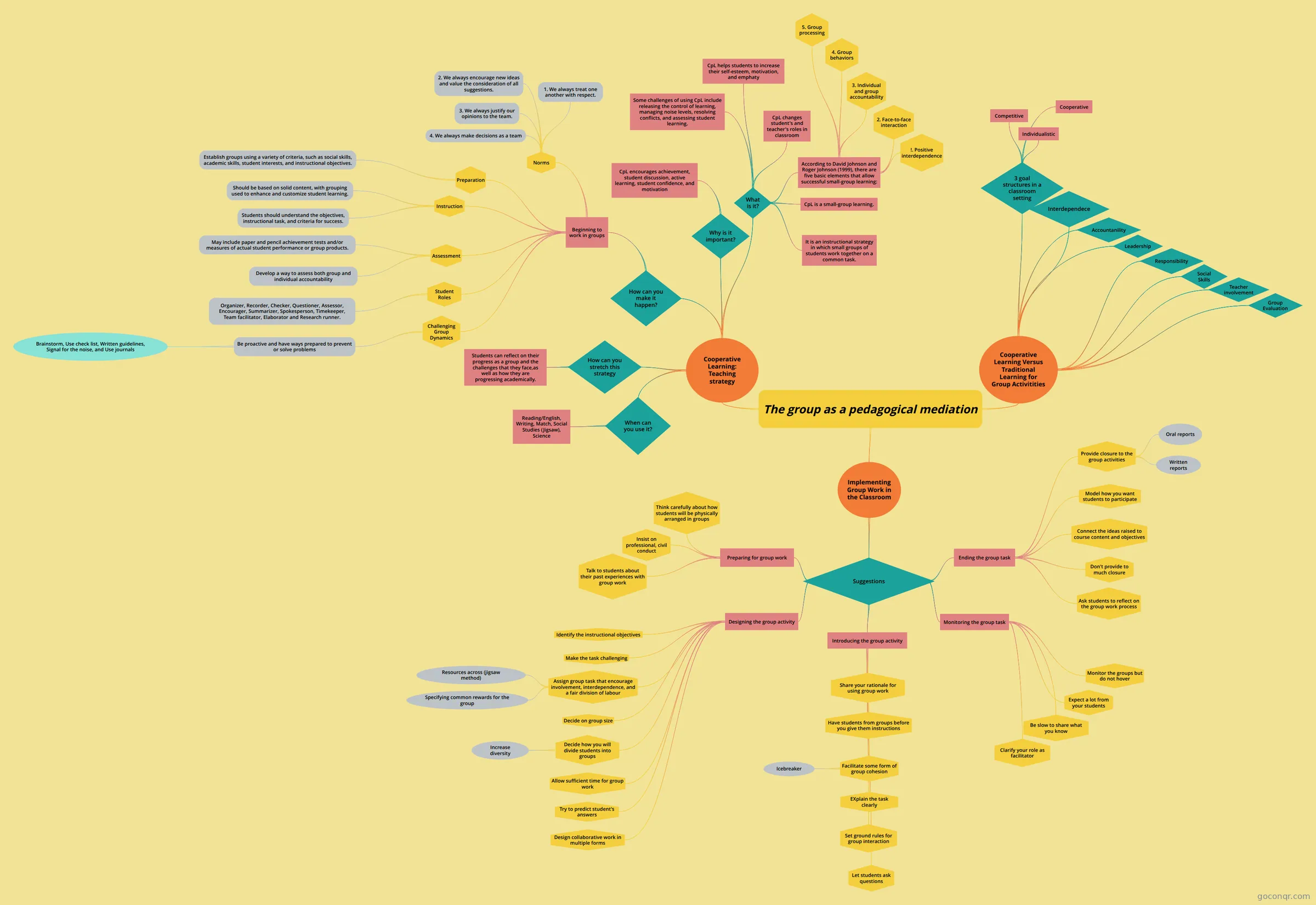
Mind map: The group as a pedagogical mediation
Map content
The group as a pedagogical mediation
Cooperative Learning: Teaching strategy
- What is it?
- CpL is a small-group learning.
- It is an instructional strategy in which small groups of students work together on a common task.
- According to David Johnson and Roger Johnson (1999), there are five basic elements that allow successful small-group learning:
- !. Positive interdependence
- 2. Face-to-face interaction
- 3. Individual and group accountability
- 4. Group behaviors
- 5. Group processing
- CpL changes student's and teacher's roles in classroom
- CpL helps students to increase their self-esteem, motivation, and emphaty
- Some challenges of using CpL include releasing the control of learning, managing noise levels, resolving conflicts, and assessing student learning.
- Why is it important?
- CpL encourages achievement, student discussion, active learning, student confidence, and motivation
- How can you make it happen?
- Beginning to work in groups
- Norms
- 1. We always treat one another with respect.
- 2. We always encourage new ideas and value the consideration of all suggestions.
- 3. We always justify our opinions to the team.
- 4. We always make decisions as a team
- Preparation
- Establish groups using a variety of criteria, such as social skills, academic skills, student interests, and instructional objectives.
- Instruction
- Should be based on solid content, with grouping used to enhance and customize student learning.
- Students should understand the objectives, instructional task, and criteria for success.
- Assessment
- May include paper and pencil achievement tests and/or measures of actual student performance or group products.
- Develop a way to assess both group and individual accountability
- Student Roles
- Organizer, Recorder, Checker, Questioner, Assessor, Encourager, Summarizer, Spokesperson, Timekeeper, Team facilitator, Elaborator and Research runner.
- Challenging Group Dynamics
- Be proactive and have ways prepared to prevent or solve problems
- Brainstorm, Use check list, Written guidelines, Signal for the noise, and Use journals
- Be proactive and have ways prepared to prevent or solve problems
- Norms
- Beginning to work in groups
- How can you stretch this strategy
- Students can reflect on their progress as a group and the challenges that they face,as well as how they are progressing academically.
- When can you use it?
- Reading/English, Writing, Match, Social Studies (Jigsaw), Science
- What is it?
Cooperative Learning Versus Traditional Learning for Group Activitities
- 3 goal structures in a classroom setting
- Competitive
- Individualistic
- Cooperative
- Interdependece
- Accountanility
- Leadership
- Responsibility
- Social Skills
- Teacher involvement
- Group Evaluation
- 3 goal structures in a classroom setting
Implementing Group Work in the Classroom
- Suggestions
- To help implement group work successfully in your classroom.
- Preparing for group work
- Think carefully about how students will be physically arranged in groups
- Insist on professional, civil conduct
- Talk to students about their past experiences with group work
- Designing the group activity
- Identify the instructional objectives
- Make the task challenging
- Assign group task that encourage involvement, interdependence, and a fair division of labour
- Resources across (jigsaw method)
- Specifying common rewards for the group
- Decide on group size
- Decide how you will divide students into groups
- Increase diversity
- Allow sufficient time for group work
- Try to predict student's answers
- Design collaborative work in multiple forms
- Introducing the group activity
- Share your rationale for using group work
- Have students from groups before you give them instructions
- Facilitate some form of group cohesion
- Icebreaker
- EXplain the task clearly
- Set ground rules for group interaction
- Let students ask questions
- Monitoring the group task
- Monitor the groups but do not hover
- Expect a lot from your students
- Be slow to share what you know
- Clarify your role as facilitator
- Ending the group task
- Provide closure to the group activities
- Oral reports
- Written reports
- Model how you want students to participate
- Connect the ideas raised to course content and objectives
- Don't provide to much closure
- Ask students to reflect on the group work process
- Provide closure to the group activities
- Suggestions
Information
- Description
- Week 4
- Created by
- Natalia Chacón
- Views
- 0
- History
-
- Created by Natalia Chacón · Oct 5, 2018
- Copied by Natalia Chacón · Oct 5, 2018
- Copied by Natalia Chacón · Oct 5, 2018
- Copied by Natalia Chacón · Oct 7, 2018
- Rating
More on Cooperative and Collaborative Learning