
Mind map
(3) The Weaknesses of Weimar
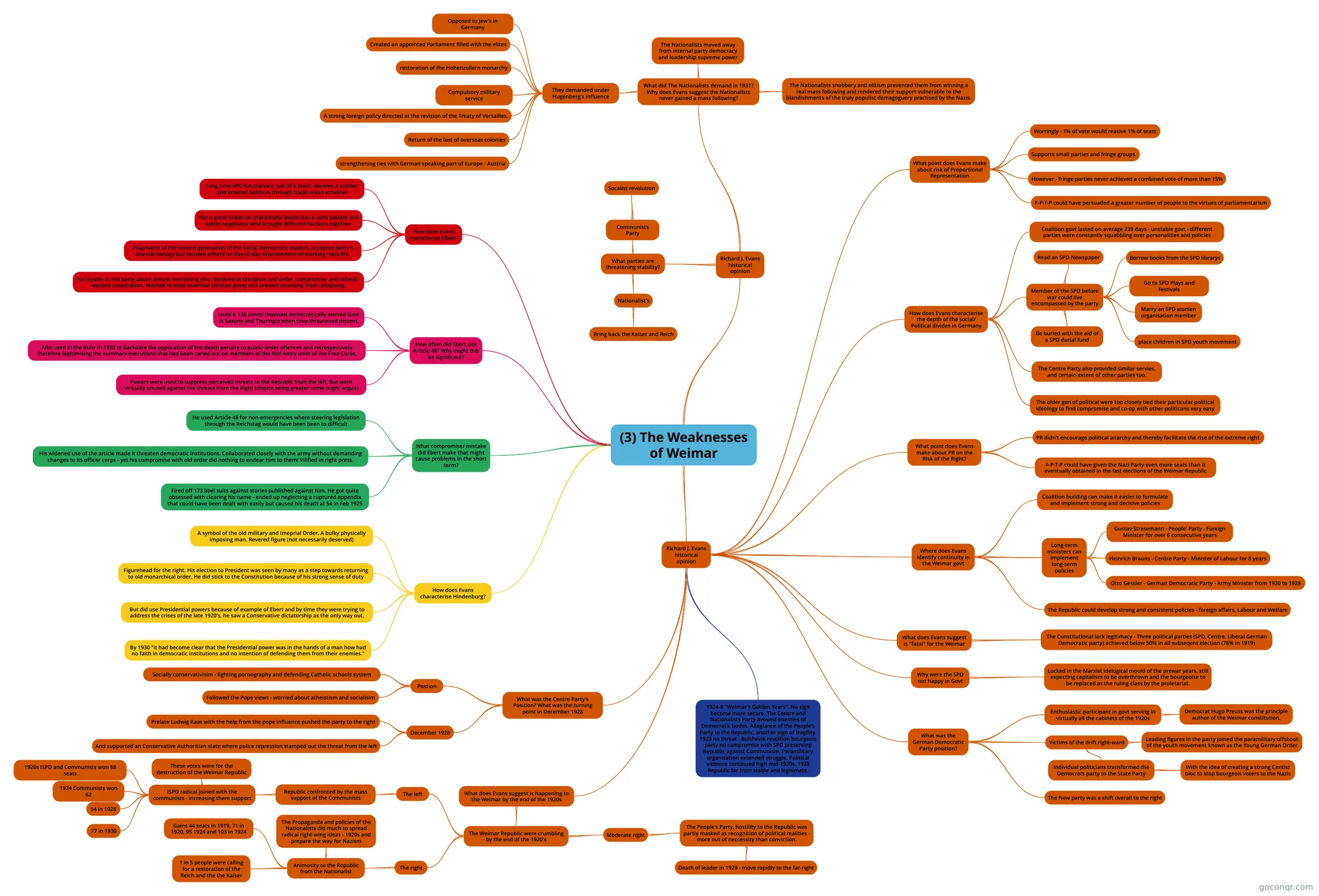
Mind map: The weaknesses of Weimar
Map content
(3) The Weaknesses of Weimar
How does Evans characterise Elbert?
- Long time SPD functionary, son of a tailor, became a saddler and entered politices through trade union activities
- Not a great orator or charismatic leader but a calm patient and subtle negotiator who brought different factions together.
- Pragmatist of the second generation of the Social Democratic leaders, accepted party's Marxist idelogy but focused efforts on day-to-day improvement of working class life.
- Put loyalty to the party above almost everything else. Believed in discipline and order, compromise and reform - wanted cooperation. Wanted to keep essential services going and prevent economy from collapsing.
How often did Ebert use Article 48? Why might this be significant?
- Used it 136 times! Deposed democratically elected Govt in Saxony and Thuringia when they threatened dissent.
- Also used in the Ruhr in 1920 to backdate the application of the death penalty to public-order offences and retrospectively therefore legitimising the summary executions that had been caried out on members of the Red Amry units of the Free Corps.
- Powers were used to suppress perceived threats to the Republic from the left. But went virtually unused against the threats from the Right (dispite being greater some might argue)
What compromise/ mistake did Ebert make that might cause problems in the short term?
- He used Article 48 for non-emergencies where steering legislation through the Reichstag would have been been to difficult
- His widened use of the article made it threaten democratic institutions. Collaborated closely with the army without demanding changes to its officer corps - yet his compromise with old order did nothing to endear him to them! Vilified in right press.
- Fired off 173 libel suits against stories published against him. He got quite obsessed with clearing his name - ended up neglecting a ruptured appendix that could have been dealt with easily but caused his death at 54 in Feb 1925
Richard J. Evans historical opinion
- What point does Evans make about risk of Proportional Representation
- Worringly - 1% of vote would reasive 1% of seats
- Supports small parties and fringe groups.
- However - fringe parties never achieved a combined vote of more than 15%
- F-P-T-P could have persuaded a greater number of people to the virtues of parliamentarism
- How does Evans characterise the depth of the social/ Political divides in Germany
- Coalition govt lasted on average 239 days - unstable govt - different parties were constantly squabbling over personalities and policies
- Member of the SPD before war could live encompassed by the party
- Read an SPD Newspaper
- Borrow books from the SPD librarys
- Go to SPD Plays and festivals
- Marry an SPD women organisation member
- place children in SPD youth movement
- Be buried with the aid of a SPD durial fund
- The Centre Party also provided similar servies, and certain extent of other parties too.
- The older gen of political were too closely tied their particular political ideology to find compromise and co-op with other politicans very easy
- What point does Evans make about PR on the Risk of the Right?
- PR didn't encourage political anarchy and thereby facilitate the rise of the extreme right.
- F-P-T-P could have given the Nazi Party even more seats than it eventually obtained in the last elections of the Weimar Republic
- Where does Evans identify continuity in the Weimar govt
- Coalition building can make it easier to formulate and implement strong and decisive policies
- Long-term ministers can implement long-term policies
- Gustav Stresemann - People' Party - Foreign Minister for over 6 consecutive years
- Heinrich Brauns - Centre Party - Minister of Labour for 8 years
- Otto Gessler - German Democratic Party - Army Minister from 1920 to 1928
- The Republic could develop strong and consistent policies - foreign affairs, Labour and Welfare
- What does Evans suggest is "fatal" for the Weimar
- The Constitutional lack legitimacy - Three political parties (SPD, Centre, Liberal German Democratic party) achieved below 50% in all subseqent election (76% in 1919)
- Why were the SPD not happy in Govt
- Locked in the Marxist idelogical mould of the prewar years, still expecting capitalism to be overthrown and the bourgeoise to be replaced as the ruling class by the proletariat.
- What was the German Democratic Party position?
- Enthusiastic participant in govt serving in virtually all the cabinets of the 1920s
- Democrat Hugo Preuss was the principle author of the Weimar constitution.
- Victims of the drift right-ward
- Leading figures in the party joined the paramilitary offshoot of the youth movement known as the Young German Order
- individual politicians transformed the Democrats party to the State Party
- With the idea of creating a strong Centist bloc to stop bourgeois voters to the Nazis
- The New party was a shift overall to the right
- Enthusiastic participant in govt serving in virtually all the cabinets of the 1920s
- What was the Centre Party's Position? What was the turning point in December 1928
- Postion
- Socially conservativisim - fighting pornography and defending Catholic schools system
- Followed the Pope views - worried about atheistism and socialisim
- December 1928
- Prelate Ludwig Kaas with the help from the pope influence pushed the party to the right
- And supported an Conservative Authoritian state where police repression stamped out the threat from the left
- Postion
- What does Evans suggest is happening to the Weimar by the end of the 1920s
- The Weimar Republic were crumbling by the end of the 1920's
- The left
- Republic confronted by the mass support of the Communists
- ISPD radical joined with the communists - increasing there support
- 1920s ISPD and Communists won 88 seats
- 1924 Communists won 62
- 54 in 1928
- 77 in 1930
- These votes were for the destruction of the Weimar Republic
- ISPD radical joined with the communists - increasing there support
- Republic confronted by the mass support of the Communists
- The right
- Animosity to the Republic from the Nationalist
- Gains 44 seats in 1919, 71 in 1920, 95 1924 and 103 in 1924
- 1 in 5 people were calling for a restoration of the Reich and the the Kaiser
- The Propaganda and policies of the Nationalists did much to spread radical right-wing ideas - 1920s and prepare the way for Nazism
- Animosity to the Republic from the Nationalist
- Moderate right
- The People's Party, hostility to the Republic was partly masked as recognition of political realities - more out of neccessity than conviction.
- Death of leader in 1929 - move rapidly to the far-right
- The People's Party, hostility to the Republic was partly masked as recognition of political realities - more out of neccessity than conviction.
- The left
- The Weimar Republic were crumbling by the end of the 1920's
- 1924-8 "Weimar's Golden Years". No sign become more secure. The Centre and Nationalists Party avowed enemies of Democratic bodes. Allegiance of the People's Party to the Republic, another sign of fragility. 1923 no threat - Bolshevik revoltion bourgeois party no compromise with SPD preserving Republic against Communism. Paramilitary organization extended struggle. Political violence continued high mid-1920s. 1928 Republic far from stable and legitimate.
- What point does Evans make about risk of Proportional Representation
How does Evans characterise Hindenburg?
- A symbol of the old military and Imeprial Order. A bulky physically imposing man. Revered figure (not necessarily deserved)
- Figurehead for the right. His election to President was seen by many as a step towards returning to old monarchical order. He did stick to the Constitution because of his strong sense of duty
- But did use Presidential powers because of example of Ebert and by time they were trying to address the crises of the late 1920's, he saw a Conservative dictatorship as the only way out.
- By 1930 "it had become clear that the Presidential power was in the hands of a man how had no faith in democratic institutions and no intention of defending them from their enemies."
Richard J. Evans historical opinion
- What parties are threatening stability?
- Nationalist's
- Bring back the Kaiser and Reich
- Communists Party
- Socalist revolution
- Nationalist's
- What did The Nationalists demand in 1931? Why does Evans suggest the Nationalists never gained a mass following?
- They demanded under Hugenberg's influence
- restoration of the Hohenzollern monarchy
- Compulsory military service
- A strong foreign policy directed at the revision of the Treaty of Versailles.
- Return of the lost of overseas colonies
- strengthening ties with German speaking part of Europe - Austria
- Created an appointed Parliament filled with the elites
- Opposed to Jew's in Germany
- The Nationalists moved away from internal party democracy and leadership supreme power
- The Nationalists snobbery and elitism prevented them from winning a real mass following and rendered their support vulnerable to the blandishments of the truly populist demagoguery practised by the Nazis.
- They demanded under Hugenberg's influence
- What parties are threatening stability?
Information
- Description
- A level Germany History ((5) Weimar's Political Crisis) Mind Map on (3) The Weaknesses of Weimar, created by Marcus Danvers on 28/11/2014.
- Created by
- Marcus Danvers
- Views
- 10
- Rating
More on Early Problems and Opposition to the Weimar Republic