
Mind map
Sociology Exam 2
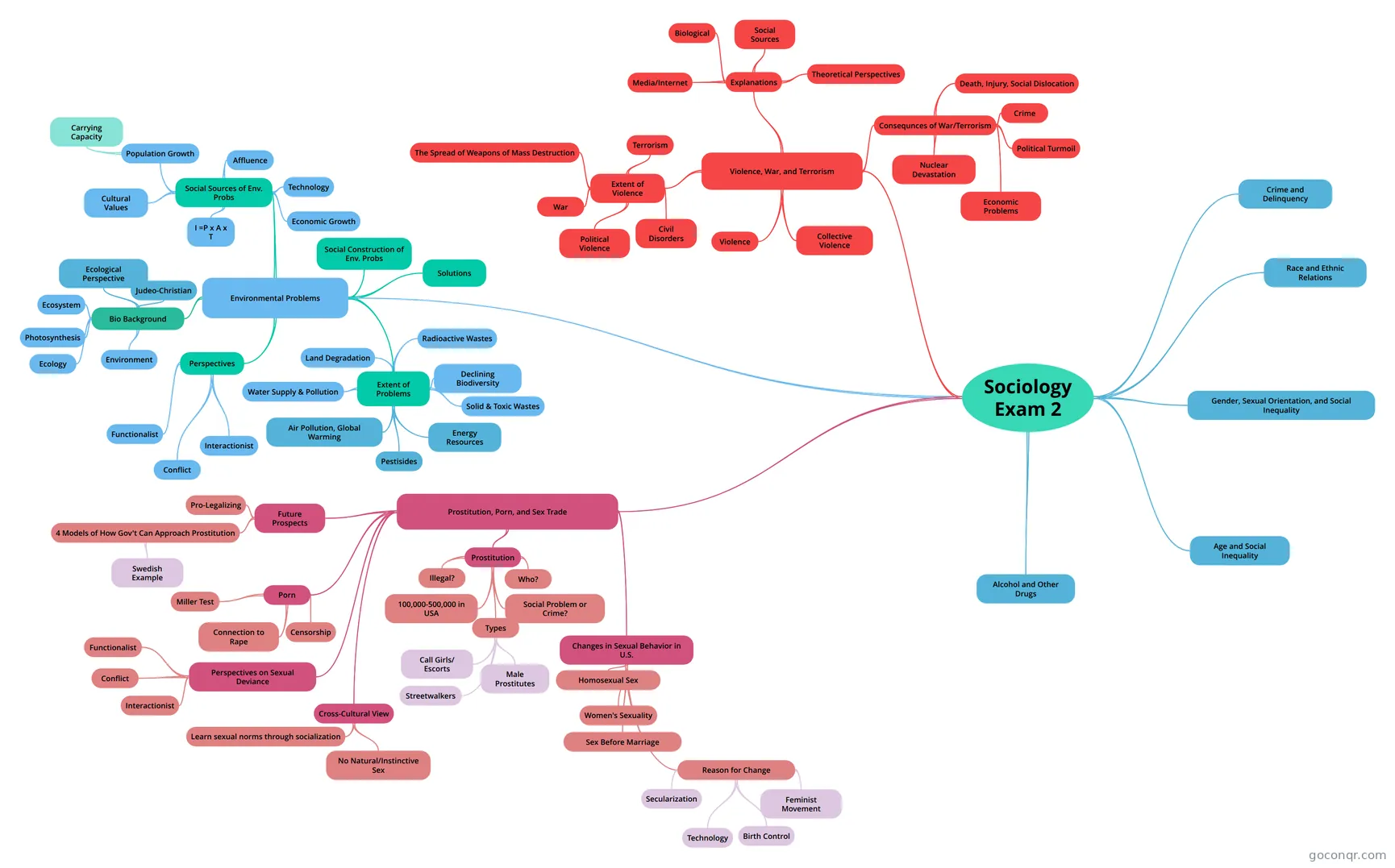
Mind map: Sociology exam 2
Map content
Sociology Exam 2
Alcohol and Other Drugs
Age and Social Inequality
Gender, Sexual Orientation, and Social Inequality
Race and Ethnic Relations
Prostitution, Porn, and Sex Trade
- Cross-Cultural View
- B/c of a variety of interpretations of what is sexual around the world, there is no "natural" or "instinctive" sex.
- We learn sexual norms of our society through socialization.
- No Natural/Instinctive Sex
- Learn sexual norms through socialization
- Changes in Sexual Behavior in U.S.
- Traditionally, sex outside of marriage was condemned.
- Today, sex before marriage has become acceptable among younger generations b/c of birth control methods.
- Sex between homosexuals is becoming more and more accepted.
- We are changing sexist & stereotypical views on women's sexuality.
- Women's sexual behavior is becoming closer to men's. "Double standard" is being eliminated.
- Why Changes? 1.Birth Control 2) Feminist Movement 3) Technology: Example-Cars allow teens to escape adult surveillance. 4)Secularization
- Homosexual Sex
- Sex Before Marriage
- Women's Sexuality
- Reason for Change
- Secularization
- The process through which the influence of religion is removed from many institutions in society and dispersed into private and personal realms.
- Birth Control
- Technology
- Cars allow youth to escape adult surviellance.
- Feminist Movement
- Secularization
- Prostitution
- Sexual activity in exchange for money or goods, in which the primary motivation for the prostitute is neither sexual nor affectional.
- Types
- Streetwalkers
- They solicit clients by walking the streets, and engage in sexual behavior with customers in client's car/cheap hotel rooms.
- Call Girls/ Escorts
- Use technology to gain business.
- Male Prostitutes
- Examples: Street Hustler Bar Hustler Escorts
- Streetwalkers
- Who?
- Young, poor, women (usually) Male prostitutes come from 2 subcultures: 1) peer-delinquent subculture 2) gay subculture
- Social Problem or Crime?
- Major Controversy. 1/4 adults believes it should be legal in their state. Victimless Crime. Illegal prostitution causes problems such as spreading of aids/disease, drugs, etc
- Illegal?
- In most places in USA, except Nevada.
- 100,000-500,000 in USA
- Porn
- Sexually "explicit" writings, still or motion pictures and similar products designed to be sexually arousing.
- Connection to Rape
- No clear connection between those who watch porn and those who are more likely to rape.
- Miller Test
- Material must meet 3 conditions to be considered legally obscene: 1) The avg. person applying community standards considers the material as a whole to appeal to prurient interests. 2) Material depicts sexual conduct, specifically defined by state/federal law, in a patently offensive way. 3) Work lacks serious artistic, literary, political, or scientific value.
- Censorship
- Perspectives on Sexual Deviance
- Functionalist
- Deviant behaviors exist because they perform important functions in society. Society functions better when people's desires are fulfilled, it reduces tension/conflict.
- Sex trade establishes boundaries of acceptable morality for society (by labeling prostitution or porn as immoral and stigmatizing for those who practice them).
- Conflict
- Sex trade is closely related to issues of social inequality and exercise of power.
- Gender inequality and patriarchy means that men dominate women.
- Those who control if it's legal or illegal dominate society.
- Interactionist
- Sexual dev. has to do w/ varying definitions of reality and w/ impact of labeling and stigmatization on self-concept and self-worth.
- A culture that defines women as subordinate, makes it more likely that they enter sex trade. Once in the trade, they become stigmatized.
- Global Sex Industry: Prostitutes from poorer regions go to richer countries, also tourists travel internationally to use prostitutes (sex tourism).
- Functionalist
- Future Prospects
- 4 Models of How Gov't Can Approach Prostitution
- 1) Laissez-Faire Model Prostitution illegal, but no enforcement
- 2) Regulation Model Prostitution legal but only in licensed settings
- 3) Zoning Model Prostitution permitted in certain areas
- 4) Control Model Prostitution illegal and enforced
- Swedish Example
- decriminalize prostitution, punish clients for exploiting women. Prostitutes= victim, spend money on helping them out of prostitution ONLY SUCCESSFUL APPROACH
- Pro-Legalizing
- Men & Educated People are more pro legalizing.
- Would provide protection to women, but wouldn't entirely stop crime related to it, or health hazards.
- 4 Models of How Gov't Can Approach Prostitution
- Cross-Cultural View
Crime and Delinquency
Environmental Problems
- Bio Background
- Ecology
- The branch of biology that studies the relationship between living organisms and their environment.
- Environment
- The conditions and circumstances surrounding and affecting a particular group of living creatures.
- Photosynthesis
- The process by which plants capture light and heat energy from sun and turn it into food.
- Ecosystem
- A complex, interrelated network of life forms and nonlife forms that interact w/ one another to produce am exchange of materials between the living & nonliving parts.
- Ecological Perspective
- Humans are NOT more important than other organisms, such as fish/plants/bacteria
- Judeo-Christian
- Considers humans to be a category of their own, above other creatures. According to this view, man was made in the image of God, and is master of Earth and its creatures.
- Ecology
- Social Sources of Env. Probs
- Population Growth
- Can lead to changes in the environment
- W/ our given set of technologies used to provide food, the Earth has a carrying capacity, that can't be exceeded w/o putting stress on the environmental resources.
- We are destroying resources faster than they can be replaced, causing irreversible damage.
- Carrying Capacity
- An upper-size limit that is imposed on a population by its environmental resources and that cannot be permanently exceeded
- Affluence
- Growing affluence= -consuming more resources -increasing pollution of the air/water -filling more landfills w/ waste
- People want to have the best possible life for themselves, & expectations regarding what that entails keeps rising.
- Technology
- New products, while life-improving, are inherently polluting. Some technologies used today are less harmful than earlier technologies, but they still affect our environment.
- Economic Growth
- Measured by the total goods/services produced, which increases each year.
- Economic growth provides increasing levels of affluence, brings higher profits
- The World Bank & International Monetary Fund encourage economic growth through their actions.
- While doing business, companies ignore part of the cost of doing business, such as environmental damage through accidents or normal operation, and depleting of resources.
- In business, short term gains outweigh considerations for the long term protection of the environment.
- Some argue that economic growth can lead to better science, that will at some point help us reduce environmental damage.
- Cultural Values
- Mastery: Man is master of his environment Progress: Idea that people's living standard must keep rising (new idea)Individualism: Belief that I am allowed to harm my own health, pollute my land, etc.
- Together these ideas make it possible to pursue economic growth in ways that are detrimental to our environment.
- I =P x A x T
- Population Growth
- Perspectives
- Functionalist
- People's beliefs & values & resulting social behavior form a system.
- A highly technological social organization has many beliefs, but also many dysfunctions.
- Environmental problems lead to social problems when they hinder the smooth functioning of the whole system.
- Perceived social problems can lead to changing ways in which we treat the environment.
- Conflict
- Limited resources are a given fact of life. Problems can arise when their distribution (which is inherently unfair), becomes contested.
- Decisions are not made to preserve a balanced ecosystem, but are the result of competition, each side looking out for themselves.
- There are always groups that benefit-at least short term- by exploiting the environment, polluting, using up resources. These are considered to be part of the doing business.
- When groups w/ some power feel that their interests are not served by current environmental policies and practices, they seek to make changes.
- Interactionist
- Environmental problems are not simply objective conditions, they must be identified by a group of people as a problem that needs to be addressed.
- As people's perceptions change, environmental problems emerge.
- Functionalist
- Social Construction of Env. Probs
- End of 19th, beginning of 20th century: US cities were heavily polluted by factories, but that was accepted back then. Early environmentalists focused on conservation.
- 1960s: Environmentalists were influenced by popular books such as... -Population Bomb (according to which the end of the world was near b/c of overpopulation) -Silent Spring (according to which the end of the world was near b/c people destroy nature, and thus the whole world. ....New groups began to engage in lobbying, demonstrations, and disruptive actions.
- 1969: National Environmental Policy Act
- 1970s: Clean Air Act Water pollution control act Environmental protection agency
- Extent of Problems
- Water Supply & Pollution
- Hydrologic Cycle: process by which nature purifies water. Raw sewage, pesticide, nitrate and phosphate fertilizers, plus waste from factories interfere w/ cycle.
- Results include: -Acid Rain (mostly from burning fossible fuels, which introduce sulfuric & nitric acids into the atmosphere) - Eutrophication: Depletion of oxygen in water by the algae in rivers and oceans. Algae (size of new jersey in gulf) kills fish and all other life forms. b/c of overabundance of plants/life
- Solid & Toxic Wastes
- Average person throws away 4-5 pounds of waste every day. Waste Consists of: -Household waste: 3 tons/ per year/ per family -Industrial Waste -Mining Waste
- Toxic Wastes:residues of the production of plastic, pesticides, nuclear energy etc. -The disposal of toxic waste is not fully regulated -30,000 sites need to be cleaned up, but the enormous cost of this has not been made available.
- Radioactive Wastes
- -Remain deadly for thousands of years or more. -Not in my backyard syndrome -Hard to transport -temporary storage we use for lack of permanent storage
- Land Degradation
- Desertification:what happens when intensification of food production (continuous cropping/ overgrazing) leads to spread of desert areas, thus reducing the quantity of arable land. 100 million acres of land turned in to desert in past 50 years.
- Deforestation -imbalence between demand & supply
- in 1882: 10% of Earth's land was desert. In 1990, 35% of Earth's land was desert.
- Declining Biodiversity
- Creates 2 Problems: 1) We are losing species that might be of some use to humans (pharmaceuticals) 2) Threatens ability of the ecosystem to support human life.
- Annihilation of many species of animals (27,000 species per year)
- Air Pollution, Global Warming
- Alarming accumulation in atmosphere of ozone= depleting and of greenhouse gases.
- Greenhouse gases lead to global warming, which leads to changing weather patterns, changing climate, and increasing water levels.
- Pestisides
- World Health Organization: Estimates 3 million of severe pesticide poisoning per year.
- Energy Resources
- Industrialized nations use an inordinate share of the world's energy. US is largest consumer per person. Our main energy sources are finite, and extremely polluting.
- Nuclear Energy: Problem when it comes to safely dispose waste for hundreds of years, until it becomes harmless.
- Water Supply & Pollution
- Solutions
- -Collective action by environmental groups -Moderating economic growth -Gov't Regulation -Environmental partnerships -Reduce, reuse, recycle -New approaches to energy -International cooperation -New values
- Bio Background
Violence, War, and Terrorism
- Violence
- Behavior intended to bring pain and injury to people and/or destruction to property
- Collective Violence
- Violence by groups of people to promote/resist social policies or practices.
- Extent of Violence
- Civil Disorders
- Strife/conflict that is threatening to the public order and that involves the gov't in some fashion, either as a party to the conflict or as a guardian of the public interest.
- Some are disorganized and have short-term goals. Examples: Race Riots Labor Conflicts
- Others are more organized and threaten basic changes in the foundations of the social order. Examples: Civil War Revolution
- Most civil disorders often arisen from racial conflict. (Examples on Notes.) Communal Riots: Whites attacked blacks in the racially contested areas.
- Since WW2, most race riots have been commodity riots: the focus of hostility is the property, merchandise, or equipment rather than people of another racial group.
- Labor strife was a source of civil disorder also. -Workers had no collective bargaining rights and strike was illegal. Police were regularly used against workers.
- Political Violence
- Aims to change the gov't, the political system, or the economic system.
- -Insurrection: Organized action by some group to rebel against existing government, or to bring in new political forms and leadership
- US Examples: 1) War of Independance 2) Civil War
- War
- Justified by: -threatened attack or invasion of US -repel aggression -protect freedom
- 20% of Federal Budget is dedicated to military expenses
- American= less than 3% of world but... Spends 22-47% of all the money spent on military expenses in the world
- The Spread of Weapons of Mass Destruction
- Terrorism
- Civil Disorders
- Explanations
- Biological
- Social Sources
- Theoretical Perspectives
- Media/Internet
- Consequnces of War/Terrorism
- Death, Injury, Social Dislocation
- Crime
- Political Turmoil
- Economic Problems
- Nuclear Devastation
- Violence
Information
- Description
- Mind Map on Sociology Exam 2, created by Lauren Wattay on 12/10/2014.
- Created by
- Lauren Wattay
- Views
- 3
- Rating