
Mind map
(5) Economic crises 1923
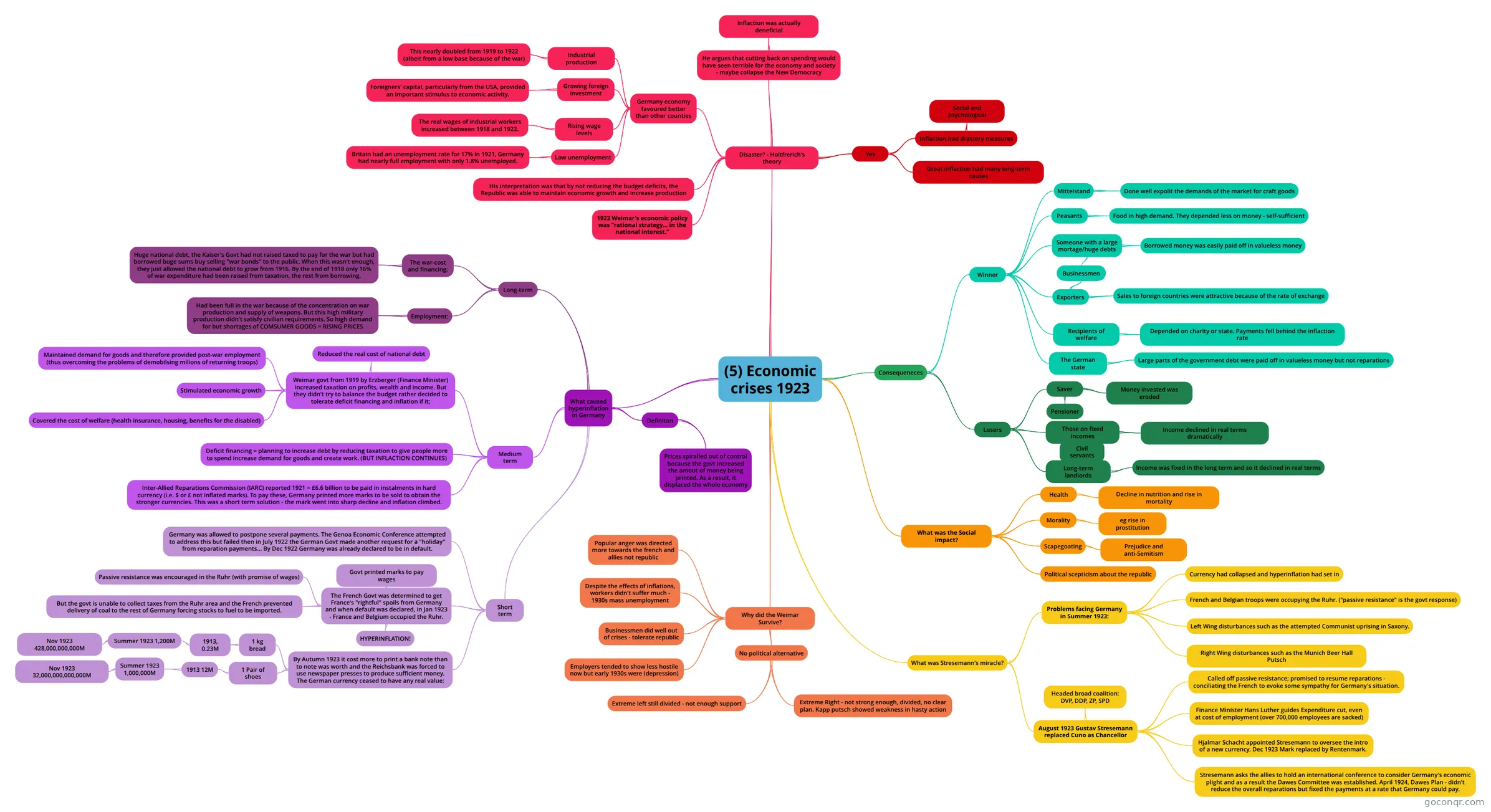
Mind map: Weimar Germany economic crises 1923
Map content
(5) Economic crises 1923
What caused hyperinflation in Germany
- Long-term
- The war-cost and financing:
- Huge national debt, the Kaiser's Govt had not raised taxed to pay for the war but had borrowed buge sums buy selling "war bonds" to the public. When this wasn't enough, they just allowed the national debt to grow from 1916. By the end of 1918 only 16% of war expenditure had been raised from taxation, the rest from borrowing.
- Employment:
- Had been full in the war because of the concentration on war production and supply of weapons. But this high military production didn't satisfy civilian requirements. So high demand for but shortages of COMSUMER GOODS = RISING PRICES
- The war-cost and financing:
- Medium term
- Weimar govt from 1919 by Erzberger (Finance Minister) increased taxation on profits, wealth and income. But they didn't try to balance the budget rather decided to tolerate deficit financing and inflation if it;
- Maintained demand for goods and therefore provided post-war employment (thus overcoming the problems of demobilsing milions of returning troops)
- Stimulated economic growth
- Covered the cost of welfare (health insurance, housing, benefits for the disabled)
- Reduced the real cost of national debt
- Deficit financing = planning to increase debt by reducing taxation to give people more to spend increase demand for goods and create work. (BUT INFLACTION CONTINUES)
- Inter-Allied Reparations Commission (IARC) reported 1921 = £6.6 billion to be paid in instalments in hard currency (i.e. $ or £ not inflated marks). To pay these, Germany printed more marks to be sold to obtain the stronger currencies. This was a short term solution - the mark went into sharp decline and inflation climbed.
- Weimar govt from 1919 by Erzberger (Finance Minister) increased taxation on profits, wealth and income. But they didn't try to balance the budget rather decided to tolerate deficit financing and inflation if it;
- Short term
- Germany was allowed to postpone several payments. The Genoa Economic Conference attempted to address this but failed then in July 1922 the German Govt made another request for a "holiday" from reparation payments... By Dec 1922 Germany was already declared to be in default.
- The French Govt was determined to get France's "rightful" spoils from Germany and when default was declared, in Jan 1923 - France and Belgium occupied the Ruhr.
- Passive resistance was encouraged in the Ruhr (with promise of wages)
- But the govt is unable to collect taxes from the Ruhr area and the French prevented delivery of coal to the rest of Germany forcing stocks to fuel to be imported.
- Govt printed marks to pay wages
- HYPERINFLATION!
- By Autumn 1923 it cost more to print a bank note than to note was worth and the Reichsbank was forced to use newspaper presses to produce sufficient money. The German currency ceased to have any real value:
- 1 kg bread
- 1913, 0.23M
- Summer 1923 1,200M
- Nov 1923 428,000,000,000M
- Summer 1923 1,200M
- 1913, 0.23M
- 1 Pair of shoes
- 1913 12M
- Summer 1923 1,000,000M
- Nov 1923 32,000,000,000,000M
- Summer 1923 1,000,000M
- 1913 12M
- 1 kg bread
- Definiton
- Prices spiralled out of control because the govt increased the amout of money being printed. As a result, it displaced the whole economy
- Long-term
Consequeneces
- Winner
- Someone with a large mortage/huge debts
- Borrowed money was easily paid off in valueless money
- Busnessman
- Exporters
- Sales to foreign countries were attractive because of the rate of exchange
- Businessmen
- Recipients of welfare
- Depended on charity or state. Payments fell behind the inflaction rate
- The German state
- Large parts of the government debt were paid off in valueless money but not reparations
- Peasants
- Food in high demand. They depended less on money - self-sufficient
- Mittelstand
- Done well expolit the demands of the market for craft goods
- Someone with a large mortage/huge debts
- Losers
- Saver
- Money invested was eroded
- Pensioner
- Those on fixed incomes
- Income declined in real terms dramatically
- Civil servants
- Long-term landlords
- Income was fixed in the long term and so it declined in real terms
- Saver
- Winner
Disaster? - Holtfrerich's theory
- 1922 Weimar's economic policy was "rational strategy... in the national interest."
- His interpretation was that by not reducing the budget deficits, the Republic was able to maintain economic growth and increase production
- Germany economy favoured better than other counties
- Low unemployment
- Britain had an unemployment rate for 17% in 1921, Germany had nearly full employment with only 1.8% unemployed.
- Rising wage levels
- The real wages of industrial workers increased between 1918 and 1922.
- Growing foreign investment
- Foreigners' capital, particularly from the USA, provided an important stimulus to economic activity.
- Industrial production
- This nearly doubled from 1919 to 1922 (albeit from a low base because of the war)
- Low unemployment
- Yes
- Great inflaction had many long-term causes
- Inflaction had drastery measures
- Social and psychological
- He argues that cutting back on spending would have seen terrible for the economy and society - maybe collapse the New Democracy
- Inflaction was actually deneficial
What was the Social impact?
- Health
- Decline in nutrition and rise in mortality
- Morality
- eg rise in prostitution
- Scapegoating
- Prejudice and anti-Semitism
- Political scepticism about the republic
- Health
What was Stresemann's miracle?
- Problems facing Germany in Summer 1923:
- Currency had collapsed and hyperinflation had set in
- French and Belgian troops were occupying the Ruhr. ("passive resistance" is the govt response)
- Left Wing disturbances such as the attempted Communist uprising in Saxony.
- Right Wing disturbances such as the Munich Beer Hall Putsch
- August 1923 Gustav Stresemann replaced Cuno as Chancellor
- Headed broad coalition: DVP, DDP, ZP, SPD
- Called off passive resistance; promised to resume reparations - conciliating the French to evoke some sympathy for Germany's situation.
- Finance Minister Hans Luther guides Expenditure cut, even at cost of employment (over 700,000 employees are sacked)
- Hjalmar Schacht appointed Stresemann to oversee the intro of a new currency. Dec 1923 Mark replaced by Rentenmark.
- Stresemann asks the allies to hold an international conference to consider Germany's economic plight and as a result the Dawes Committee was established. April 1924, Dawes Plan - didn't reduce the overall reparations but fixed the payments at a rate that Germany could pay.
- Problems facing Germany in Summer 1923:
Why did the Weimar Survive?
- Popular anger was directed more towards the french and allies not republic
- Despite the effects of inflations, workers didn't suffer much - 1930s mass unemployment
- Businessmen did well out of crises - tolerate republic
- Employers tended to show less hostile now but early 1930s were (depression)
- No political alternative
- Extreme left still divided - not enough support
- Extreme Right - not strong enough, divided, no clear plan. Kapp putsch showed weakness in hasty action
Information
- Description
- A level Germany History ((5) Weimar's Political Crisis) Mind Map on (5) Economic crises 1923, created by Marcus Danvers on 12/12/2014.
- Created by
- Marcus Danvers
- Views
- 4
- Rating
More on The 1923 Crisis and Hyperinflation