
Mind map
P1 - The Earth in the Universe
Map content
P1 - The Earth in the Universe
Lesson 1: The Solar System and Beyond
- The Solar System consists of a star (the Sun) and stuff orbiting it
- Planets
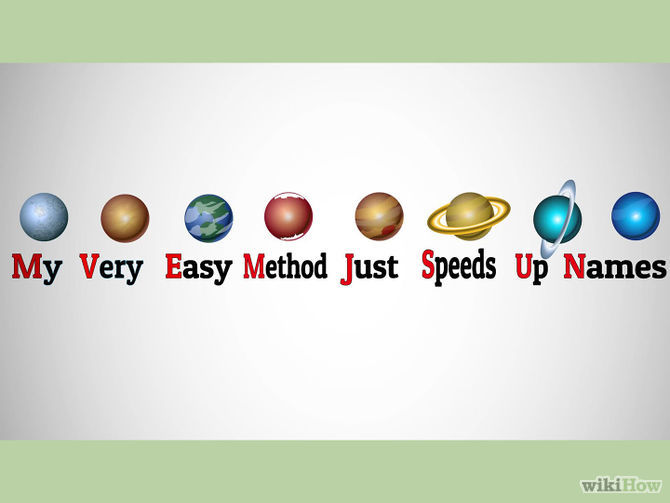
- Mercury Venus Earth Mars Jupiter Saturn Uranus Neptune
- Mercury, Venus, Earth and Mars are called INNER PLANETS
- Jupiter, Saturn, Uranus and Neptune are called OUTER PLANETS
- Eight planets
- Pluto is not a planet anymore
- Orbit in almost circular paths
- Elipses
- Mercury Venus Earth Mars Jupiter Saturn Uranus Neptune
- The asteroid planet comes between the inner and outer planets
- Asteroids and comets are made from stuff that was left over from the Solar System's formation
- Asteroids are lumps of rubble an rock
- Comets are balls of rock, dust and ice
- Orbit the sun in very long elipses
- The sun is at the end of the elipses
- When a comet approaches the sun, the ice melts leaving a tail of gas and debris
- Orbit the sun in very long elipses
- Asteroids and comets are made from stuff that was left over from the Solar System's formation
- The Solar System is about 5 thousand million years old
- Formed over long periods of time from big clouds of dust and gas
- 1) A cloud started to get squeezed slightly
- Nearby exploding star
- 1) A cloud started to get squeezed slightly
- 2) Particles got closer together and gravity caused the cloud to collapse on itself
- At the centre of the collapse a protostar was formed
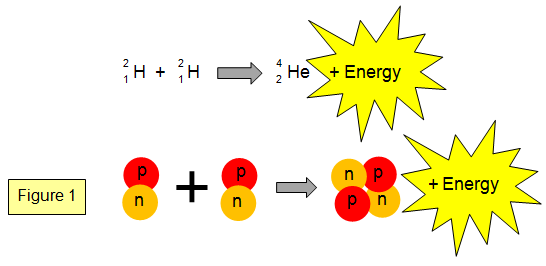
- 3) Fusion started when the temperature got high enough
- Hydrogen particles joined together to make helium
- Gives out a lot of heat and light which created a star (the Sun)
- 4) Around the sun, hydrogen, helium and other heavier elements clumped together to make planets
- Sun and planets are similar ages
- We know the Solar System is at least 4500 million years old
- This is because the oldest rocks on Earth are meteorites that crashed into the Earth about 4500 million years ago
- Formed over long periods of time from big clouds of dust and gas
- Planets
- Stars and Planets are very different
- Stars are huge, very hot and give out lots of light
- Planets are a lot smaller and reflect sunlight
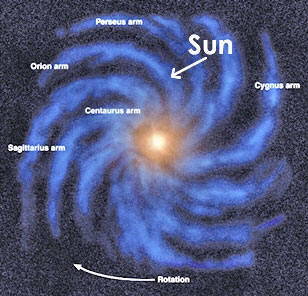
- Our Solar System is in the Milky Way Galaxy
- There are about 100,000,000,000 in the galaxy
- They create spiral arms leading out from the centre
- The Sun is about halfway along one of the arms
- They create spiral arms leading out from the centre
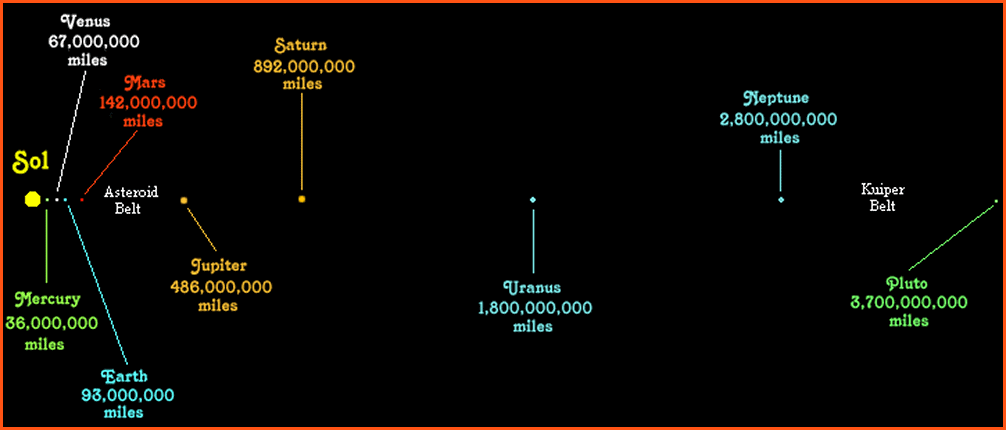
- The distance between each star in the solar system is millions of times greater than the distance between the planets in the Solar System
- There are about 100,000,000,000 in the galaxy
- The Universe is made up of millions of galaxies
- You can measure distances in the Universe by using light years
- This is the distance that light travels through a vacuum in one year
- You need to know relative sizes and distances of different stuff in space
- And some ages
- Earth - 5000 years
- Sun - 5000 years
- Universe - 14,000 years
- And some ages
- The Solar System consists of a star (the Sun) and stuff orbiting it
Lesson 2: Looking into Space
- We can tell a lot about a star by studying the electromagnetic radiation
- The colour of a star is a good guide to working out its surface temperature
- There are various methods to work out how far away a star is
- 1) For 'nearby' stars you can use a parallax
- Astronomers take pictures of the sky six months apart
- This is when the Earth is at opposite sides of its orbit
- A parallax is when something appears to move when you look at it from different places
- The apparent movement of the star between the two photos
- Stars further away appear to move less
- Astronomers take pictures of the sky six months apart
- 2) You can also measure its brightness
- Unfortunately a star that looks very bright from Earth could either be
- a) Quite close to Earth but not actually that bright
- b) Or a long way away and very bright
- Astronomers know how much radiation certain types of star actually emit, though, so by examining the brightness, they can tell how far from Earth it is
- Unfortunately a star that looks very bright from Earth could either be
- 1) For 'nearby' stars you can use a parallax
- The Atmosphere and Light Pollution cause some problems though
- The atmosphere absorbs a lot of light before it can reach us
- Light pollution makes it hard to see dim objects
- Light pollution is light thrown upwards from street lamps, etc.
- This is why scientists put the Hubble telescope into space - where you can't get these problems
- We see stars and galaxies as they were in the past
- Electromagnetic radiation travels very fast
- The Sun is about 150 million km away from Earth so the radiation from the Sun reaches us 8 minutes after it has left the Sun
- This means we see the Sun as it was 8 minutes ago
- The Sun is about 150 million km away from Earth so the radiation from the Sun reaches us 8 minutes after it has left the Sun
- The nearest star to our star is about 4.2 light years away from us
- This means the light takes 4.2 years to reach us
- We see the star as it was 4.2 years ago
- This means the light takes 4.2 years to reach us
- For other stars, the effect is more extreme
- The North Star is about 430 light years away, whihc means we see it as it was during the time of William Shakespeare
- Electromagnetic radiation travels very fast
- We can tell a lot about a star by studying the electromagnetic radiation
Lesson 3: The Life of the Universe
- When a galaxy is moving away from us, the wavelength of the light changes and becomes redder
- This is called red shift
- By measuring how much the light has been red-shifted you can work out how quickly it is moving away
- The greater the red shift, the faster it is moving away
- From observations of different red shifts of different galaxies we know that the more distant the galaxy the faster it moves away from us
- This proves that the Universe is expanding
- Th Big Bang Theory
- All the galaxies seem to be moving apart from a single point
- According to the theory, all the matter and energy in the Universe must have been compressed in a very small space
- It then exploded and expanded and the expansion is still going on
- The age of the Universe can be estimated from the current rate of expansion
- They think the Big Bang happened about 14 thousand million years ago
- It is difficult to estimate because it is hard to tell how much the expansion has slowed down
- They think the Big Bang happened about 14 thousand million years ago
- The Universe's ultimate fate depends on how fast it's expanding and the total mass there is in it
- To calculate the speed of expansion, large distances need to be measured
- Because of the size of the Universe it is hard to accurately measure the distances involved
- Also need to observe the motion of objects accurately
- Only assumptions can be made
- Pollution gets in the way
- Only assumptions can be made
- Difficult to measure mass because most of it appears to be invisible
- Doesn't glow like a star
- The amount of dark matter in the Universe has not been measured
- Scientists aren't exactly sure what it is
- The dark matter will dictate the future of the Universe
- All the mass is attracted together by gravity
- The more mass there is, the greater the pull and the greater the slowing down of the Universe's expansion
- To calculate the speed of expansion, large distances need to be measured
- If there is enough mass compared to how fast the galaxies are moving the Universe will eventually stop expanding
- This will cause it to contract
- The Big Crunch
- This will cause it to contract
- If there's not enough mass in the Universe to stop the expansion, it could expand forever
- Universe becoming more and more spread out into eternity
- When a galaxy is moving away from us, the wavelength of the light changes and becomes redder
Lesson 4: The Changing Earth
- The Earth has been changing for thousands of millions of years
- Rocks provide a record of changes to the Earth
- Erosion
- The slow wearing away of soil/rock by water flow or wind.
- Cliffs worn away by the sea
- The Grand Canyon
- Making new rock
- When lava from volcanoes sets, it forms new rock
- Fossils
- Rocks built up around dead animals and plants
- The oldest rocks found on Earth so far are about 4 thousand million years old
- Erosion
- The rock cycle
- 1) Particles eroded from existing rock get washed into the sea and settle as sediment
- These sediments are crushed together to make sedimentary rocks
- 2) These can get pushed to the surface or they can descend into the heat and pressure inside the Earth
- If they descend, the structure of the rock can completely change as it gets heated and crushed
- Sometimes the rock actually melts and will solidify into new rock on the Earth's surface
- If they descend, the structure of the rock can completely change as it gets heated and crushed
- 3) When any of these rocks are pushed up to the surface, the cycle starts again
- They gradually get worn down and carried off to the sea again and so on
- The rock cycle needs dome very powerful forces to push rock up or down as described - but there's very good evidence that this is what happens.
- For example, some rock formations show rock that's been squeezed so hard it's just folded
- 1) Particles eroded from existing rock get washed into the sea and settle as sediment
Lesson 5: Wegener's Theory of Continental Drift
- Past beliefs
- For years, fossils of very similar plants and animals had been found on continents at opposite ends of the Atlantic Ocean
- People thought this was because the continents had been linked by land-bridges which had sunk or been covered in water as the Earth cooled
- Why the coastlines of South America and Africa matched so well was also unknown
- People also didn't understand why fossils of sea creatures had been found in the Alps
- For years, fossils of very similar plants and animals had been found on continents at opposite ends of the Atlantic Ocean
- Alfred Wegener hypothesised that Africa and South America had previously been one continent which had then split
- He found evidence to back up his hypothesis
- There were matching layers in the rocks on different continents
- There were similar fossils in both South America and South Africa
- His theory of continental drift supposed that 300 million years ago there had been just one supercontintent which he called Pangaea
- According to Wegener, Pangaea broke into smaller chunks which are our continents which are still slowly drifting apart
- A lot of people opposed his theory because it opposed things said in the land-bridge theory
- These were things like mountains being formed as continents crashed into one another
- Scientist's reactions were hostile
- Wegener's explanation of how the drifting was happening wasn't convincing enough because the movement wasn't detectable
- Wegener suggested that tidal movement or the Earth's rotation could cause the drifting
- Geologists showed this was impossible
- Wegener suggested that tidal movement or the Earth's rotation could cause the drifting
- It also didn't help that Wegener was a meteorologist not a 'proper' geologist, which was frowned upon
- Wegener's explanation of how the drifting was happening wasn't convincing enough because the movement wasn't detectable
- He found evidence to back up his hypothesis
- New evidence
- In the 1950's, scientists discovered the Mid-Atlantic ridge, which runs the whole length of the Atlantic
- The found evidence that magma rises up through the sea floor, solidifies and forms underwater mountains that are roughly symmetrical
- This suggested that the sea floor spread by a few centimetres per year
- The found evidence that magma rises up through the sea floor, solidifies and forms underwater mountains that are roughly symmetrical
- Evidence that the continents are moving apart came from the magnetic orientation of the rocks
- As liquid magma erupts out of the gap, iron particles align themselves with the Earth's magnetic field and as it cools, they set in position
- Every half a million years, the Earth's magnetic orientation swaps direction and the rocks on either side of the ridge has bands of alternate magenetic polarity, syymetrical about the ridge
- As liquid magma erupts out of the gap, iron particles align themselves with the Earth's magnetic field and as it cools, they set in position
- This was convincing evidence of how the sea floor was created and how the continents were moved apart
- In the 1950's, scientists discovered the Mid-Atlantic ridge, which runs the whole length of the Atlantic
- Past beliefs
Lesson 6: The Structure of the Earth
- The Earth is almost spherical and has layers
- The Crust
- We live on it
- 20 km thick
- Continental crust
- Forms the land
- Oceanic crust
- Under oceans
- The Mantle
- Properties of solid
- Flows slowly
- The Outer Core
- Hot
- Radioactive decay
- Heat and decay cause mantle to flow in convection currents
- Liquid
- The Inner Core
- Solid
- Made of mainly iron and nickel
- The Crust
- Tectonic plates
- Crust and upper mantle
- Floating
- The Earth is almost spherical and has layers
Images and files in the map

Information
- Description
- Mind Map on P1 - The Earth in the Universe, created by niamhzorina on 29/12/2014.
- Created by
- niamhzorina
- Views
- 36
- Rating