
Mind map
(4) Germany Foreign Affairs 1924-9 stable?
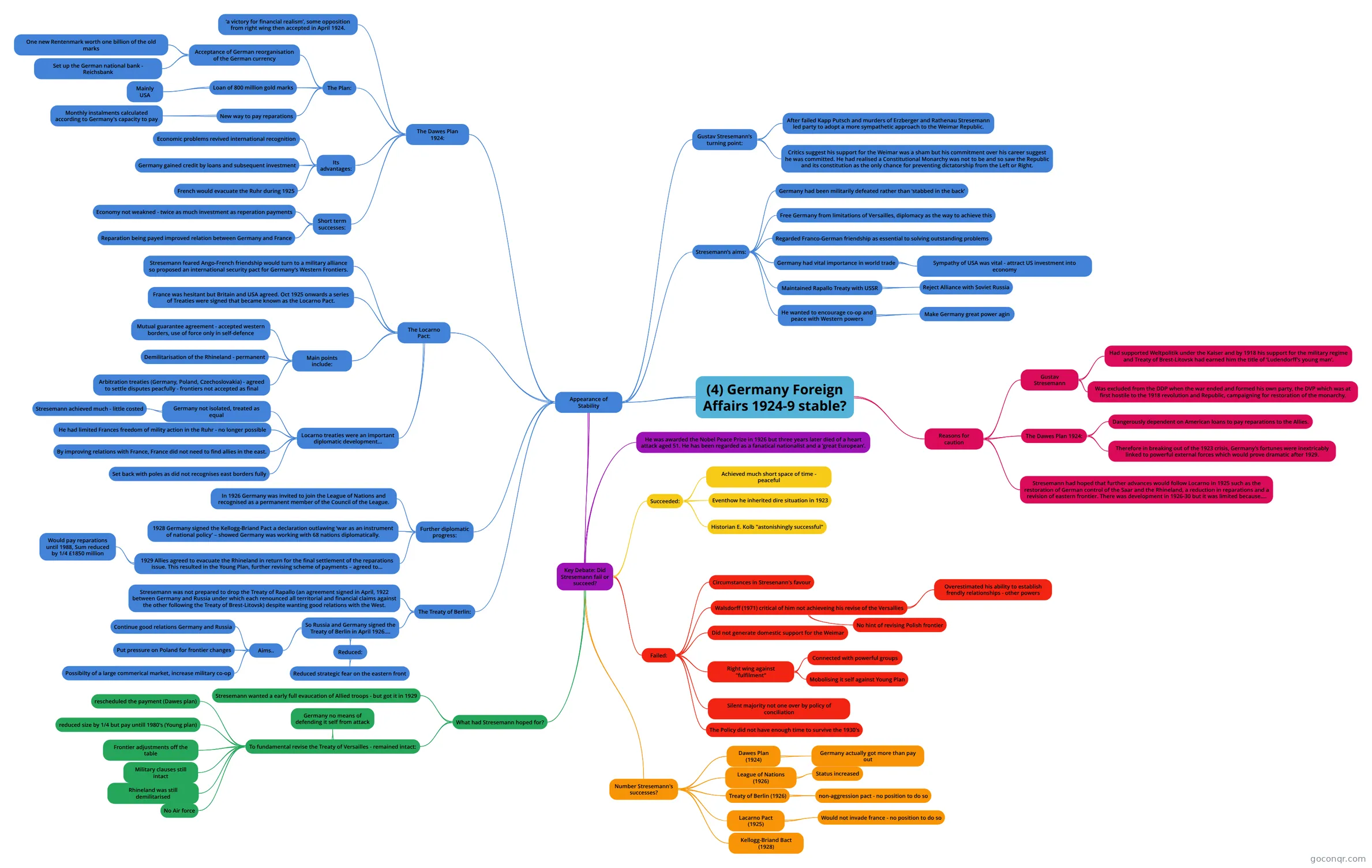
Mind map: Germany foreign affairs 1924-9
Map content
(4) Germany Foreign Affairs 1924-9 stable?
Appearance of Stability
- Gustav Stresemann’s turning point:
- After failed Kapp Putsch and murders of Erzberger and Rathenau Stresemann led party to adopt a more sympathetic approach to the Weimar Republic.
- Critics suggest his support for the Weimar was a sham but his commitment over his career suggest he was committed. He had realised a Constitutional Monarchy was not to be and so saw the Republic and its constitution as the only chance for preventing dictatorship from the Left or Right.
- Stresemann’s aims:
- Germany had been militarily defeated rather than ‘stabbed in the back’
- Free Germany from limitations of Versailles, diplomacy as the way to achieve this
- Regarded Franco-German friendship as essential to solving outstanding problems
- Germany had vital importance in world trade
- Sympathy of USA was vital - attract US investment into economy
- Maintained Rapallo Treaty with USSR
- Reject Alliance with Soviet Russia
- He wanted to encourage co-op and peace with Western powers
- Make Germany great power agin
- The Dawes Plan 1924:
- ‘a victory for financial realism’, some opposition from right wing then accepted in April 1924.
- The Plan:
- Acceptance of German reorganisation of the German currency
- One new Rentenmark worth one billion of the old marks
- Set up the German national bank - Reichsbank
- Loan of 800 million gold marks
- Mainly USA
- New way to pay reparations
- Monthly instalments calculated according to Germany's capacity to pay
- Acceptance of German reorganisation of the German currency
- Its advantages:
- Economic problems revived international recognition
- Germany gained credit by loans and subsequent investment
- French would evacuate the Ruhr during 1925
- Short term successes:
- Economy not weakned - twice as much investment as reperation payments
- Reparation being payed improved relation between Germany and France
- The Locarno Pact:
- Stresemann feared Ango-French friendship would turn to a military alliance so proposed an international security pact for Germany’s Western Frontiers.
- France was hesitant but Britain and USA agreed. Oct 1925 onwards a series of Treaties were signed that became known as the Locarno Pact.
- Main points include:
- Mutual guarantee agreement - accepted western borders, use of force only in self-defence
- Demilitarisation of the Rhineland - permanent
- Arbitration treaties (Germany, Poland, Czechoslovakia) - agreed to settle disputes peacfully - frontiers not accepted as final
- Locarno treaties were an important diplomatic development…
- Germany not isolated, treated as equal
- Stresemann achieved much - little costed
- He had limited Frances freedom of mility action in the Ruhr - no longer possible
- By improving relations with France, France did not need to find allies in the east.
- Set back with poles as did not recognises east borders fully
- Germany not isolated, treated as equal
- Further diplomatic progress:
- In 1926 Germany was invited to join the League of Nations and recognised as a permanent member of the Council of the League.
- 1928 Germany signed the Kellogg-Briand Pact a declaration outlawing ‘war as an instrument of national policy’ – showed Germany was working with 68 nations diplomatically.
- 1929 Allies agreed to evacuate the Rhineland in return for the final settlement of the reparations issue. This resulted in the Young Plan, further revising scheme of payments – agreed to…
- Would pay reparations until 1988, Sum reduced by 1/4 £1850 million
- The Treaty of Berlin:
- Stresemann was not prepared to drop the Treaty of Rapallo (an agreement signed in April, 1922 between Germany and Russia under which each renounced all territorial and financial claims against the other following the Treaty of Brest-Litovsk) despite wanting good relations with the West.
- So Russia and Germany signed the Treaty of Berlin in April 1926….
- Aims..
- Continue good relations Germany and Russia
- Put pressure on Poland for frontier changes
- Possibilty of a large commerical market, increase military co-op
- Reduced:
- Reduced strategic fear on the eastern front
- Aims..
- Key Debate: Did Stresemann fail or succeed?
- He was awarded the Nobel Peace Prize in 1926 but three years later died of a heart attack aged 51. He has been regarded as a fanatical nationalist and a ‘great European’.
- Succeeded:
- Achieved much short space of time - peaceful
- Eventhow he inherited dire situation in 1923
- Historian E. Kolb "astonishingly successful"
- Failed:
- Circumstances in Stresenann's favour
- Walsdorff (1971) critical of him not achieveing his revise of the Versallies
- Overestimated his ability to establish frendly relationships - other powers
- No hint of revising Polish frontier
- Did not generate domestic support for the Weimar
- Right wing against "fulfilment"
- Connected with powerful groups
- Mobolising it self against Young Plan
- Silent majority not one over by policy of conciliation
- The Policy did not have enough time to survive the 1930's
- What had Stresemann hoped for?
- Stresemann wanted a early full evaucation of Allied troops - but got it in 1929
- To fundamental revise the Treaty of Versailles - remained intact:
- Germany no means of defending it self from attack
- rescheduled the payment (Dawes plan)
- reduced size by 1/4 but pay untill 1980's (Young plan)
- Frontier adjustments off the table
- Military clauses still intact
- Rhineland was still demilitarised
- No Air force
- Number Stresemann's successes?
- Dawes Plan (1924)
- Germany actually got more than pay out
- League of Nations (1926)
- Status increased
- Treaty of Berlin (1926)
- non-aggression pact - no position to do so
- Lacarno Pact (1925)
- Would not invade france - no position to do so
- Kellogg-Briand Bact (1928)
- Dawes Plan (1924)
- Gustav Stresemann’s turning point:
Reasons for caution
- Gustav Stresemann
- Had supported Weltpolitik under the Kaiser and by 1918 his support for the military regime and Treaty of Brest-Litovsk had earned him the title of ‘Ludendorff’s young man’.
- Was excluded from the DDP when the war ended and formed his own party, the DVP which was at first hostile to the 1918 revolution and Republic, campaigning for restoration of the monarchy.
- The Dawes Plan 1924:
- Dangerously dependent on American loans to pay reparations to the Allies.
- Therefore in breaking out of the 1923 crisis, Germany’s fortunes were inextricably linked to powerful external forces which would prove dramatic after 1929.
- Stresemann had hoped that further advances would follow Locarno in 1925 such as the restoration of German control of the Saar and the Rhineland, a reduction in reparations and a revision of eastern frontier. There was development in 1926-30 but it was limited because….
- Gustav Stresemann
Information
- Description
- A level Germany History ((6) Weimar: The Years of Stability 1924-9) Mind Map on (4) Germany Foreign Affairs 1924-9 stable?, created by Marcus Danvers on 09/01/2015.
- Created by
- Marcus Danvers
- Views
- 9
- Rating