
Mind map
Vertebral Column, Back Muscles & Nerve Supply
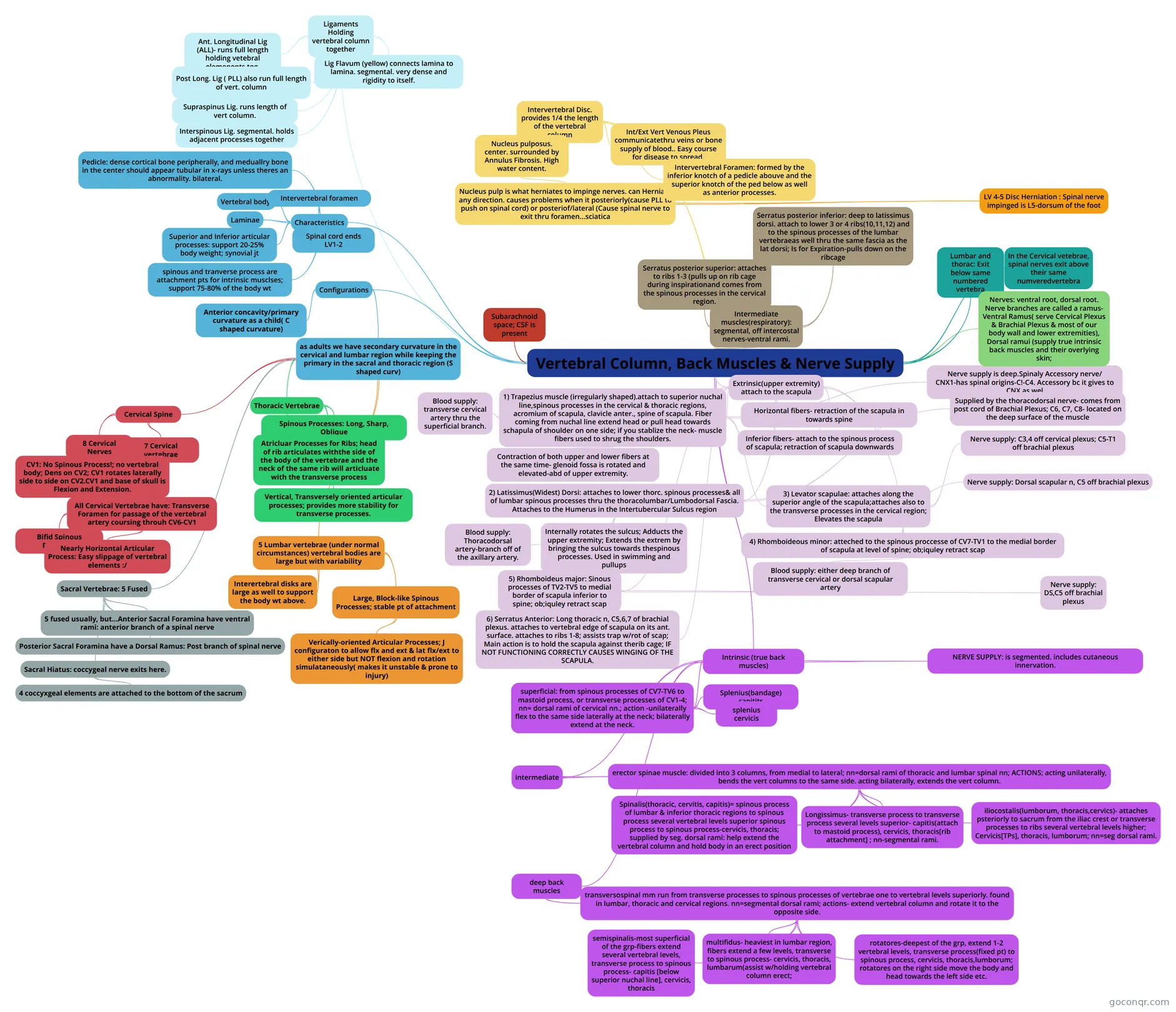
Mind map: Vertebral column, back muscles & nerve supply
Map content
Vertebral Column, Back Muscles & Nerve Supply
Configurations
- Anterior concavity/primary curvature as a child( C shaped curvature)
- as adults we have secondary curvature in the cervical and lumbar region while keeping the primary in the sacral and thoracic region (S shaped curv)
- Cervical Spine
- 7 Cervical vertebrae
- CV1: No Spinous Process!; no vertebral body; Dens on CV2; CV1 rotates laterally side to side on CV2.CV1 and base of skull is Flexion and Extension.
- All Cervical Vertebrae have: Transverse Foramen for passage of the vertebral artery coursing throuh CV6-CV1
- Bifid Spinous Processes
- Nearly Horizontal Articular Process: Easy slippage of vertebral elements :/
- 8 Cervical Nerves
- 7 Cervical vertebrae
- Thoracic Vertebrae
- Spinous Processes: Long, Sharp, Oblique
- Atricluar Processes for Ribs; head of rib articulates withthe side of the body of the vertebrae and the neck of the same rib will articluate with the transverse process
- Vertical, Transversely oriented articular processes; provides more stability for transverse processes.
- 5 Lumbar vertebrae (under normal circumstances) vertebral bodies are large but with variability
- Large, Block-like Spinous Processes; stable pt of attachment
- Verically-oriented Articular Processes; J configuraton to allow flx and ext & lat flx/ext to either side but NOT flexion and rotation simulataneously( makes it unstable & prone to injury)
- Interertebral disks are large as well to support the body wt above.
- Large, Block-like Spinous Processes; stable pt of attachment
- Sacral Vertebrae: 5 Fused
- 5 fused usually, but...Anterior Sacral Foramina have ventral rami: anterior branch of a spinal nerve
- Posterior Sacral Foramina have a Dorsal Ramus: Post branch of spinal nerve
- Sacral Hiatus: coccygeal nerve exits here.
- 4 coccyxgeal elements are attached to the bottom of the sacrum
- Cervical Spine
Characteristics
- Vertebral body:
- Pedicle: dense cortical bone peripherally, and meduallry bone in the center should appear tubular in x-rays unless theres an abnormality. bilateral.
- Laminae
- spinous and tranverse process are attachment pts for intrinsic musclses; support 75-80% of the body wt
- Superior and Inferior articular processes: support 20-25% body weight; synovial jt
- Intervertebral foramen
- Spinal cord ends LV1-2
Extrinsic(upper extremity) attach to the scapula
- 1) Trapezius muscle (irregularly shaped).attach to superior nuchal line,spinous processes in the cervical & thoracic regions, acromium of scapula, clavicle anter., spine of scapula. Fiber coming from nuchal line extend head or pull head towards schapula of shoulder on one side; if you stablize the neck- muscle fibers used to shrug the shoulders.
- Contraction of both upper and lower fibers at the same time- glenoid fossa is rotated and elevated-abd of upper extremity.
- Nerve supply is deep.Spinaly Accessory nerve/ CNX1-has spinal origins-C!-C4. Accessory bc it gives to CNX as wel
- Blood supply: transverse cervical artery thru the superficial branch.
- 3) Levator scapulae: attaches along the superior angle of the scapula;attaches also to the transverse processes in the cervical region; Elevates the scapula
- Nerve supply: C3,4 off cervical plexus; C5-T1 off brachial plexus
- Horizontal fibers- retraction of the scapula in towards spine
- Inferior fibers- attach to the spinous process of scapula; retraction of scapula downwards
- 2) Latissimus(Widest) Dorsi: attaches to lower thorc. spinous processes& all of lumbar spinous processes thru the thoracolumbar/Lumbodorsal Fascia. Attaches to the Humerus in the Intertubercular Sulcus region
- Internally rotates the sulcus; Adducts the upper extremity; Extends the extrem by bringing the sulcus towards thespinous processes. Used in swimming and pullups
- Supplied by the thoracodorsal nerve- comes from post cord of Brachial Plexus; C6, C7, C8- located on the deep surface of the muscle
- Blood supply: Thoracodorsal artery-branch off of the axillary artery.
- 4) Rhomboideous minor: atteched to the spinous proccesse of CV7-TV1 to the medial border of scapula at level of spine; ob;iquley retract scap
- Nerve supply: Dorsal scapular n, C5 off brachial plexus
- Blood supply: either deep branch of transverse cervical or dorsal scapular artery
- 5) Rhomboideus major: Sinous processes of TV2-TV5 to medial border of scapula inferior to spine; ob;iquley retract scap
- Nerve supply: DS,C5 off brachial plexus
- 6) Serratus Anterior: Long thoracic n, C5,6,7 of brachial plexus. attaches to vertebral edge of scapula on its ant. surface. attaches to ribs 1-8; assists trap w/rot of scap; Main action is to hold the scapula against therib cage; IF NOT FUNCTIONING CORRECTLY CAUSES WINGING OF THE SCAPULA.
- 1) Trapezius muscle (irregularly shaped).attach to superior nuchal line,spinous processes in the cervical & thoracic regions, acromium of scapula, clavicle anter., spine of scapula. Fiber coming from nuchal line extend head or pull head towards schapula of shoulder on one side; if you stablize the neck- muscle fibers used to shrug the shoulders.
Intermediate muscles(respiratory): segmental, off intercostal nerves-ventral rami.
- Serratus posterior superior: attaches to ribs 1-3 (pulls up on rib cage during inspirationand comes from the spinous processes in the cervical region.
- Serratus posterior inferior: deep to latissimus dorsi. attach to lower 3 or 4 ribs(10,11,12) and to the spinous processes of the lumbar vertebraeas well thru the same fascia as the lat dorsi; Is for Expiration-pulls down on the ribcage
Intrinsic (true back muscles)
- superficial: from spinous processes of CV7-TV6 to mastoid process, or transverse processes of CV1-4; nn= dorsal rami of cervical nn.; action -unilaterally flex to the same side laterally at the neck; bilaterally extend at the neck.
- Splenius(bandage) capitits
- splenius cervicis
- intermediate
- erector spinae muscle: divided into 3 columns, from medial to lateral; nn=dorsal rami of thoracic and lumbar spinal nn; ACTIONS; acting unilaterally, bends the vert columns to the same side. acting bilaterally, extends the vert column.
- Spinalis(thoracic, cervitis, capitis)= spinous process of lumbar & inferior thoracic regions to spinous process several vertebral levels superior spinous process to spinous process-cervicis, thoracis; supplied by seg. dorsal rami: help extend the vertebral column and hold body in an erect position
- Longissimus- transverse process to transverse process several levels superior- capitis(attach to mastoid process), cervicis, thoracis[rib attachment] ; nn-segmental rami.
- iliocostalis(lumborum, thoracis,cervics)- attaches psteriorly to sacrum from the iliac crest or transverse processes to ribs several vertebral levels higher; Cervicis[TPs], thoracis, lumborum; nn=seg dorsal rami.
- erector spinae muscle: divided into 3 columns, from medial to lateral; nn=dorsal rami of thoracic and lumbar spinal nn; ACTIONS; acting unilaterally, bends the vert columns to the same side. acting bilaterally, extends the vert column.
- deep back muscles
- transversospinal mm run from transverse processes to spinous processes of vertebrae one to vertebral levels superiorly. found in lumbar, thoracic and cervical regions. nn=segmental dorsal rami; actions- extend vertebral column and rotate it to the opposite side.
- rotatores-deepest of the grp, extend 1-2 vertebral levels, transverse process(fixed pt) to spinous process, cervicis, thoracis,lumborum; rotatores on the right side move the body and head towards the left side etc.
- multifidus- heaviest in lumbar region, fibers extend a few levels, transverse to spinous process- cervicis, thoracis, lumbarum(assist w/holding vertebral column erect;
- semispinalis-most superficial of the grp-fibers extend several vertebral levels, transverse process to spinous process- capitis [below superior nuchal line], cervicis, thoracis
- transversospinal mm run from transverse processes to spinous processes of vertebrae one to vertebral levels superiorly. found in lumbar, thoracic and cervical regions. nn=segmental dorsal rami; actions- extend vertebral column and rotate it to the opposite side.
- NERVE SUPPLY: is segmented. includes cutaneous innervation.
- superficial: from spinous processes of CV7-TV6 to mastoid process, or transverse processes of CV1-4; nn= dorsal rami of cervical nn.; action -unilaterally flex to the same side laterally at the neck; bilaterally extend at the neck.
Ligaments Holding vertebral column together
- Ant. Longitudinal Lig (ALL)- runs full length holding vetebral elemenents tog.
- Post Long. Lig ( PLL) also run full length of vert. column
- Lig Flavum (yellow) connects lamina to lamina. segmental. very dense and rigidity to itself.
- Supraspinus Lig. runs length of vert column.
- Interspinous Lig. segmental. holds adjacent processes together
Intervertebral Disc. provides 1/4 the length of the vertebral column
- Nucleus pulposus. center. surrounded by Annulus Fibrosis. High water content.
- Nucleus pulp is what herniates to impinge nerves. can Herniate any direction. causes problems when it posteriorly(cause PLL to push on spinal cord) or posteriof/lateral (Cause spinal nerve to exit thru foramen...sciatica
- LV 4-5 Disc Herniation : Spinal nerve impinged is L5-dorsum of the foot
- Nucleus pulp is what herniates to impinge nerves. can Herniate any direction. causes problems when it posteriorly(cause PLL to push on spinal cord) or posteriof/lateral (Cause spinal nerve to exit thru foramen...sciatica
- Int/Ext Vert Venous Pleus communicatethru veins or bone supply of blood.. Easy course for disease to spread.
- Intervertebral Foramen: formed by the inferior knotch of a pedicle abouve and the superior knotch of the ped below as well as anterior processes.
- Nucleus pulposus. center. surrounded by Annulus Fibrosis. High water content.
Subarachnoid space; CSF is present
In the Cervical vetebrae, spinal nerves exit above their same numveredvertebra
Lumbar and thorac: Exit below same numbered vertebra
Nerves: ventral root, dorsal root. Nerve branches are called a ramus- Ventral Ramus( serve Cervical Plexus & Brachial Plexus & most of our body wall and lower extremities), Dorsal ramui (supply true intrinsic back muscles and their overlying skin;
Information
- Description
- Mind Map on Vertebral Column, Back Muscles & Nerve Supply, created by Lauren Sellers on 13/01/2015.
- Created by
- Lauren Sellers
- Views
- 0
- Rating
More on Spine and back anatomy